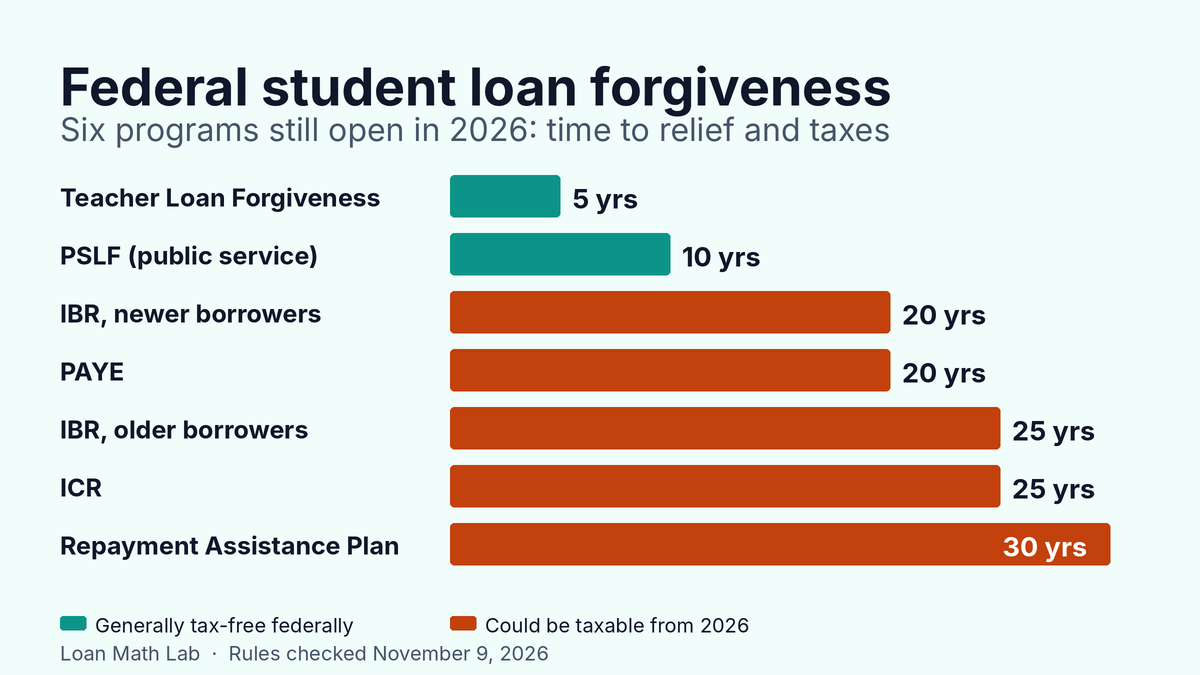
Federal student loan forgiveness still exists in 2026, but it comes through specific programs written into law and regulation, not through one-time mass cancellation. Six main routes are open: Public Service Loan Forgiveness, income-driven repayment forgiveness, Teacher Loan Forgiveness, and discharges for disability, a closed school or school misconduct. Each has its own clock, and since January 1, 2026 some of them can leave you with a federal tax bill.
This guide shows where each federal student loan forgiveness program stands as of November 9, 2026, who qualifies, which dates matter and what forgiven debt can cost at tax time. We opened every official page cited here on that date. It covers federal loans only; private loans follow the terms of your lender’s contract. For the running list of rule changes, see our student loan changes log.
Table of Contents
Federal student loan forgiveness at a glance
| Program | Status, November 9, 2026 | How long it takes | What is forgiven | Federal income tax |
|---|---|---|---|---|
| Public Service Loan Forgiveness | Open; employer rule struck down in court | 120 qualifying payments, at least 10 years | Remaining Direct Loan balance | Not taxed |
| IBR, PAYE and ICR forgiveness | Open; discharges being processed | 20 or 25 years of payments | Remaining balance | Could be taxed if you reach the milestone in 2026 or later |
| Repayment Assistance Plan (RAP) | Open since July 1, 2026 | 360 qualifying payments, at least 30 years | Remaining balance | Could be taxed |
| Teacher Loan Forgiveness | Open | 5 complete, consecutive academic years | Up to $5,000 or $17,500 | Generally not taxed |
| Total and permanent disability discharge | Open; some discharges are automatic | No payment period | Eligible federal loans | Not taxed; your Social Security number must be on the return |
| Closed school discharge | Open under older rules | Depends on the closure date | Loans for that school | Not taxed |
| Borrower defense discharge | Open; individual review | Case by case | Loans for that school, if approved | Long treated as not taxed |

Student loan forgiveness update: what changed in 2026
If you last looked at federal student loan forgiveness in 2025, these are the changes that matter, newest first:
- October 21-23, 2026: the PSLF employer fight ends. The administration dropped all three appeals over a rule that would have let the Education Department remove employers from PSLF: two on October 21, as AACOM reported (November 2, 2026), and the one in the states’ case, announced by Wisconsin’s attorney general on October 23. The June 30 court rulings that threw out the rule before it took effect now stand.
- September 29, 2026: official status of income-driven forgiveness. StudentAid.gov says IBR discharges resumed in September 2025 and its systems now process PAYE and ICR too. The payment counters are still being rebuilt.
- July 17, 2026: Sweet v. McMahon. A federal appeals court rejected the Department’s bid to delay relief for more than 170,000 borrower defense applicants, as the borrowers’ lawyers reported.
- July 1, 2026: RAP opens. Loans made from this date cannot use IBR, PAYE or ICR. Income-based relief for them runs through the Repayment Assistance Plan.
- March 10, 2026: SAVE ends. A court order blocked discharges under SAVE. Borrowers in SAVE forbearance must pick another plan; our SAVE plan update covers the steps.
- January 1, 2026: the tax break ends. The temporary rule that kept most forgiven student debt out of federal taxable income expired.
One thing has not come back: broad, one-time cancellation. The Supreme Court struck down the 2022 plan in Biden v. Nebraska on June 30, 2023. Any message promising a new mass federal student loan forgiveness program should be checked against StudentAid.gov before you act on it.
Student loan forgiveness programs tied to repayment
Two federal student loan forgiveness programs reward years of payments: one for public service, the other for staying on an income-driven plan. They can overlap, and the first is much faster.
Public Service Loan Forgiveness
PSLF forgives the remaining balance on Direct Loans after the equivalent of 120 qualifying monthly payments made while you work full time for an eligible employer. The payments do not have to be consecutive. To see how much PSLF could cancel in your case and when your 120th payment falls, use our PSLF calculator. The official requirements are:
- Employer: a U.S. federal, state, local or tribal government, including the military; a 501(c)(3) nonprofit; or another nonprofit that provides certain qualifying public services. For-profit contractors, labor unions and partisan political groups do not count.
- Hours: a weekly average of at least 30 hours, alone or combined across qualifying employers.
- Loans: Direct Loans. FFEL and Perkins loans only become eligible if you consolidate them into a Direct Consolidation Loan.
- Repayment plan: RAP, IBR, ICR, PAYE or the 10-year Standard plan. Payments on the Tiered Standard, Graduated and Extended plans do not qualify for PSLF.
You must still work for a qualifying employer when you submit the form for forgiveness, so do not leave the job before you apply. The Department advises certifying your employment every year and whenever you change employers. If you have 120 months of qualifying employment but some of them were spent in a deferment or forbearance, our PSLF buyback guide explains how to pay for those months so they count. Parents should read the fine print: StudentAid.gov now says parent PLUS loans, and consolidation loans that include one, are ineligible for RAP and cannot continue to qualify for PSLF, even if they qualified before through IBR or ICR. If that is you, confirm your position with your servicer and read our guide to the Parent PLUS loan changes.
The employer rule that worried many nonprofit workers never applied. A federal court vacated it on June 30, 2026, finding that it exceeded the Department’s authority and violated the First Amendment, and Michigan’s attorney general reported in October that the appeal in the states’ case had been dropped.
Income-driven repayment forgiveness
Income-driven federal student loan forgiveness cancels what is left after a long repayment period. The clock depends on the plan, under 34 CFR 685.209(k) and the Department’s court actions page:
| Plan | Forgiveness after | Good to know |
|---|---|---|
| IBR, first loans after July 1, 2014 | 20 years of payments | Only Direct Loans made before July 1, 2026 can use IBR |
| IBR, first loans before July 1, 2014 | 25 years of payments | Same cutoff |
| PAYE | 20 years of payments | Plan ends: choose another by June 30, 2028 |
| ICR | 25 years of payments | Plan ends: choose another by June 30, 2028 |
| RAP | 360 qualifying payments over at least 30 years | Certain earlier payments on other plans can count |
| SAVE | None | Discharges under SAVE were blocked by the March 10, 2026 order |
You do not apply for this type of federal student loan forgiveness: the regulation says the Department tracks your progress and forgives eligible loans without an application. It will notify you when your loan is identified as eligible, and you then have 21 days to opt out. Loans in default are not eligible for discharge under an income-driven plan, so getting out of default comes first.
Processing of income-driven federal student loan forgiveness has been uneven. Student loan lawyer Stanley Tate’s summary of the court reports counts 21,200 discharges in March 2026 (10,500 IBR, 9,900 ICR and 800 PAYE), followed by months with none, because eligibility is checked in batches. Court-ordered reporting ended in May 2026, so no public source can give a current processing time. To see what you would pay along the way, try our IBR calculator or our RAP calculator, or read IBR vs RAP with worked examples.
Teacher loan forgiveness
Teacher Loan Forgiveness is the form of federal student loan forgiveness that pays a fixed amount rather than your whole balance. You need five complete and consecutive academic years as a full-time, highly qualified teacher at a low-income school or educational service agency.
| You taught | Maximum forgiven |
|---|---|
| Mathematics or science at the secondary level, as a highly qualified full-time teacher | $17,500 |
| Special education at the elementary or secondary level, as a highly qualified teacher | $17,500 |
| Other elementary or secondary subjects, as a highly qualified full-time teacher | $5,000 |
It covers Direct and FFEL Subsidized and Unsubsidized Loans; PLUS and Perkins loans are excluded. You also must have had no outstanding Direct or FFEL balance on October 1, 1998, or on the date of your next such loan after it. You apply through your servicer once the five years are done, and your school’s chief administrative officer certifies the service.
The trap is the overlap with PSLF. The same period of service cannot count for both. The Department gives this example: if you receive Teacher Loan Forgiveness after five years, payments made during those years do not count toward your 120, so you would need 120 more. A public school teacher with a large balance should run the numbers before applying, because the Department says it cannot change this once the forgiveness is granted.
Federal student loan forgiveness when something went wrong
Discharges are the part of federal student loan forgiveness that does not depend on years of payments. They respond to an event: a disability, a school that closed or a school that misled you.
Total and permanent disability discharge
A total and permanent disability discharge cancels Direct, FFEL and Perkins loans and any TEACH Grant service obligation. You can qualify with documentation from the Department of Veterans Affairs, from the Social Security Administration or from an authorized medical professional. The Department also matches records with VA and Social Security and sends a letter; the discharge is then automatic unless you opt out.
Applying, or telling the Department you plan to apply, can pause your payments for 120 days. StudentAid.gov states that a three-year monitoring period applies to discharges based on Social Security or medical certifications, and that the loans may be reinstated if its conditions are not met.
Closed school discharge
If your school closed and you could not finish, a closed school discharge can cancel the Direct, FFEL or Perkins loans you took to attend it. StudentAid.gov lists three situations: you were enrolled when it closed, you were on an approved leave of absence, or it closed within 180 days after you withdrew. You generally do not qualify if you finished the program, or if you are completing it through a teach-out or at another branch.
Do not count on the automatic route. That page describes an automatic discharge one year after closures from July 1, 2023, while its own notice says a court delayed the 2023 rule. Federal Student Aid letter GEN-25-04 then confirmed that the rules in effect on July 1, 2020 apply to loans originated before July 1, 2035. Our practical reading: contact your servicer and apply as soon as the closure is confirmed. The page also says to keep paying while the application is processed.
Borrower defense discharge
Borrower defense applies when a school’s misconduct, usually a misrepresentation about jobs, salaries or transferable credits, harmed you. If approved, the Department discharges the remaining balance on loans for that school and may refund payments. Parent PLUS borrowers can apply too. You must have an outstanding federal loan tied to the school, and you sign the application under penalty of perjury.
The standard depends on when the loan was made. The more generous 2022 rules are blocked and delayed by law, so according to Tate Law (updated October 4, 2026), loans made after July 1, 2020 fall under the 2019 rules: a general limit of three years after leaving the school, and proof of a knowing or reckless misrepresentation, your reliance on it and financial harm beyond owing the loan. Separately, the Sweet v. McMahon settlement covers people who applied by late 2022; if that is you, look for a notice about your application.
Other routes exist for narrower cases. 34 CFR 685.212 also lists discharges for death, bankruptcy, false certification, unpaid refunds and survivors of the September 11 attacks.
Who qualifies for student loan forgiveness
Federal student loan forgiveness depends on your job, your plan or what happened to you. Start with the row that sounds like your situation:
| Your situation | Look first at | Check before relying on it |
|---|---|---|
| Full-time government or nonprofit job | PSLF | Your employer in the PSLF Employer Search; loans must be Direct |
| Teacher at a low-income school | PSLF or Teacher Loan Forgiveness | Balance size; the same years cannot count for both |
| Low income compared with your debt | IBR or RAP | Whether any loan was made on or after July 1, 2026; your likely tax |
| Disability that stops you from working | Total and permanent disability discharge | Which proof you have: VA, Social Security or a medical professional |
| School closed before you finished | Closed school discharge | Your withdrawal date and whether you finished elsewhere |
| School lied about something central | Borrower defense | Evidence, such as ads and emails, and when you left the school |
Federal student loan forgiveness dates to know
Most federal student loan forgiveness programs have no single deadline, but these dates change who gets what:
| Date | What it means |
|---|---|
| January 1, 2026 | Income-driven milestones reached before this date stay free of federal tax, even if the discharge posts later |
| January 28 and April 15, 2026 | Decision deadlines for Sweet v. McMahon post-class applicants; missed decisions trigger relief under the settlement |
| June 30, 2026 | Courts vacate the PSLF employer rule |
| July 1, 2026 | Loans made from this date cannot use IBR, PAYE or ICR; RAP opens |
| June 30, 2028 | Last day for PAYE and ICR borrowers to choose a new plan; after that the Department assigns one |
| July 1, 2035 | The 2020-era closed school rules apply to loans originated before this date |
Is federal student loan forgiveness taxable?
Whether federal student loan forgiveness is taxed depends on the program. The law that kept most forgiven student debt out of federal income covered discharges through December 31, 2025. Here is where federal student loan forgiveness stands now:
- Income-driven plans: the Department says a discharge “could create a federal tax liability” depending on its effective date. If you met your milestone before January 1, 2026, it is not subject to federal tax even if the loan is discharged later.
- Disability and death: the 2025 law made this exclusion permanent, under section 108(f)(5) of the tax code, and requires your Social Security number on the return.
- Work-based forgiveness: section 108(f)(1) excludes loans discharged for working a set period in certain professions for a broad class of employers. PSLF has long been treated as tax-free federally, as student loan attorney Adam Minsky explains, along with closed school and borrower defense discharges.
- State tax: a federal exclusion does not bind your state. The Department warns that some discharges can count as income for state tax.
Worked example. Suppose $40,000 is forgiven under IBR after a milestone reached in 2027, and all of it is taxed at a 22% rate. The federal bill is about $8,800 ($40,000 × 0.22). A large forgiven amount can also push part of your income into a higher bracket, so the real figure may differ. Our example is simplified and uses an assumed rate.
There is one common way to reduce that. Under IRS Publication 4681 (2025 edition), you are insolvent to the extent your total liabilities exceed the fair market value of your total assets immediately before the cancellation, and you can exclude the smaller of the canceled debt or that shortfall by filing Form 982 and checking line 1b. In the same example, with liabilities of $120,000 and assets of $90,000, you are insolvent by $30,000. You would exclude $30,000, leaving $10,000 taxable and about $2,200 of tax at 22%, or $6,600 less. Have a tax professional confirm this before you file.
How to get student loans forgiven, step by step
Federal student loan forgiveness rarely happens by accident. Whichever route fits you, these steps apply to most borrowers:
- Identify your loans. Log in to StudentAid.gov and note which loans are Direct, FFEL, Perkins or parent PLUS, and the date of each. Private loans will not appear there.
- Get out of default first. Default blocks income-driven forgiveness and, unless you make satisfactory arrangements, Teacher Loan Forgiveness.
- Choose the plan that fits the goal. Compare your options with our student loan calculator. A plan that does not count, such as Tiered Standard for PSLF, can cost you years.
- Document everything. Submit the PSLF form every year, and keep your payment records. The Department says it is still changing how income-driven payment counters are displayed, so your own records matter.
- Apply through official channels. Use StudentAid.gov or your servicer. Be wary of any company that charges a fee to do this for you, and never share your StudentAid.gov login.
- Plan for the tax. If your federal student loan forgiveness could be taxable, estimate the bill years ahead and check your state’s rule.
Federal student loan forgiveness FAQ
Is student loan forgiveness still happening in 2026?
Yes, federal student loan forgiveness continues through the programs above. As of November 9, 2026, StudentAid.gov lists PSLF, Teacher Loan Forgiveness and the discharge programs as available and says it is processing IBR, PAYE and ICR discharges. SAVE forgiveness and broad one-time cancellation are not available.
Can I get Teacher Loan Forgiveness and PSLF?
Yes, but not for the same period of service. The five years used for Teacher Loan Forgiveness do not count toward your 120 PSLF payments.
Do loans made after July 1, 2026 qualify for federal student loan forgiveness?
Direct Loans for students can reach forgiveness through RAP after 360 qualifying payments, or through PSLF while on RAP. For those loans, only full payments made by the due date count toward PSLF. Parent PLUS loans cannot use RAP.
Are private student loans eligible?
No. Federal student loan forgiveness only covers federal loans. StudentAid.gov lists loans from private lenders as ineligible for PSLF, and any relief on a private loan depends on your lender’s contract.
Is student loan forgiveness taxable if I reach IBR forgiveness next year?
It could be. A milestone reached on or after January 1, 2026 falls outside the expired federal exclusion, so the forgiven amount can count as income unless another exclusion, such as insolvency, applies.
Sources for federal student loan forgiveness
- Public Service Loan Forgiveness, Teacher Loan Forgiveness, Total and Permanent Disability Discharge, Closed School Discharge and Borrower Defense Loan Discharge (StudentAid.gov)
- IDR Plan Court Actions: Impact on Borrowers (StudentAid.gov, updated September 29, 2026)
- 34 CFR 685.209, Income-driven repayment plans and 34 CFR 685.212, Discharge of a loan obligation (Cornell LII)
- GEN-25-04: Provisions Effective Upon Enactment (Federal Student Aid, July 18, 2025)
- Publication 4681, Canceled Debts (IRS, for 2025 returns) and annotated text of 26 U.S.C. 108(f) (Prof. Annette Nellen, San Jose State University)
- Michigan Attorney General (October 26, 2026), Wisconsin Department of Justice (October 23, 2026) and AACOM (November 2, 2026) on the PSLF employer rule
- Project on Predatory Student Lending (July 17, 2026) on Sweet v. McMahon, and SCOTUSblog on Biden v. Nebraska
- Student Loan Planner (May 18, 2026) on taxes, and Tate Law on IBR processing (September 23, 2026) and borrower defense (October 4, 2026)
This guide to federal student loan forgiveness is general information, not financial, legal or tax advice. Eligibility is decided by the U.S. Department of Education and your loan servicer, and rules can change. Loan Math Lab is not affiliated with the U.S. Department of Education. See our How We Verify page and Disclaimer. Information checked on November 9, 2026.