Category: Forgiveness

  • PSLF Buyback 2026: How the Program Works, Who Qualifies and What It Costs

    PSLF Buyback 2026: How the Program Works, Who Qualifies and What It Costs

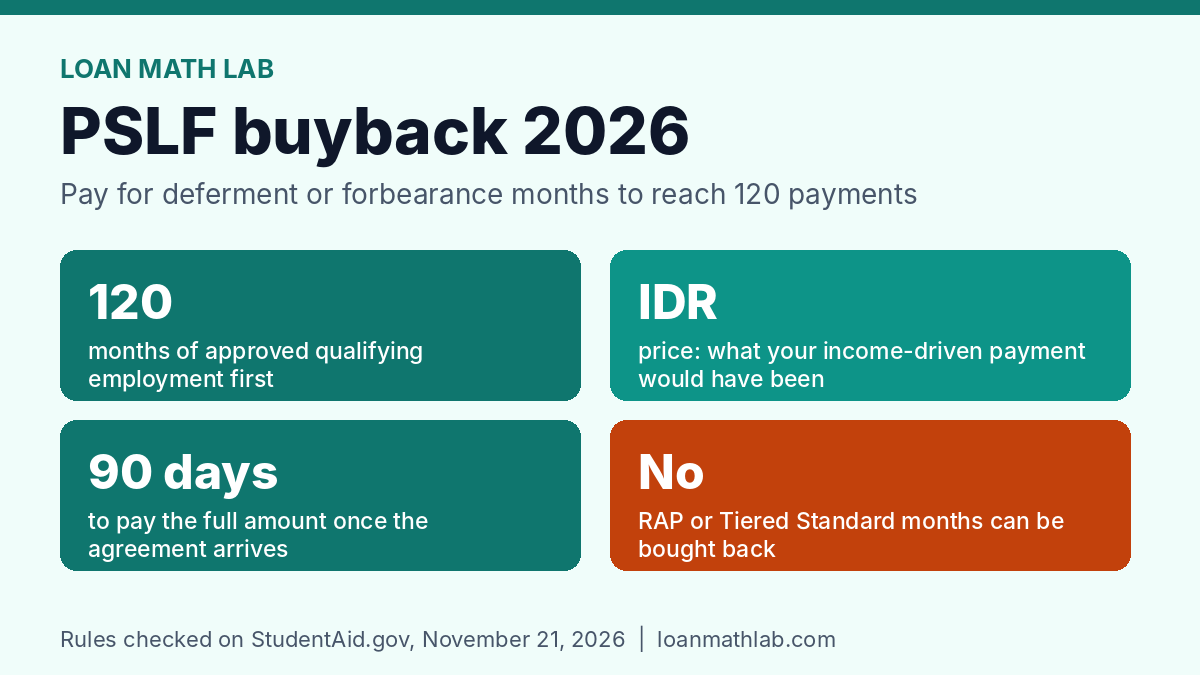
    PSLF buyback lets a public service worker pay for months spent in deferment or forbearance so that those months count toward the 120 qualifying payments needed for Public Service Loan Forgiveness. You can use it only once you already have 120 months of approved qualifying employment, and the price is roughly what your income-driven payment would have been at the time. This guide explains how PSLF buyback works under the 2026 rules, who qualifies, how the cost is calculated with worked examples, how to apply, how long the wait is and when it is worth it.

    PSLF buyback at a glance

    QuestionShort answer
    What you buyMonths in deferment or forbearance that did not count toward PSLF
    Who can request itBorrowers with at least 120 months of approved qualifying employment and a Direct Loan balance above zero
    PriceWhat your income-driven repayment (IDR) payment would have been in those months; $0 if your income was low enough
    How to request itPSLF Reconsideration on StudentAid.gov, reconsideration type “PSLF Buyback”
    Payment windowThe full amount within 90 days of the date of your buyback agreement
    Months that never qualifyMonths repaid under the Repayment Assistance Plan (RAP) or the Tiered Standard plan, plus school, grace, default, bankruptcy and disability monitoring
    Waiting timeNo official estimate; about 82,000 requests were pending in October 2026
    Sources: StudentAid.gov PSLF Buyback page and 34 CFR 685.219(g)(6), checked November 21, 2026.

    How does PSLF buyback work?

    Public Service Loan Forgiveness cancels your remaining Direct Loan balance after 120 qualifying monthly payments made while you work full time for a qualifying employer. Months when your loans were in most types of deferment or forbearance do not count, even if you were working in public service the whole time. That is the gap PSLF buyback fills.

    The rule is in the Direct Loan regulations, 34 CFR 685.219(g)(6): for a month you spent in a non-qualifying deferment or forbearance while employed full time by a qualifying employer, you can get PSLF credit by making an additional payment at least equal to what you would have paid on a qualifying plan at that time, or by showing that you would have qualified for a $0 income-driven payment. The Department of Education first called this idea “hold harmless” during rulemaking; the final rule, issued in November 2022, took effect on July 1, 2023, as Tate Law summarizes.

    In practice, the PSLF buyback program works like this. You ask the Department to review your account. It checks which deferment or forbearance months overlap your certified employment, works out the payment you would have made, and sends a PSLF Buyback Agreement with one total amount. Once your servicer receives that amount within 90 days, the bought-back months count as qualifying payments. If they take you to 120, the Department forgives the rest of your balance. You can buy back only as many months as you need to reach 120, not extra months for a refund.

    Before you request anything, count where you stand. Our PSLF calculator shows how much would be forgiven and when, from the qualifying payments you already have. For the other forgiveness routes and their dates, see our guide to federal student loan forgiveness.

    PSLF buyback eligibility: who can use it

    According to the official PSLF Buyback page on StudentAid.gov, you can request PSLF buyback only if all of these are true:

    • 120 months of employment already certified. You need at least 120 months of approved qualifying employment and no plans to certify more. The Department sets this requirement so that people do not pay for months they would never need.
    • A Direct Loan with a balance. The loan must have outstanding principal or interest above zero. Loans that are paid in full, forgiven or discharged cannot be bought back.
    • Employment in the same months. Your certified qualifying employment must cover each deferment or forbearance month you want to buy.

    You are not eligible if you only have Federal Family Education Loan (FFEL), Perkins or other non-Direct loans. You can consolidate them into a Direct Consolidation Loan to work toward PSLF, but months on the old loans cannot be bought back. Our guide to student loan consolidation explains what else a new consolidation loan changes in 2026.

    Which months you can buy back

    Loan status in that monthCan you buy it back?
    Deferment (for example, economic hardship or unemployment)Yes, if you had qualifying employment that month
    Forbearance (general, administrative or the SAVE forbearance)Yes, if you had qualifying employment that month
    Deferment or forbearance on a Direct Consolidation Loan after its first disbursementYes, on the current consolidation loan only
    In school, in grace or in originationNo
    Default or bankruptcyNo
    Total and permanent disability monitoringNo
    Repayment under RAP or Tiered StandardNo
    Months on loans later included in a consolidation loan, or before its first disbursementNo
    Source: StudentAid.gov, “Which Months Are Eligible for Buyback?”, checked November 21, 2026.

    How far back you can go depends on consolidation. Without a consolidation loan, PSLF buyback reaches back to October 2007, when Congress created PSLF. With a Direct Consolidation Loan, it starts at whichever is later: October 2007 or the earliest disbursement date of that consolidation loan.

    To find your months, log in to StudentAid.gov, select “View details” in the My Loans section, confirm the principal or interest balance is above zero, then open “View loan details” in the Loan Breakdown section to see each loan’s status history. Compare the deferment and forbearance dates with the employment periods in your PSLF tracker.

    PSLF buyback and the SAVE forbearance

    Millions of borrowers spent months in the forbearance placed on SAVE accounts while that plan was blocked in court. Those months do not earn PSLF credit on their own, but they are forbearance months, so they can be bought back if you had qualifying employment. What changed is the price: if you were enrolled in SAVE on or after July 18, 2024, the Department uses the income-driven plan you were on immediately before SAVE to set the amount, not the SAVE formula. Because SAVE usually gave the lowest payment, the PSLF buyback cost for SAVE forbearance months can be higher than borrowers expected. If you are still sorting out your move off SAVE, read our SAVE plan update first.

    How the PSLF buyback cost is calculated

    There is no fee. The PSLF buyback cost is the payment you would likely have made during the deferment or forbearance, multiplied by the months you buy. It is based on your income and family size at that time, not today. StudentAid.gov describes three cases:

    • You were on an IDR plan right before or after, and the break was under a year. The Department uses the lower of the two monthly IDR payments, the one just before and the one just after the deferment or forbearance. If you were on SAVE on or after July 18, 2024, it uses the IDR plan you had before SAVE.
    • You were not on an IDR plan before or after. The Department asks for your tax information for each calendar year involved (or a statement that you did not have to file) and a statement of your family size. It uses the lowest IDR payment you were eligible for, or the 10-year Standard payment if that was lower.
    • You do not send the documents within 30 days. The amount is set at what you would have paid on the 10-year Standard plan, which is usually much higher than an income-driven payment.

    If your income in those months was low enough for a $0 IDR payment, the buyback is free: the Department sends a $0 agreement and moves straight to processing forgiveness.

    PSLF buyback calculator: four worked examples

    There is no official PSLF buyback calculator, because only the Department sees your full payment history. You can still estimate the amount with the same rules. These four borrowers are illustrations; the payment amounts are assumptions, and the arithmetic was checked in Python on November 21, 2026.

    BorrowerMonths boughtPayment usedPSLF buyback amount
    A: 6-month general forbearance; IDR payment $180 before and $220 after6$180 (the lower one)$1,080
    B: 10-month deferment; IDR payment $310 before and $295 after10$295$2,950
    C: 12 months, no IDR plan; sends tax returns, IDR payment works out to $24012$240$2,880
    C again, but misses the 30-day document deadline (10-year Standard on $55,000 at 6.8%)12$632.94$7,595
    D: 8 months while earning under the IDR poverty threshold8$0$0
    Loan Math Lab calculation, November 21, 2026. Payment amounts are assumptions for illustration; your agreement shows the real figure.

    Borrower C shows the costliest mistake: the same 12 months cost $4,715 more only because the paperwork arrived late. To estimate the IDR payment for a past year yourself, our IBR student loan calculator works from income and family size; enter the income and family size you had in that year.

    Parent PLUS loans and buyback

    For a parent PLUS loan that has not been consolidated, the Department uses the 10-year Standard plan to work out the equivalent payment. If the parent PLUS loan is inside a Direct Consolidation Loan, it uses the Income-Contingent Repayment (ICR) calculation, or IBR where that applies. Parent PLUS loans are not eligible for Temporary Expanded PSLF (TEPSLF).

    How to apply for PSLF buyback in 4 steps

    1. Certify all your employment. If any period of qualifying employment is not yet on your record, submit a PSLF form with the PSLF Help Tool on StudentAid.gov and wait until it is approved. You need 120 approved months before you ask.
    2. Check your months. Confirm which deferment or forbearance months you want to buy and that your approved employment covers the same months, as described above.
    3. Submit a PSLF Reconsideration request. Log in to StudentAid.gov, open PSLF Reconsideration, select “PSLF Buyback” as the reconsideration type and confirm “Yes, I have 120 months of qualifying employment.” You will get an automated email confirming the request.
    4. Pay the agreement in full within 90 days. If you qualify, the Department or your servicer sends a PSLF Buyback Agreement with the amount and payment instructions. Your servicer must receive the full amount within 90 days of the date of the agreement.

    The PSLF buyback application and form

    There is no separate PSLF buyback form or paper application. The PSLF buyback application is the online PSLF Reconsideration request, with “PSLF Buyback” selected. The PSLF form you may have heard about is a different document: it certifies employment, and you use it in step 1, before you ask for a buyback. Do not send a new PSLF form after you receive a buyback agreement, because that voids the agreement.

    If the Department asks for tax returns or a family-size statement, answer within 30 days. Keep copies of everything you send and the confirmation email.

    PSLF buyback processing time and status

    The Department has not published a PSLF buyback processing time. StudentAid.gov says each account needs an in-depth review, that you cannot check the status of your request, and that it will answer by email. Early in 2025 the guidance was 60 to 90 days; that estimate has since been withdrawn, according to The College Investor, whose readers report reviews of 20 to 24 months.

    PSLF buyback processing time: pending PSLF buyback requests rose from 83,370 in December 2025 to 89,720 in March 2026 and were about 82,000 in October 2026

    The chart uses the monthly status reports the Department filed in the court case brought by the American Federation of Teachers: 83,370 pending requests at the end of December 2025 and 88,170 at the end of February 2026, as NASFAA reported, then a peak of 89,720 in March. April was the first month on record with more decisions than new requests: 6,870 requests were processed and 6,600 approved, about 96%, according to The College Investor. In summer 2026 the Department brought in servicers to help with reviews, and about 82,000 requests were still pending in October 2026, according to a Washington Post report cited by Tate Law.

    What this means for you: plan for a wait of a year or more, keep making your regular payments, and watch your email. For questions about a buyback agreement you have received, contact your servicer if your loans are with CRI, Edfinancial, Aidvantage (Maximus) or Nelnet; if they are with MOHELA, StudentAid.gov tells you to call the Department at 1-888-303-7818.

    After approval: the 90-day payment window

    The approval letter is the PSLF Buyback Agreement, sometimes called the buyback offer letter. It states one total amount. You do not have to pay it as a single lump sum: StudentAid.gov allows several payments to your servicer, as long as the full amount arrives within 90 days of the date on the agreement. Your regular monthly bill still has to be paid on top of it.

    The agreement becomes void, and you have to start over, if any of these happens after it is sent:

    • the full amount is not received within 90 days;
    • you submit a PSLF form;
    • you pay off the loan, or apply for or complete a consolidation;
    • the loan is discharged or forgiven for any other reason.

    Money paid toward a voided agreement is not refunded; it is credited as regular payments on your loan. If you pay more than the agreement amount, the extra goes first to your other federal loans, and you get a refund only if you have no other outstanding loans.

    Is PSLF buyback worth it? Buy back or keep paying

    PSLF buyback is usually cheaper than the months it replaces, because the price is an old income-driven payment and the reward is the rest of your balance. The real question is timing. While a request waits, your normal payments keep counting toward PSLF, and you can buy back only the months you still need. So the closer you are to 120, the less buyback matters. Three typical cases (illustrations, calculated November 21, 2026):

    SituationBuybackKeep paying insteadWhat usually makes sense
    111 payments counted, 9 forbearance months at $180, current payment $260$1,620, after a wait that may exceed 9 months9 payments of $260 = $2,340, done in 9 monthsKeep paying; you will likely reach 120 before a decision
    84 payments counted, 36 forbearance months at $150, current payment $300$5,40036 payments of $300 = $10,800 over 3 yearsRequest buyback now and keep paying while you wait
    Left public service after 120 months of employment; 100 payments counted, 20 months of hardship deferment at a $0 IDR payment$0Not possible: new payments no longer qualifyBuyback is the only route to forgiveness
    Loan Math Lab calculation, November 21, 2026. Payment amounts are assumptions for illustration.

    Two more checks before you decide. First, the PSLF buyback cost is fixed by the past, so a lower payment today does not lower it. Second, if you are now on RAP or have a loan made on or after July 1, 2026, your future months on RAP or Tiered Standard can never be bought back, so any gap from now on has to be closed with real payments. Our guide to the Repayment Assistance Plan explains how RAP months count toward PSLF, and the tiered standard plan guide explains why Tiered Standard months do not count at all.

    PSLF buyback program changes in 2026

    The PSLF buyback program is still open in 2026, but two changes narrowed it:

    • March 31, 2026: SAVE no longer sets the price. For borrowers enrolled in SAVE on or after July 18, 2024, the amount is based on the IDR plan they had before SAVE, as StudentAid.gov now states; Tate Law dates the change to March 31, 2026. SAVE forbearance months remain eligible.
    • July 1, 2026: RAP and Tiered Standard months excluded. The regulation, as amended on May 1, 2026, excludes repayment periods under RAP, and StudentAid.gov also excludes months under Tiered Standard. A borrower whose loans are all on these two plans has nothing left to buy back for those months.

    Buyback exists by regulation, not by statute, so a future rule could change it. No proposal to end it had been published when we checked on November 21, 2026. Every rule change we track is listed with its date in our student loan changes log.

    PSLF buyback FAQ

    Is there a PSLF buyback deadline?

    There is no deadline to request it. The two deadlines are the 30 days to send any tax or family-size documents the Department asks for, and the 90 days to pay once your agreement is dated.

    Is PSLF buyback forgiveness taxable?

    No, not federally. StudentAid.gov notes that, according to the IRS, amounts forgiven under PSLF or TEPSLF are not income for federal tax purposes, and that includes forgiveness reached through buyback. Check your state rules with a tax advisor.

    Can I get a PSLF buyback refund?

    Only in a narrow case. You cannot buy back earlier months to turn later payments into a refund, because buyback covers only the months you need for forgiveness. If you overpay an agreement, you get money back only when you have no other outstanding loans.

    Can I use buyback if I left public service?

    Yes, if you were employed by a qualifying employer in the month that becomes your 120th payment and your loan still has a balance.

    Can I consolidate after buyback?

    Yes, StudentAid.gov allows it. But applying to consolidate after an agreement has been sent and before you pay voids that agreement, and a new consolidation loan made on or after July 1, 2026 can be repaid only under RAP or Tiered Standard.

    Sources for this PSLF buyback guide

    Information checked on November 21, 2026. Worked examples use assumed payment amounts; our How We Verify page explains how we check each figure.

    Loan Math Lab is an independent website. It is not affiliated with the U.S. Department of Education, Federal Student Aid, any loan servicer, lender or school, and nothing on it is financial, legal or tax advice. Read our Disclaimer.
  • Federal Student Loan Forgiveness Programs 2026: What Is Open, Key Dates and Taxes

    Federal Student Loan Forgiveness Programs 2026: What Is Open, Key Dates and Taxes

    Federal student loan forgiveness still exists in 2026, but it comes through specific programs written into law and regulation, not through one-time mass cancellation. Six main routes are open: Public Service Loan Forgiveness, income-driven repayment forgiveness, Teacher Loan Forgiveness, and discharges for disability, a closed school or school misconduct. Each has its own clock, and since January 1, 2026 some of them can leave you with a federal tax bill.

    This guide shows where each federal student loan forgiveness program stands as of November 9, 2026, who qualifies, which dates matter and what forgiven debt can cost at tax time. We opened every official page cited here on that date. It covers federal loans only; private loans follow the terms of your lender’s contract. For the running list of rule changes, see our student loan changes log.

    Federal student loan forgiveness at a glance

    ProgramStatus, November 9, 2026How long it takesWhat is forgivenFederal income tax
    Public Service Loan ForgivenessOpen; employer rule struck down in court120 qualifying payments, at least 10 yearsRemaining Direct Loan balanceNot taxed
    IBR, PAYE and ICR forgivenessOpen; discharges being processed20 or 25 years of paymentsRemaining balanceCould be taxed if you reach the milestone in 2026 or later
    Repayment Assistance Plan (RAP)Open since July 1, 2026360 qualifying payments, at least 30 yearsRemaining balanceCould be taxed
    Teacher Loan ForgivenessOpen5 complete, consecutive academic yearsUp to $5,000 or $17,500Generally not taxed
    Total and permanent disability dischargeOpen; some discharges are automaticNo payment periodEligible federal loansNot taxed; your Social Security number must be on the return
    Closed school dischargeOpen under older rulesDepends on the closure dateLoans for that schoolNot taxed
    Borrower defense dischargeOpen; individual reviewCase by caseLoans for that school, if approvedLong treated as not taxed
    Our summary of federal student loan forgiveness rules from the program pages at StudentAid.gov, 34 CFR 685.209 and the tax sources listed below, read November 9, 2026. State income tax can differ.
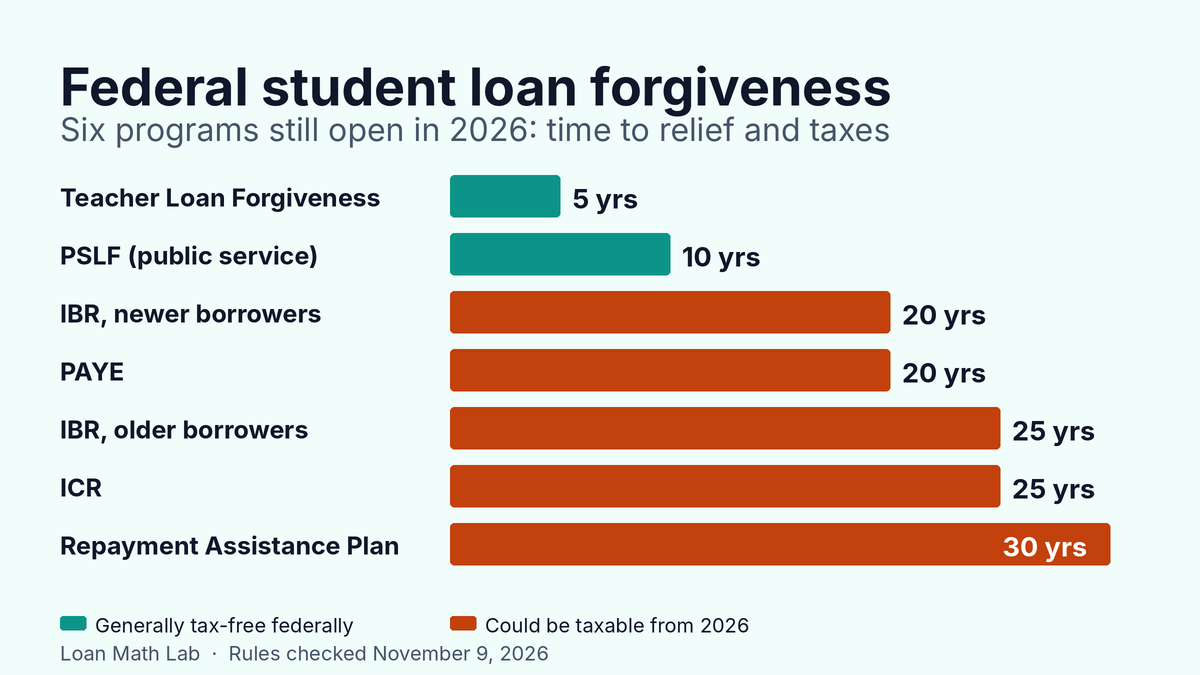
    Federal student loan forgiveness 2026 chart: years of payments or service for Teacher Loan Forgiveness, PSLF, IBR, PAYE, ICR and RAP, and whether the amount can be taxed

    Student loan forgiveness update: what changed in 2026

    If you last looked at federal student loan forgiveness in 2025, these are the changes that matter, newest first:

    • October 21-23, 2026: the PSLF employer fight ends. The administration dropped all three appeals over a rule that would have let the Education Department remove employers from PSLF: two on October 21, as AACOM reported (November 2, 2026), and the one in the states’ case, announced by Wisconsin’s attorney general on October 23. The June 30 court rulings that threw out the rule before it took effect now stand.
    • September 29, 2026: official status of income-driven forgiveness. StudentAid.gov says IBR discharges resumed in September 2025 and its systems now process PAYE and ICR too. The payment counters are still being rebuilt.
    • July 17, 2026: Sweet v. McMahon. A federal appeals court rejected the Department’s bid to delay relief for more than 170,000 borrower defense applicants, as the borrowers’ lawyers reported.
    • July 1, 2026: RAP opens. Loans made from this date cannot use IBR, PAYE or ICR. Income-based relief for them runs through the Repayment Assistance Plan.
    • March 10, 2026: SAVE ends. A court order blocked discharges under SAVE. Borrowers in SAVE forbearance must pick another plan; our SAVE plan update covers the steps.
    • January 1, 2026: the tax break ends. The temporary rule that kept most forgiven student debt out of federal taxable income expired.

    One thing has not come back: broad, one-time cancellation. The Supreme Court struck down the 2022 plan in Biden v. Nebraska on June 30, 2023. Any message promising a new mass federal student loan forgiveness program should be checked against StudentAid.gov before you act on it.

    Student loan forgiveness programs tied to repayment

    Two federal student loan forgiveness programs reward years of payments: one for public service, the other for staying on an income-driven plan. They can overlap, and the first is much faster.

    Public Service Loan Forgiveness

    PSLF forgives the remaining balance on Direct Loans after the equivalent of 120 qualifying monthly payments made while you work full time for an eligible employer. The payments do not have to be consecutive. To see how much PSLF could cancel in your case and when your 120th payment falls, use our PSLF calculator. The official requirements are:

    • Employer: a U.S. federal, state, local or tribal government, including the military; a 501(c)(3) nonprofit; or another nonprofit that provides certain qualifying public services. For-profit contractors, labor unions and partisan political groups do not count.
    • Hours: a weekly average of at least 30 hours, alone or combined across qualifying employers.
    • Loans: Direct Loans. FFEL and Perkins loans only become eligible if you consolidate them into a Direct Consolidation Loan.
    • Repayment plan: RAP, IBR, ICR, PAYE or the 10-year Standard plan. Payments on the Tiered Standard, Graduated and Extended plans do not qualify for PSLF.

    You must still work for a qualifying employer when you submit the form for forgiveness, so do not leave the job before you apply. The Department advises certifying your employment every year and whenever you change employers. If you have 120 months of qualifying employment but some of them were spent in a deferment or forbearance, our PSLF buyback guide explains how to pay for those months so they count. Parents should read the fine print: StudentAid.gov now says parent PLUS loans, and consolidation loans that include one, are ineligible for RAP and cannot continue to qualify for PSLF, even if they qualified before through IBR or ICR. If that is you, confirm your position with your servicer and read our guide to the Parent PLUS loan changes.

    The employer rule that worried many nonprofit workers never applied. A federal court vacated it on June 30, 2026, finding that it exceeded the Department’s authority and violated the First Amendment, and Michigan’s attorney general reported in October that the appeal in the states’ case had been dropped.

    Income-driven repayment forgiveness

    Income-driven federal student loan forgiveness cancels what is left after a long repayment period. The clock depends on the plan, under 34 CFR 685.209(k) and the Department’s court actions page:

    PlanForgiveness afterGood to know
    IBR, first loans after July 1, 201420 years of paymentsOnly Direct Loans made before July 1, 2026 can use IBR
    IBR, first loans before July 1, 201425 years of paymentsSame cutoff
    PAYE20 years of paymentsPlan ends: choose another by June 30, 2028
    ICR25 years of paymentsPlan ends: choose another by June 30, 2028
    RAP360 qualifying payments over at least 30 yearsCertain earlier payments on other plans can count
    SAVENoneDischarges under SAVE were blocked by the March 10, 2026 order
    Sources: 34 CFR 685.209(c), (d) and (k) and StudentAid.gov (page updated September 29, 2026).

    You do not apply for this type of federal student loan forgiveness: the regulation says the Department tracks your progress and forgives eligible loans without an application. It will notify you when your loan is identified as eligible, and you then have 21 days to opt out. Loans in default are not eligible for discharge under an income-driven plan, so getting out of default comes first.

    Processing of income-driven federal student loan forgiveness has been uneven. Student loan lawyer Stanley Tate’s summary of the court reports counts 21,200 discharges in March 2026 (10,500 IBR, 9,900 ICR and 800 PAYE), followed by months with none, because eligibility is checked in batches. Court-ordered reporting ended in May 2026, so no public source can give a current processing time. To see what you would pay along the way, try our IBR calculator or our RAP calculator, or read IBR vs RAP with worked examples.

    Teacher loan forgiveness

    Teacher Loan Forgiveness is the form of federal student loan forgiveness that pays a fixed amount rather than your whole balance. You need five complete and consecutive academic years as a full-time, highly qualified teacher at a low-income school or educational service agency.

    You taughtMaximum forgiven
    Mathematics or science at the secondary level, as a highly qualified full-time teacher$17,500
    Special education at the elementary or secondary level, as a highly qualified teacher$17,500
    Other elementary or secondary subjects, as a highly qualified full-time teacher$5,000
    Source: StudentAid.gov, Teacher Loan Forgiveness, read November 9, 2026. The amount is a combined maximum across Direct and FFEL loans.

    It covers Direct and FFEL Subsidized and Unsubsidized Loans; PLUS and Perkins loans are excluded. You also must have had no outstanding Direct or FFEL balance on October 1, 1998, or on the date of your next such loan after it. You apply through your servicer once the five years are done, and your school’s chief administrative officer certifies the service.

    The trap is the overlap with PSLF. The same period of service cannot count for both. The Department gives this example: if you receive Teacher Loan Forgiveness after five years, payments made during those years do not count toward your 120, so you would need 120 more. A public school teacher with a large balance should run the numbers before applying, because the Department says it cannot change this once the forgiveness is granted.

    Federal student loan forgiveness when something went wrong

    Discharges are the part of federal student loan forgiveness that does not depend on years of payments. They respond to an event: a disability, a school that closed or a school that misled you.

    Total and permanent disability discharge

    A total and permanent disability discharge cancels Direct, FFEL and Perkins loans and any TEACH Grant service obligation. You can qualify with documentation from the Department of Veterans Affairs, from the Social Security Administration or from an authorized medical professional. The Department also matches records with VA and Social Security and sends a letter; the discharge is then automatic unless you opt out.

    Applying, or telling the Department you plan to apply, can pause your payments for 120 days. StudentAid.gov states that a three-year monitoring period applies to discharges based on Social Security or medical certifications, and that the loans may be reinstated if its conditions are not met.

    Closed school discharge

    If your school closed and you could not finish, a closed school discharge can cancel the Direct, FFEL or Perkins loans you took to attend it. StudentAid.gov lists three situations: you were enrolled when it closed, you were on an approved leave of absence, or it closed within 180 days after you withdrew. You generally do not qualify if you finished the program, or if you are completing it through a teach-out or at another branch.

    Do not count on the automatic route. That page describes an automatic discharge one year after closures from July 1, 2023, while its own notice says a court delayed the 2023 rule. Federal Student Aid letter GEN-25-04 then confirmed that the rules in effect on July 1, 2020 apply to loans originated before July 1, 2035. Our practical reading: contact your servicer and apply as soon as the closure is confirmed. The page also says to keep paying while the application is processed.

    Borrower defense discharge

    Borrower defense applies when a school’s misconduct, usually a misrepresentation about jobs, salaries or transferable credits, harmed you. If approved, the Department discharges the remaining balance on loans for that school and may refund payments. Parent PLUS borrowers can apply too. You must have an outstanding federal loan tied to the school, and you sign the application under penalty of perjury.

    The standard depends on when the loan was made. The more generous 2022 rules are blocked and delayed by law, so according to Tate Law (updated October 4, 2026), loans made after July 1, 2020 fall under the 2019 rules: a general limit of three years after leaving the school, and proof of a knowing or reckless misrepresentation, your reliance on it and financial harm beyond owing the loan. Separately, the Sweet v. McMahon settlement covers people who applied by late 2022; if that is you, look for a notice about your application.

    Other routes exist for narrower cases. 34 CFR 685.212 also lists discharges for death, bankruptcy, false certification, unpaid refunds and survivors of the September 11 attacks.

    Who qualifies for student loan forgiveness

    Federal student loan forgiveness depends on your job, your plan or what happened to you. Start with the row that sounds like your situation:

    Your situationLook first atCheck before relying on it
    Full-time government or nonprofit jobPSLFYour employer in the PSLF Employer Search; loans must be Direct
    Teacher at a low-income schoolPSLF or Teacher Loan ForgivenessBalance size; the same years cannot count for both
    Low income compared with your debtIBR or RAPWhether any loan was made on or after July 1, 2026; your likely tax
    Disability that stops you from workingTotal and permanent disability dischargeWhich proof you have: VA, Social Security or a medical professional
    School closed before you finishedClosed school dischargeYour withdrawal date and whether you finished elsewhere
    School lied about something centralBorrower defenseEvidence, such as ads and emails, and when you left the school
    Where to start with federal student loan forgiveness. Eligibility is decided by the Department of Education and your servicer.

    Federal student loan forgiveness dates to know

    Most federal student loan forgiveness programs have no single deadline, but these dates change who gets what:

    DateWhat it means
    January 1, 2026Income-driven milestones reached before this date stay free of federal tax, even if the discharge posts later
    January 28 and April 15, 2026Decision deadlines for Sweet v. McMahon post-class applicants; missed decisions trigger relief under the settlement
    June 30, 2026Courts vacate the PSLF employer rule
    July 1, 2026Loans made from this date cannot use IBR, PAYE or ICR; RAP opens
    June 30, 2028Last day for PAYE and ICR borrowers to choose a new plan; after that the Department assigns one
    July 1, 2035The 2020-era closed school rules apply to loans originated before this date
    Sources: StudentAid.gov, 34 CFR 685.209(c)(7) and (d)(5), Project on Predatory Student Lending and GEN-25-04.

    Is federal student loan forgiveness taxable?

    Whether federal student loan forgiveness is taxed depends on the program. The law that kept most forgiven student debt out of federal income covered discharges through December 31, 2025. Here is where federal student loan forgiveness stands now:

    • Income-driven plans: the Department says a discharge “could create a federal tax liability” depending on its effective date. If you met your milestone before January 1, 2026, it is not subject to federal tax even if the loan is discharged later.
    • Disability and death: the 2025 law made this exclusion permanent, under section 108(f)(5) of the tax code, and requires your Social Security number on the return.
    • Work-based forgiveness: section 108(f)(1) excludes loans discharged for working a set period in certain professions for a broad class of employers. PSLF has long been treated as tax-free federally, as student loan attorney Adam Minsky explains, along with closed school and borrower defense discharges.
    • State tax: a federal exclusion does not bind your state. The Department warns that some discharges can count as income for state tax.

    Worked example. Suppose $40,000 is forgiven under IBR after a milestone reached in 2027, and all of it is taxed at a 22% rate. The federal bill is about $8,800 ($40,000 × 0.22). A large forgiven amount can also push part of your income into a higher bracket, so the real figure may differ. Our example is simplified and uses an assumed rate.

    There is one common way to reduce that. Under IRS Publication 4681 (2025 edition), you are insolvent to the extent your total liabilities exceed the fair market value of your total assets immediately before the cancellation, and you can exclude the smaller of the canceled debt or that shortfall by filing Form 982 and checking line 1b. In the same example, with liabilities of $120,000 and assets of $90,000, you are insolvent by $30,000. You would exclude $30,000, leaving $10,000 taxable and about $2,200 of tax at 22%, or $6,600 less. Have a tax professional confirm this before you file.

    How to get student loans forgiven, step by step

    Federal student loan forgiveness rarely happens by accident. Whichever route fits you, these steps apply to most borrowers:

    1. Identify your loans. Log in to StudentAid.gov and note which loans are Direct, FFEL, Perkins or parent PLUS, and the date of each. Private loans will not appear there.
    2. Get out of default first. Default blocks income-driven forgiveness and, unless you make satisfactory arrangements, Teacher Loan Forgiveness.
    3. Choose the plan that fits the goal. Compare your options with our student loan calculator. A plan that does not count, such as Tiered Standard for PSLF, can cost you years.
    4. Document everything. Submit the PSLF form every year, and keep your payment records. The Department says it is still changing how income-driven payment counters are displayed, so your own records matter.
    5. Apply through official channels. Use StudentAid.gov or your servicer. Be wary of any company that charges a fee to do this for you, and never share your StudentAid.gov login.
    6. Plan for the tax. If your federal student loan forgiveness could be taxable, estimate the bill years ahead and check your state’s rule.

    Federal student loan forgiveness FAQ

    Is student loan forgiveness still happening in 2026?

    Yes, federal student loan forgiveness continues through the programs above. As of November 9, 2026, StudentAid.gov lists PSLF, Teacher Loan Forgiveness and the discharge programs as available and says it is processing IBR, PAYE and ICR discharges. SAVE forgiveness and broad one-time cancellation are not available.

    Can I get Teacher Loan Forgiveness and PSLF?

    Yes, but not for the same period of service. The five years used for Teacher Loan Forgiveness do not count toward your 120 PSLF payments.

    Do loans made after July 1, 2026 qualify for federal student loan forgiveness?

    Direct Loans for students can reach forgiveness through RAP after 360 qualifying payments, or through PSLF while on RAP. For those loans, only full payments made by the due date count toward PSLF. Parent PLUS loans cannot use RAP.

    Are private student loans eligible?

    No. Federal student loan forgiveness only covers federal loans. StudentAid.gov lists loans from private lenders as ineligible for PSLF, and any relief on a private loan depends on your lender’s contract.

    Is student loan forgiveness taxable if I reach IBR forgiveness next year?

    It could be. A milestone reached on or after January 1, 2026 falls outside the expired federal exclusion, so the forgiven amount can count as income unless another exclusion, such as insolvency, applies.

    Sources for federal student loan forgiveness

    This guide to federal student loan forgiveness is general information, not financial, legal or tax advice. Eligibility is decided by the U.S. Department of Education and your loan servicer, and rules can change. Loan Math Lab is not affiliated with the U.S. Department of Education. See our How We Verify page and Disclaimer. Information checked on November 9, 2026.