Comparing IBR vs RAP student loans comes down to one question: which plan gives you the lower payment and the better finish line with your income, family and loans? Both are federal income-driven plans, and both stay open in 2026. They just measure your income in very different ways, so the same borrower can pay $100 a month on one and $134 on the other, or the reverse.
This IBR vs RAP student loans guide runs the numbers instead of listing pros and cons. You will see the two formulas side by side, four worked examples checked in Python, what happens to your balance in the first year, and a short checklist to decide. If you want your own figures, our student loan calculator puts both plans next to each other in one screen.
Table of Contents
IBR vs RAP student loans at a glance
| IBR (Income-Based Repayment) | RAP (Repayment Assistance Plan) | |
|---|---|---|
| Who can use it | Only Direct Loans made before July 1, 2026 | Any Direct Loan borrower with eligible loans |
| How income counts | AGI minus 150% of the poverty line for your family size | A percentage of your whole AGI, from 1% to 10% |
| Share charged | 10% (new borrowers) or 15% (earlier borrowers) of discretionary income | 1% to 10% of AGI, by $10,000 bracket |
| Family | Family size raises the protected amount | $50 a month off for each dependent on your tax return |
| Payment cap | Never more than the 10-year Standard payment | No cap |
| Minimum | $0 below $5; $10 between $5 and $10 | $10 a month |
| Unpaid interest | Charged, except 3 years on subsidized loans | Not charged if you pay on time |
| Principal | No help | Up to $50 a month added to principal if your payment does not cut it |
| Forgiveness | 20 years (new borrowers) or 25 years | 30 years (360 payments) |
The rest of this page explains each row with numbers, because the table alone hides the most important point: which plan is cheaper changes as your income changes.
Can you choose IBR? Check this first
Before comparing anything, check whether IBR is still open to you. Under the federal rules in 34 CFR 685.209, only Direct Loans made before July 1, 2026 can be repaid under IBR. RAP has no such limit: any borrower with eligible Direct Loans can choose it.
- All your loans were paid out before July 1, 2026. You can choose either plan, so the comparison below applies to you.
- You borrowed a new Direct Loan on or after July 1, 2026. That loan cannot go on IBR. Student loan lawyer Stanley Tate writes that a new loan or consolidation after that date closes IBR for your whole Direct Loan portfolio, so check with your servicer before you borrow or consolidate.
- You have Parent PLUS loans. They are not eligible for RAP, and they are a separate case not covered by this page. Our guide to the Parent PLUS loan changes explains their new limits and repayment plans.
Borrowers still on SAVE, PAYE or ICR have a different starting point and a deadline; our SAVE plan update explains the steps.
How IBR vs RAP student loans set your payment
The IBR formula
IBR starts from your adjusted gross income (AGI) and first protects 150% of the federal poverty line for your family size. Only the rest, called discretionary income, is charged. Then it takes 10% of that amount if you are a new borrower, or 15% if you are not, and divides by 12.
A “new borrower” for IBR is someone who had no federal student loan balance on July 1, 2014 or who had none left when they borrowed again after that date (before July 1, 2026). For a single person in the 48 contiguous states, 150% of the 2026 HHS poverty guideline is $23,940; for a family of three it is $40,980. Alaska and Hawaii have higher figures.
One more rule matters a lot: the IBR payment never goes above what you would pay on the 10-year Standard plan for the balance you had when you entered IBR. Higher earners hit that cap and stop paying more.
The RAP formula
RAP ignores the poverty line. It takes a percentage of your whole AGI, from 1% at $10,001 to 10% above $100,000, divides by 12 and subtracts $50 for each dependent you claim on your tax return. The minimum is $10 a month, and there is no cap.
In exchange, RAP protects your balance: if your on-time payment does not cover the month’s interest, the rest is not charged, and if your payment reduces principal by less than $50, the government adds the difference up to $50. Our guide to the Repayment Assistance Plan explains these rules step by step.

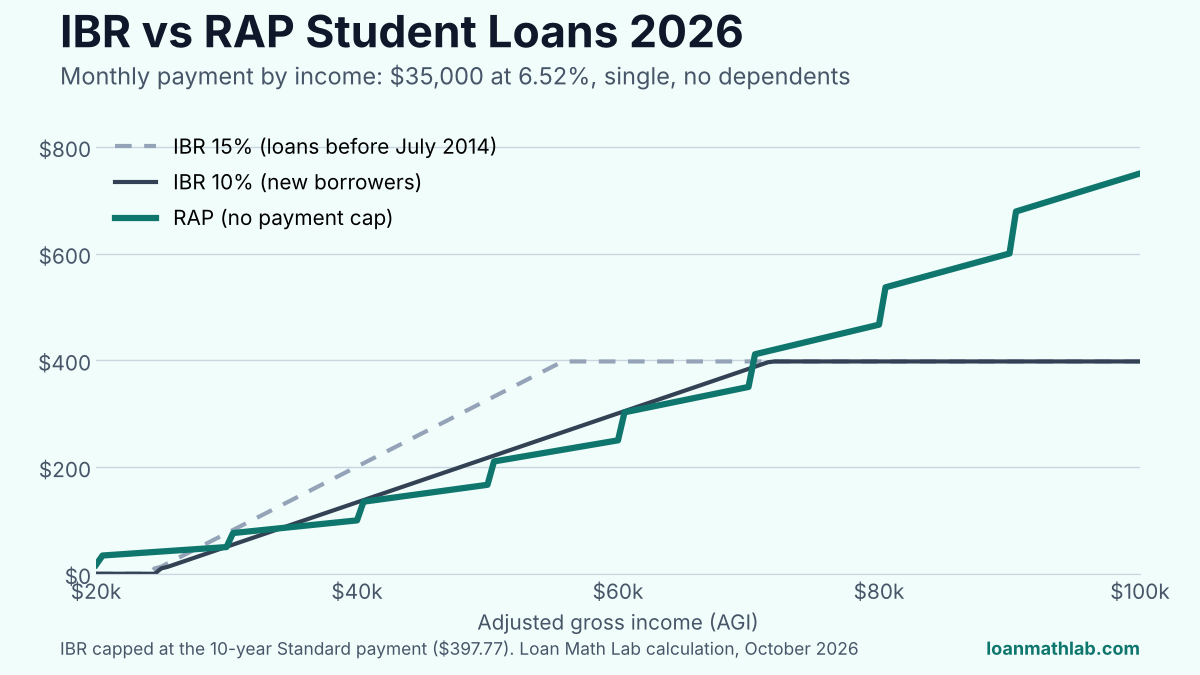
The chart shows the pattern for a single borrower with $35,000 at 6.52%. Between about $35,000 and $70,000 of income, RAP is the lowest line; below that, the poverty-line protection makes IBR cheaper. Above roughly $75,000, both IBR lines flatten at the $397.77 cap while RAP keeps rising.
Repayment assistance plan vs IBR: four worked examples
All four IBR vs RAP student loans examples use the same loan, $35,000 in Direct Loans at 6.52%, so only the borrower changes. The 10-year Standard payment for that balance is $397.77, which is the IBR cap. Each example shows what both plans charge in the first month.
| Borrower | AGI | RAP | IBR 10% (new) | IBR 15% (older loans) |
|---|---|---|---|---|
| A. Single, no children | $40,000 | $100.00 | $133.83 | $200.75 |
| B. Single, no children | $75,000 | $437.50 | $397.77 (cap) | $397.77 (cap) |
| C. Single parent, 2 children | $55,000 | $129.17 | $116.83 | $175.25 |
| D. Single, part-time job | $25,000 | $41.67 | $10.00 | $13.25 |
Example A: $40,000 income
RAP charges 3% of $40,000, which is $1,200 a year or $100.00 a month. IBR first protects $23,940 and charges 10% of the remaining $16,060, so $133.83 a month for a new borrower and $200.75 for an older one. RAP is cheaper here, by $33.83 to $100.75 a month.
Example B: $75,000 income
RAP charges 7% of all $75,000: $437.50 a month. Both IBR versions would charge more than $397.77, so the cap applies and the payment stays at $397.77. At this income, IBR saves $39.73 a month, and the gap grows as income rises: at $90,000, RAP asks $600.00.
Example C: single parent with two children
With two dependents, RAP takes 5% of $55,000 ($229.17) and subtracts $100, for $129.17. IBR protects $40,980 for a family of three, leaving $14,020: $116.83 at 10% and $175.25 at 15%. A new borrower pays less on IBR; an older borrower pays less on RAP. Your loan dates decide the winner.
Example D: low income
At $25,000, RAP charges 2% ($41.67). IBR protects almost all of that income: the 10% version works out to $8.83, which the rules round up to the $10 minimum, and the 15% version to $13.25. For very low incomes, IBR usually asks less each month.
Your balance after year one
The monthly payment is only half of the IBR vs RAP student loans comparison. Take borrower A, whose payment is lower than the monthly interest of $190.17 on either plan:
| After 12 months | IBR 10% | RAP |
|---|---|---|
| Paid in the year | $1,605.96 | $1,200.00 |
| Unpaid interest added | $676.08 | $0 |
| Principal | $35,000.00 | $34,400.00 |
| Total owed | $35,676.08 | $34,400.00 |
Borrower A pays $405.96 less on RAP and ends the year owing $1,276.08 less, because RAP waives the uncovered interest and adds a $50 principal match every month. On IBR, unpaid interest keeps building and can be added to the principal later, for example if you leave the plan. To follow the RAP side over the full 30 years, use our RAP student loan calculator; for the IBR side over 20 or 25 years, use our IBR student loan calculator.
Which student loan repayment plan is best for you?
There is no single winner in IBR vs RAP student loans. Use these rules of thumb, then confirm with your own numbers:
- RAP tends to win for middle incomes (roughly $35,000 to $70,000 for a single borrower with $35,000 of debt), when your payment does not cover the interest, and when you claim dependents, since each one takes $50 off.
- IBR tends to win at very low incomes, at high incomes where the 10-year cap applies, and for new borrowers with large families, because the poverty line protects more income.
- Forgiveness changes the long view. IBR forgives what is left after 20 or 25 years; RAP after 30. A borrower with a high balance and low income may finish years earlier on IBR, even if the payments look similar.
- Your balance size matters. The IBR cap is set by your balance, so a larger debt raises the cap and moves the point where IBR becomes cheaper.
The break-even incomes above are for this one example. A different balance, rate or family size moves them, which is why a side-by-side calculation is safer than a rule of thumb.
Forgiveness and PSLF: IBR vs RAP student loans
For Public Service Loan Forgiveness, the RAP plan is named as a qualifying repayment plan in 34 CFR 685.219, and income-driven plans under 685.209, which include IBR, also qualify. If you expect PSLF after 120 payments, the 20, 25 or 30-year forgiveness date matters less, and the lowest monthly payment usually decides.
Outside PSLF, the timelines differ by a decade: 20 years for new IBR borrowers, 25 for older ones and 30 years (360 payments) on RAP. Months already made on an income-driven plan can count toward later forgiveness, but the exact credit depends on your history, so check your count in your StudentAid.gov account before switching.
Married borrowers: IBR vs RAP student loans
Both plans use your joint income if you file taxes jointly, and only your own income if you file separately, according to 34 CFR 685.209. When both spouses have federal loans and file jointly, RAP splits the payment by each spouse’s share of the combined loan balance.
Filing separately can lower your loan payment on either plan, but it can raise your tax bill, for example by losing credits available only to joint filers. Compare both before deciding, ideally with a tax professional.
Switching plans after comparing IBR vs RAP student loans
- When. A borrower on an income-driven plan may change to another eligible plan at any time, under 34 CFR 685.209. You ask your loan servicer or use the application on StudentAid.gov.
- One-way doors. If you take a new Direct Loan on or after July 1, 2026, IBR is no longer available for that loan, so moving from RAP back to IBR may not be possible later.
- Deadline for older plans. Borrowers on PAYE or ICR must choose RAP, IBR or another listed plan before July 1, 2028; if they do not, they are placed on RAP for RAP-eligible loans, or on IBR for others.
- Interest on leaving IBR. Unpaid interest on IBR can be added to your principal when you leave the plan, which raises the balance RAP starts from.
If a fixed payment fits your budget better than either income-driven plan, compare the 10-year Standard or Tiered Standard term with our student loan payment calculator.
IBR vs RAP student loans FAQ
Is RAP better than IBR?
For many single borrowers with middle incomes, RAP has the lower payment and better interest protection. At very low or high incomes, IBR often asks less each month, and it forgives the balance sooner.
Can I switch from IBR to RAP?
Yes. A borrower on an income-driven plan may change plans at any time. Ask your servicer how any unpaid interest will be treated before you switch.
Can I still enroll in IBR in 2026?
Yes, if your loans were made before July 1, 2026. Direct Loans made on or after that date cannot be repaid under IBR.
Does RAP have a payment cap like IBR?
No. RAP has no cap, so a high income can push the RAP payment above the 10-year Standard payment. IBR never charges more than that amount.
Which plan counts for PSLF?
Both. RAP is listed as a qualifying plan for Public Service Loan Forgiveness, and so are the income-driven plans that include IBR.
Sources for this IBR vs RAP student loans guide
- 34 CFR 685.209, Income-driven repayment plans (Cornell LII; RAP and IBR rules, eligibility dates, switching, minimum payments)
- 34 CFR 685.219, Public Service Loan Forgiveness (Cornell LII; qualifying repayment plans)
- HHS Poverty Guidelines for 2026 (U.S. Department of Health and Human Services, ASPE)
- IBR vs RAP: Which Student Loan Repayment Plan Is Better for You? (Stanley Tate, updated September 24, 2026; effect of new loans on IBR)
- Repayment Calculator (StudentAid.gov, formerly Loan Simulator: check your real loans)
This comparison of IBR vs RAP student loans is general information, not financial, legal or tax advice. Your servicer calculates your real payment; check it with the official Repayment Calculator on StudentAid.gov or a qualified professional before you change plans. Loan Math Lab is not affiliated with the U.S. Department of Education. See our How We Verify page and Disclaimer. Information checked on October 26, 2026.