Author: Casey Morrow

  • Refinance Federal Student Loans? What You Lose in 2026 and When It Can Still Pay Off

    Refinance Federal Student Loans? What You Lose in 2026 and When It Can Still Pay Off

    Should you refinance federal student loans? A private lender can pay off your federal loans with a new private loan, sometimes at a lower rate, but the switch is permanent and the new loan leaves the federal system for good. This guide lists what you give up when you refinance federal student loans in 2026, puts a dollar figure on it in three worked examples, and shows when a lower rate can still be worth it. We opened every official page cited here on November 23, 2026. We do not list or recommend lenders, and we do not publish lender rates.

    Refinance federal student loans: what changes at a glance

    FeatureFederal Direct LoansAfter you refinance (private loan)
    Who sets the termsFederal law and regulationsThe lender’s contract
    Interest rateFixed, set by formula for each school yearFixed or variable, based on your credit and the lender
    Payment tied to your incomeRAP for Direct Loans except parent PLUS loans and the consolidations that repaid them; IBR if all your loans were made before July 1, 2026Not required by law; ask the lender
    Public Service Loan ForgivenessYes, on qualifying plansNo
    Deferment and forbearanceSet types, such as unemployment and economic hardship defermentOnly what the lender offers
    DeathDischarged; a parent PLUS loan is also discharged if the student diesMany, but not all, lenders offer a discharge
    Prepayment penaltyNoneCheck the contract
    Can you go back?Not applicableNo: private loans cannot go into a Direct Consolidation Loan
    Sources: StudentAid.gov, Federal Versus Private Loans and Discharge Due to Death; CFPB, Should I consolidate or refinance my student loans? Checked November 23, 2026.

    The short version: when you refinance federal student loans, you trade a set of legal protections for a rate. The rest of this guide puts a price on that trade.

    What happens when you refinance federal student loans

    To refinance federal student loans, you take out a brand-new private loan. The lender checks your credit, often asks for a cosigner if your credit history is short, and offers a rate and a term. If you accept, it uses the new loan to pay off the loans you picked. Your federal loans then show as paid in full, and from that day you owe the lender instead of the Department of Education.

    StudentAid.gov sums up the difference in its comparison of federal and private loans: federal loans have terms set by law and benefits such as fixed rates and income-driven plans, while a private loan’s terms are set by the lender, and private loans are generally more expensive. You choose which loans to include, so you can refinance private loans and keep your federal loans as they are.

    The step only goes one way. The Consumer Financial Protection Bureau warns that it cannot be reversed, and StudentAid.gov states that private student loans cannot be consolidated into a Direct Consolidation Loan. Once you refinance federal student loans, no federal program will take them back.

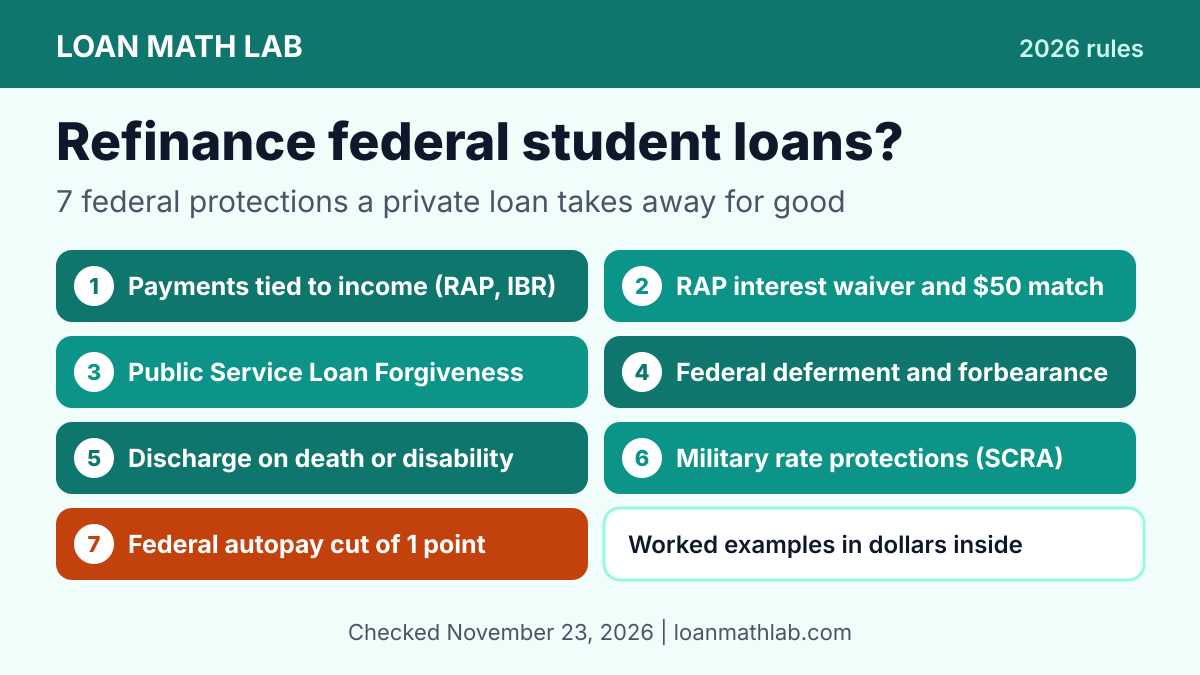
    Seven things you give up when you refinance federal student loans

    1. A payment tied to your income. The Repayment Assistance Plan (RAP) charges 1% to 10% of your adjusted gross income (AGI), divided by 12 and reduced by $50 for each dependent, with a $10 minimum, under 34 CFR 685.209. If your AGI falls to $30,000, RAP asks 2% of it, or $50 a month. A private loan keeps its fixed payment. If all your loans were made before July 1, 2026, Income-Based Repayment (IBR) is open to you as well.
    2. Interest that RAP never charges. On RAP, interest your on-time payment does not cover is not charged at all, and the Department lowers your principal by up to $50 in any month your payment barely touches it. A private lender charges every dollar of interest.
    3. Public Service Loan Forgiveness and other forgiveness. PSLF cancels what is left on Direct Loans after 120 qualifying payments, and a refinanced loan is no longer a Direct Loan. The CFPB notes that you also lose teacher forgiveness and the forgiveness at the end of income-driven plans.
    4. Federal deferment and forbearance. StudentAid.gov lists deferments for unemployment, economic hardship, cancer treatment, military service and other cases, each with fixed rules. A private lender decides its own relief; the CFPB says you may still qualify for options like forbearance, on the lender’s terms.
    5. Discharge if you die or become disabled. Federal loans are discharged on the borrower’s death, and a parent PLUS loan is also discharged if the student dies. Total and permanent disability discharge applies too. According to the CFPB, many but not all private lenders offer something similar.
    6. Military protections. The CFPB warns that active-duty servicemembers can lose the Servicemembers Civil Relief Act interest-rate reduction, including its 6% cap, on loans taken out before service.
    7. The temporary federal autopay cut. Since July 1, 2026, automatic payments lower the rate on Direct Loans made after July 1, 2012 by 1 percentage point instead of 0.25, through June 30, 2028, according to the Department of Education. The federal servicer Edfinancial gives the enrollment deadline as 11:59 p.m. ET on December 31, 2026. On $45,000, one point is worth about $450 of interest a year while it lasts.

    None of these seven items appear in a rate comparison. That is why a lower rate on its own is not a reason to refinance federal student loans: the rate is the only part of the deal you can see on the offer.

    Refinance student loans pros and cons for federal borrowers

    ProsCons
    A lower fixed rate can cut the interest you pay if your credit or income has improved since you borrowedAll seven federal protections above are gone for good
    One lender and one bill if you also have private loansThe rate depends on your credit, and a variable rate can rise above your old fixed federal rate
    A shorter term can clear the debt soonerA longer term lowers the payment but can raise the total interest, as the CFPB points out
    You choose which loans to includeFees, where the offer has them, take months to win back
    Based on StudentAid.gov and the CFPB, checked November 23, 2026.

    The main reason people refinance federal student loans is a lower rate; the main reason not to is everything in the right-hand column. Most disadvantages of refinancing student loans are about risk, not price. The saving is fixed in the contract on day one; the cost only shows up in a bad year, such as a job loss, an illness or a move into public service. So the question is not only how much you save, but what that saving buys if your plans change.

    Worked example: what a lower rate saves, and what it risks

    Jordan owes $45,000 in federal Direct Loans at an average 7.5%, with 10 years left on a fixed payment. A lender offers a fixed 6.0% for 10 years with no fees. The offer is an assumption for illustration, not a lender rate. Here is what it means to refinance federal student loans at that rate.

    Keep federal loansRefinance at 6.0%, 10 years
    Monthly payment$534.16$499.59
    Interest from now$19,099$14,951
    Difference–$4,148 less interest, $34.57 less a month
    If AGI drops to $30,000$50 a month on RAPStill $499.59, unless the lender agrees to relief
    If Jordan diesDischargedDepends on the lender’s contract
    Our calculation in Python, November 23, 2026: fixed payment, interest at one twelfth of the yearly rate, last payment adjusted. Balance, rates and income are assumptions.

    On paper, Jordan saves $4,148 over 10 years by refinancing. The federal autopay cut, about $450 a year on this balance until June 30, 2028, takes a large part of that gap if Jordan has not enrolled yet. And the saving buys nothing in a hard year: with an AGI of $30,000, RAP would ask $50 a month, while the private loan still asks $499.59. Our student loan refinance calculator works out the break-even point and the break-even rate for your own offer, fees included.

    Refinance federal student loans and lose PSLF: the costliest mistake

    Take the teacher from our PSLF calculator: single, $60,000 at 6.5%, an AGI of $50,000 with 3% raises, and 36 qualifying payments already made. On RAP she pays $18,656 over her remaining 84 payments, and PSLF forgives $55,800, tax-free under federal law. Now suppose she refinances at an assumed 5.5% for 10 years.

    Refinance federal student loans example: a teacher pays $18,656 on RAP with $55,800 forgiven by PSLF, or $78,139 after refinancing at 5.5%

    The private loan costs $651.16 a month and $78,139 in total, with nothing forgiven: about $59,500 more than staying on RAP. A lower rate cannot close a gap that size. If you work for a government or a qualifying not-for-profit employer, check your PSLF count before you refinance federal student loans or even look at an offer. PSLF buyback cannot fix it later either, because it needs a Direct Loan with a balance, and a refinanced loan has been paid off.

    Refinance Parent PLUS loans: a closer call in 2026

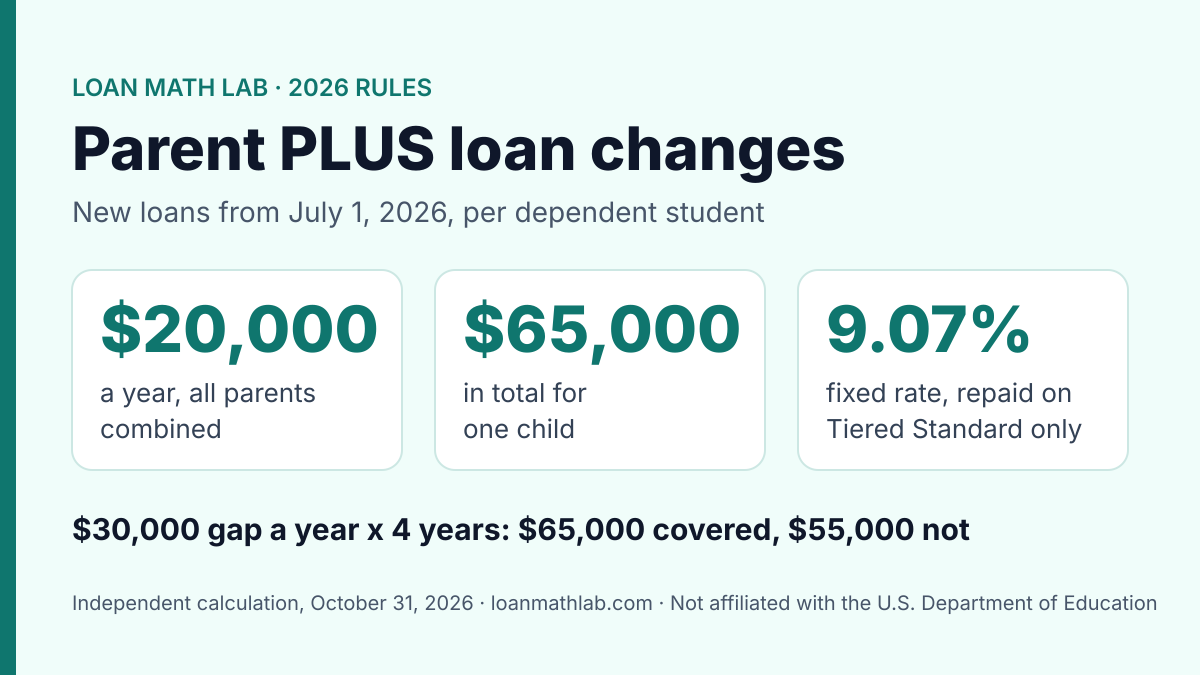
    Parents who refinance federal student loans taken out for a child have less to lose than students, because the federal side has shrunk. StudentAid.gov’s Parent PLUS page says that a parent who takes out or consolidates a parent PLUS loan after July 1, 2026 can use only the Tiered Standard plan, with no income-driven plan and no PSLF. Here is a $40,000 Parent PLUS loan at the 2026-27 rate of 9.07%, which falls in the 15-year tier:

    Monthly paymentTotal interestInterest saved
    Federal, Tiered Standard, 15 years at 9.07%$407.37$33,328–
    Refinanced at 7.5%, 10 years$474.81$16,977$16,351
    Refinanced at 7.5%, 15 years$370.80$26,746$6,582
    Our calculation in Python, November 23, 2026. The 7.5% offer is an assumption for illustration, not a lender rate.

    A parent who refinances still gives up real protections: the loan is discharged if the parent or the student dies, disability discharge applies, and the Parent PLUS borrower deferment lets payments wait while the student is in school. Parents who consolidated before July 1, 2026 may also have a route through Income-Contingent Repayment to IBR that a private loan ends. Our guide to the Parent PLUS loan changes explains who keeps it. If none of that applies and the rate gap is wide, refinancing a Parent PLUS loan can be a reasonable choice; it is still one you cannot undo.

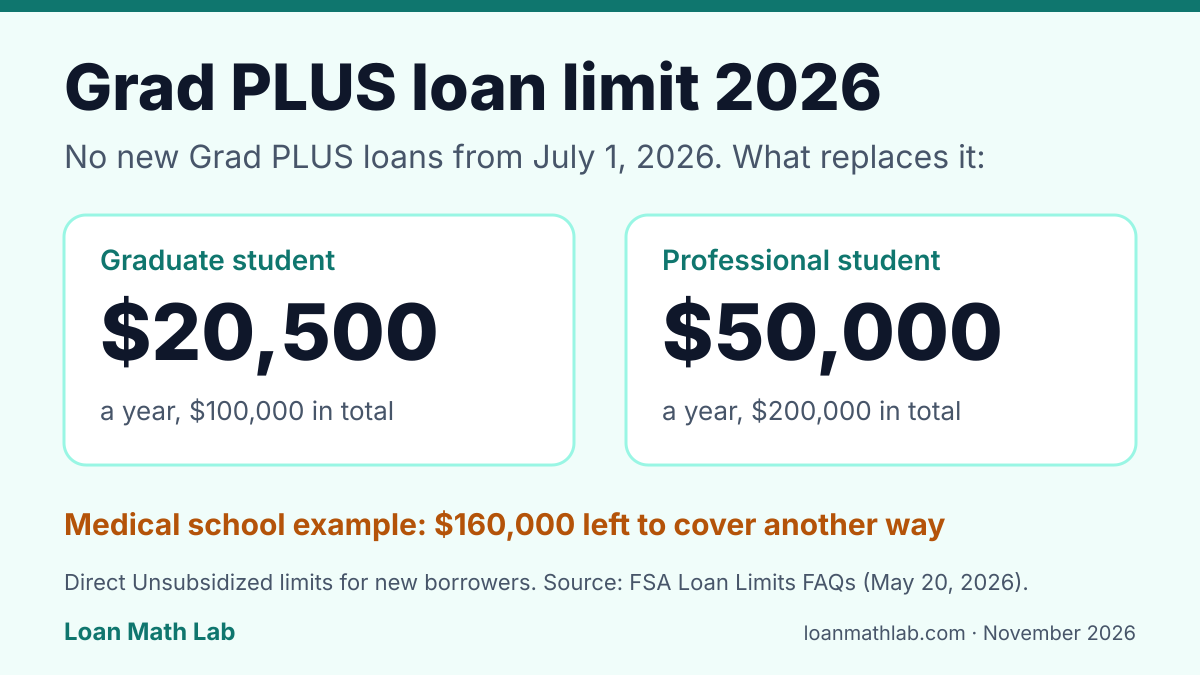
    Grad PLUS loans are a different case. Graduate borrowers keep RAP and PSLF, and those whose loans were all made before July 1, 2026 can still use IBR, so the full list of seven applies before you refinance grad PLUS loans. Our tiered standard plan guide shows the federal payment for each balance tier.

    Student loan refinance vs consolidation

    Federal Direct Consolidation LoanPrivate refinancing
    Who makes the loanThe Department of Education, through StudentAid.govA private lender
    Interest rateWeighted average of your loans, rounded up to the next one-eighth of a pointA new rate based on your credit
    Loans stay federalYesNo
    Private loans can be includedNoYes
    The 2026 catchA consolidation loan made on or after July 1, 2026 limits your Direct Loans to RAP or Tiered StandardEvery federal protection is lost
    Sources: 34 CFR 685.202 and StudentAid.gov, as explained in our consolidation guide; checked November 23, 2026.

    If what you want is one bill, consolidation keeps your loans federal but does not lower the rate. If what you want is a lower rate, you have to refinance federal student loans with a private lender, at the price above. Our student loan consolidation guide explains when a federal consolidation still pays off in 2026.

    Student loan refinance rates: what to compare them with

    We do not publish student loan refinance rates from lenders, because offers depend on your credit and change often. What you can do before you refinance federal student loans is hold each written offer against the right numbers:

    • Your own federal rate. Use the average of your loans weighted by balance. For loans first paid out in 2026-27, federal rates are 6.52% for undergraduates, 8.07% for graduate unsubsidized loans and 9.07% for PLUS loans; earlier years are in our federal student loan interest rates table.
    • Your federal rate after the autopay cut. If you are enrolled in autopay, compare against your rate minus one point until June 30, 2028.
    • A fixed rate, not a range. Advertised ranges are not offers, and a variable rate can rise above your fixed federal rate, as the CFPB warns.
    • The same term. Compare at the years you have left first. A longer term can show a lower payment and still cost more.

    Should I refinance federal student loans? Five questions first

    1. Do I work in public service, or might I in the next ten years? If yes, stop here: PSLF is worth more than any rate cut.
    2. Is my income steady enough that I will not need RAP, a deferment or a forbearance?
    3. Do I have savings that cover several months of the new payment if I lose my job?
    4. Does the offer beat my federal rate after the autopay cut, at the same term, after fees?
    5. Have I read the lender’s contract on death and disability discharge, forbearance and prepayment penalties?

    If every answer points the same way, it can make sense to refinance federal student loans, usually for borrowers with steady private-sector income and a wide rate gap. If any answer gives you pause, keep the federal loans and refinance only private loans, if you have them. To compare federal plans first, start with our student loan calculator.

    Refinance federal student loans FAQ

    Can you refinance private student loans into federal loans?

    No. StudentAid.gov says private student loans cannot be consolidated into a Direct Consolidation Loan, and there is no federal refinancing program. Private loans can only be refinanced with another private lender.

    Can I undo it if I refinance federal student loans to private?

    No. The CFPB says the change cannot be reversed. Paying the private loan off is the only way out of it.

    Can I refinance only some of my loans?

    Yes. When you refinance federal student loans, you choose which loans to include. Many borrowers refinance private loans and keep the federal ones, especially loans counting toward PSLF.

    Do I keep the student loan interest deduction?

    StudentAid.gov lists interest as possibly tax deductible for federal and private student loans alike. Whether you can take the deduction depends on your income and the IRS rules for your tax year.

    What happens to forgiveness progress I already have?

    If you refinance federal student loans, progress on those loans ends. They are paid in full, so their PSLF and income-driven repayment counts no longer lead anywhere, and buyback cannot restore them.

    Sources for this guide

    Information checked on November 23, 2026. The examples use assumed balances, rates and incomes; our How We Verify page explains how we check each figure. Rule changes are listed in our student loan changes log.

    Loan Math Lab is an independent website. It is not affiliated with the U.S. Department of Education, Federal Student Aid, any loan servicer, lender or school, and it does not list or recommend lenders. Nothing on it is financial, legal or tax advice. Read our Disclaimer.
  • PSLF Buyback 2026: How the Program Works, Who Qualifies and What It Costs

    PSLF Buyback 2026: How the Program Works, Who Qualifies and What It Costs

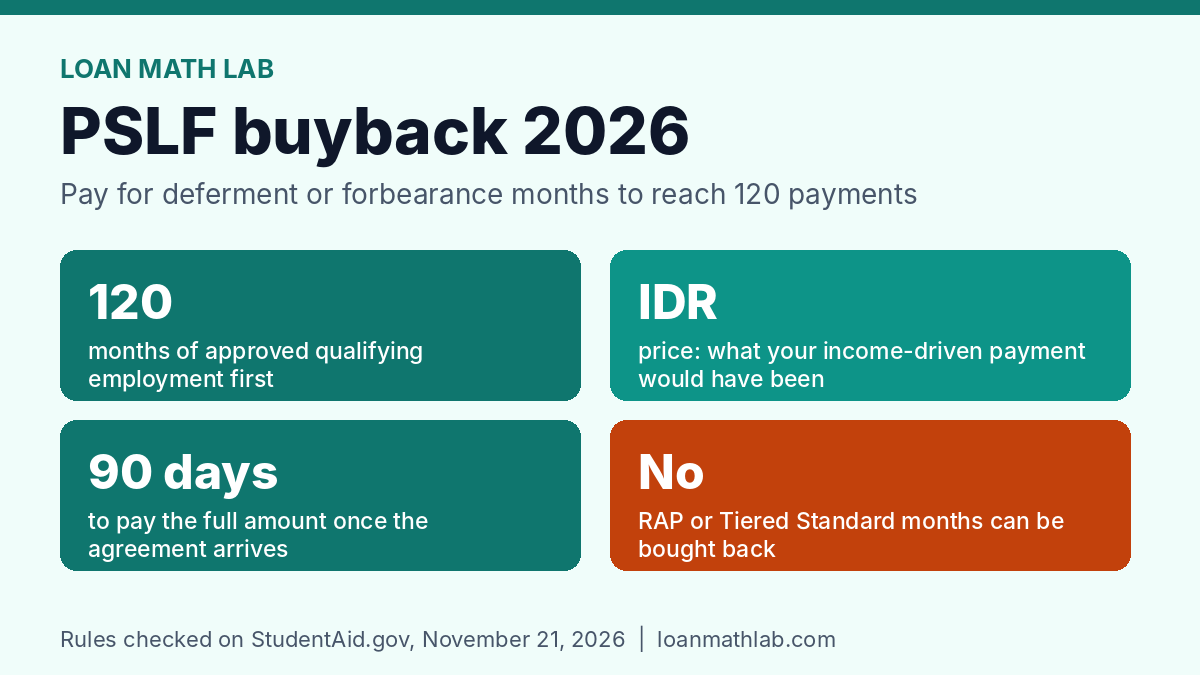
    PSLF buyback lets a public service worker pay for months spent in deferment or forbearance so that those months count toward the 120 qualifying payments needed for Public Service Loan Forgiveness. You can use it only once you already have 120 months of approved qualifying employment, and the price is roughly what your income-driven payment would have been at the time. This guide explains how PSLF buyback works under the 2026 rules, who qualifies, how the cost is calculated with worked examples, how to apply, how long the wait is and when it is worth it.

    PSLF buyback at a glance

    QuestionShort answer
    What you buyMonths in deferment or forbearance that did not count toward PSLF
    Who can request itBorrowers with at least 120 months of approved qualifying employment and a Direct Loan balance above zero
    PriceWhat your income-driven repayment (IDR) payment would have been in those months; $0 if your income was low enough
    How to request itPSLF Reconsideration on StudentAid.gov, reconsideration type “PSLF Buyback”
    Payment windowThe full amount within 90 days of the date of your buyback agreement
    Months that never qualifyMonths repaid under the Repayment Assistance Plan (RAP) or the Tiered Standard plan, plus school, grace, default, bankruptcy and disability monitoring
    Waiting timeNo official estimate; about 82,000 requests were pending in October 2026
    Sources: StudentAid.gov PSLF Buyback page and 34 CFR 685.219(g)(6), checked November 21, 2026.

    How does PSLF buyback work?

    Public Service Loan Forgiveness cancels your remaining Direct Loan balance after 120 qualifying monthly payments made while you work full time for a qualifying employer. Months when your loans were in most types of deferment or forbearance do not count, even if you were working in public service the whole time. That is the gap PSLF buyback fills.

    The rule is in the Direct Loan regulations, 34 CFR 685.219(g)(6): for a month you spent in a non-qualifying deferment or forbearance while employed full time by a qualifying employer, you can get PSLF credit by making an additional payment at least equal to what you would have paid on a qualifying plan at that time, or by showing that you would have qualified for a $0 income-driven payment. The Department of Education first called this idea “hold harmless” during rulemaking; the final rule, issued in November 2022, took effect on July 1, 2023, as Tate Law summarizes.

    In practice, the PSLF buyback program works like this. You ask the Department to review your account. It checks which deferment or forbearance months overlap your certified employment, works out the payment you would have made, and sends a PSLF Buyback Agreement with one total amount. Once your servicer receives that amount within 90 days, the bought-back months count as qualifying payments. If they take you to 120, the Department forgives the rest of your balance. You can buy back only as many months as you need to reach 120, not extra months for a refund.

    Before you request anything, count where you stand. Our PSLF calculator shows how much would be forgiven and when, from the qualifying payments you already have. For the other forgiveness routes and their dates, see our guide to federal student loan forgiveness.

    PSLF buyback eligibility: who can use it

    According to the official PSLF Buyback page on StudentAid.gov, you can request PSLF buyback only if all of these are true:

    • 120 months of employment already certified. You need at least 120 months of approved qualifying employment and no plans to certify more. The Department sets this requirement so that people do not pay for months they would never need.
    • A Direct Loan with a balance. The loan must have outstanding principal or interest above zero. Loans that are paid in full, forgiven or discharged cannot be bought back.
    • Employment in the same months. Your certified qualifying employment must cover each deferment or forbearance month you want to buy.

    You are not eligible if you only have Federal Family Education Loan (FFEL), Perkins or other non-Direct loans. You can consolidate them into a Direct Consolidation Loan to work toward PSLF, but months on the old loans cannot be bought back. Our guide to student loan consolidation explains what else a new consolidation loan changes in 2026.

    Which months you can buy back

    Loan status in that monthCan you buy it back?
    Deferment (for example, economic hardship or unemployment)Yes, if you had qualifying employment that month
    Forbearance (general, administrative or the SAVE forbearance)Yes, if you had qualifying employment that month
    Deferment or forbearance on a Direct Consolidation Loan after its first disbursementYes, on the current consolidation loan only
    In school, in grace or in originationNo
    Default or bankruptcyNo
    Total and permanent disability monitoringNo
    Repayment under RAP or Tiered StandardNo
    Months on loans later included in a consolidation loan, or before its first disbursementNo
    Source: StudentAid.gov, “Which Months Are Eligible for Buyback?”, checked November 21, 2026.

    How far back you can go depends on consolidation. Without a consolidation loan, PSLF buyback reaches back to October 2007, when Congress created PSLF. With a Direct Consolidation Loan, it starts at whichever is later: October 2007 or the earliest disbursement date of that consolidation loan.

    To find your months, log in to StudentAid.gov, select “View details” in the My Loans section, confirm the principal or interest balance is above zero, then open “View loan details” in the Loan Breakdown section to see each loan’s status history. Compare the deferment and forbearance dates with the employment periods in your PSLF tracker.

    PSLF buyback and the SAVE forbearance

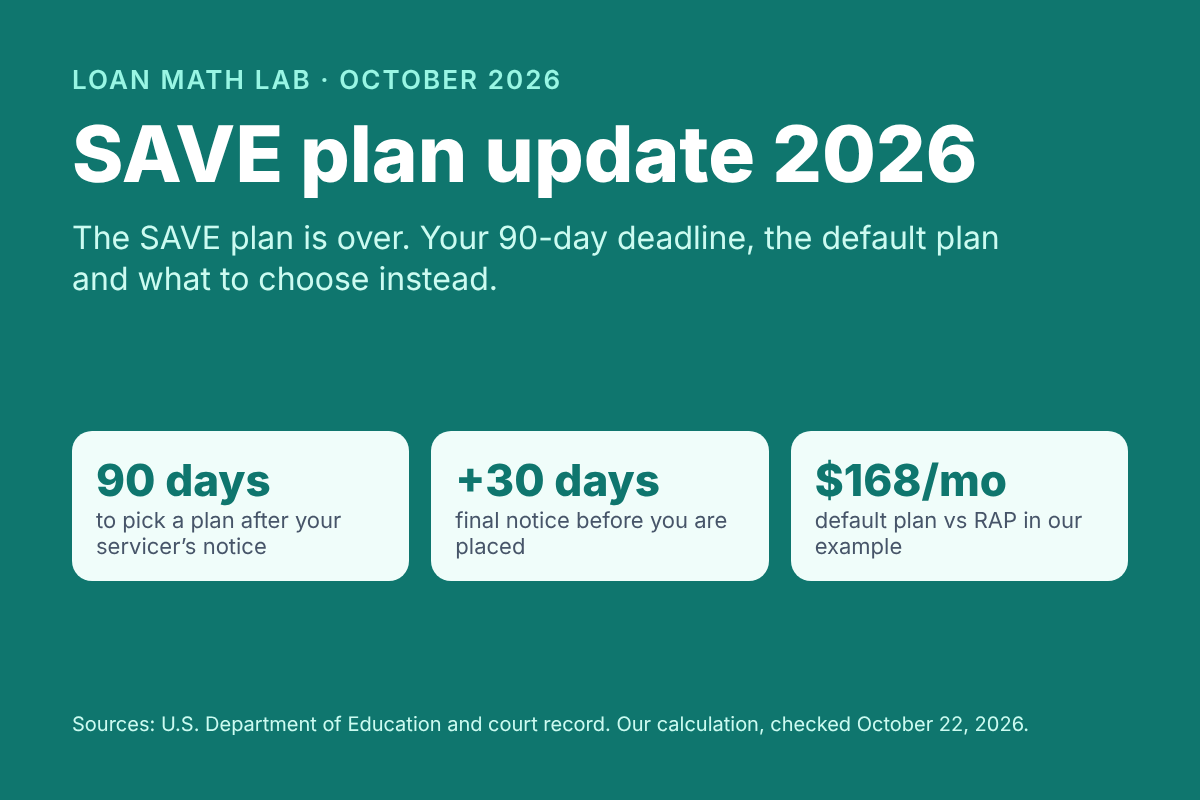
    Millions of borrowers spent months in the forbearance placed on SAVE accounts while that plan was blocked in court. Those months do not earn PSLF credit on their own, but they are forbearance months, so they can be bought back if you had qualifying employment. What changed is the price: if you were enrolled in SAVE on or after July 18, 2024, the Department uses the income-driven plan you were on immediately before SAVE to set the amount, not the SAVE formula. Because SAVE usually gave the lowest payment, the PSLF buyback cost for SAVE forbearance months can be higher than borrowers expected. If you are still sorting out your move off SAVE, read our SAVE plan update first.

    How the PSLF buyback cost is calculated

    There is no fee. The PSLF buyback cost is the payment you would likely have made during the deferment or forbearance, multiplied by the months you buy. It is based on your income and family size at that time, not today. StudentAid.gov describes three cases:

    • You were on an IDR plan right before or after, and the break was under a year. The Department uses the lower of the two monthly IDR payments, the one just before and the one just after the deferment or forbearance. If you were on SAVE on or after July 18, 2024, it uses the IDR plan you had before SAVE.
    • You were not on an IDR plan before or after. The Department asks for your tax information for each calendar year involved (or a statement that you did not have to file) and a statement of your family size. It uses the lowest IDR payment you were eligible for, or the 10-year Standard payment if that was lower.
    • You do not send the documents within 30 days. The amount is set at what you would have paid on the 10-year Standard plan, which is usually much higher than an income-driven payment.

    If your income in those months was low enough for a $0 IDR payment, the buyback is free: the Department sends a $0 agreement and moves straight to processing forgiveness.

    PSLF buyback calculator: four worked examples

    There is no official PSLF buyback calculator, because only the Department sees your full payment history. You can still estimate the amount with the same rules. These four borrowers are illustrations; the payment amounts are assumptions, and the arithmetic was checked in Python on November 21, 2026.

    BorrowerMonths boughtPayment usedPSLF buyback amount
    A: 6-month general forbearance; IDR payment $180 before and $220 after6$180 (the lower one)$1,080
    B: 10-month deferment; IDR payment $310 before and $295 after10$295$2,950
    C: 12 months, no IDR plan; sends tax returns, IDR payment works out to $24012$240$2,880
    C again, but misses the 30-day document deadline (10-year Standard on $55,000 at 6.8%)12$632.94$7,595
    D: 8 months while earning under the IDR poverty threshold8$0$0
    Loan Math Lab calculation, November 21, 2026. Payment amounts are assumptions for illustration; your agreement shows the real figure.

    Borrower C shows the costliest mistake: the same 12 months cost $4,715 more only because the paperwork arrived late. To estimate the IDR payment for a past year yourself, our IBR student loan calculator works from income and family size; enter the income and family size you had in that year.

    Parent PLUS loans and buyback

    For a parent PLUS loan that has not been consolidated, the Department uses the 10-year Standard plan to work out the equivalent payment. If the parent PLUS loan is inside a Direct Consolidation Loan, it uses the Income-Contingent Repayment (ICR) calculation, or IBR where that applies. Parent PLUS loans are not eligible for Temporary Expanded PSLF (TEPSLF).

    How to apply for PSLF buyback in 4 steps

    1. Certify all your employment. If any period of qualifying employment is not yet on your record, submit a PSLF form with the PSLF Help Tool on StudentAid.gov and wait until it is approved. You need 120 approved months before you ask.
    2. Check your months. Confirm which deferment or forbearance months you want to buy and that your approved employment covers the same months, as described above.
    3. Submit a PSLF Reconsideration request. Log in to StudentAid.gov, open PSLF Reconsideration, select “PSLF Buyback” as the reconsideration type and confirm “Yes, I have 120 months of qualifying employment.” You will get an automated email confirming the request.
    4. Pay the agreement in full within 90 days. If you qualify, the Department or your servicer sends a PSLF Buyback Agreement with the amount and payment instructions. Your servicer must receive the full amount within 90 days of the date of the agreement.

    The PSLF buyback application and form

    There is no separate PSLF buyback form or paper application. The PSLF buyback application is the online PSLF Reconsideration request, with “PSLF Buyback” selected. The PSLF form you may have heard about is a different document: it certifies employment, and you use it in step 1, before you ask for a buyback. Do not send a new PSLF form after you receive a buyback agreement, because that voids the agreement.

    If the Department asks for tax returns or a family-size statement, answer within 30 days. Keep copies of everything you send and the confirmation email.

    PSLF buyback processing time and status

    The Department has not published a PSLF buyback processing time. StudentAid.gov says each account needs an in-depth review, that you cannot check the status of your request, and that it will answer by email. Early in 2025 the guidance was 60 to 90 days; that estimate has since been withdrawn, according to The College Investor, whose readers report reviews of 20 to 24 months.

    PSLF buyback processing time: pending PSLF buyback requests rose from 83,370 in December 2025 to 89,720 in March 2026 and were about 82,000 in October 2026

    The chart uses the monthly status reports the Department filed in the court case brought by the American Federation of Teachers: 83,370 pending requests at the end of December 2025 and 88,170 at the end of February 2026, as NASFAA reported, then a peak of 89,720 in March. April was the first month on record with more decisions than new requests: 6,870 requests were processed and 6,600 approved, about 96%, according to The College Investor. In summer 2026 the Department brought in servicers to help with reviews, and about 82,000 requests were still pending in October 2026, according to a Washington Post report cited by Tate Law.

    What this means for you: plan for a wait of a year or more, keep making your regular payments, and watch your email. For questions about a buyback agreement you have received, contact your servicer if your loans are with CRI, Edfinancial, Aidvantage (Maximus) or Nelnet; if they are with MOHELA, StudentAid.gov tells you to call the Department at 1-888-303-7818.

    After approval: the 90-day payment window

    The approval letter is the PSLF Buyback Agreement, sometimes called the buyback offer letter. It states one total amount. You do not have to pay it as a single lump sum: StudentAid.gov allows several payments to your servicer, as long as the full amount arrives within 90 days of the date on the agreement. Your regular monthly bill still has to be paid on top of it.

    The agreement becomes void, and you have to start over, if any of these happens after it is sent:

    • the full amount is not received within 90 days;
    • you submit a PSLF form;
    • you pay off the loan, or apply for or complete a consolidation;
    • the loan is discharged or forgiven for any other reason.

    Money paid toward a voided agreement is not refunded; it is credited as regular payments on your loan. If you pay more than the agreement amount, the extra goes first to your other federal loans, and you get a refund only if you have no other outstanding loans.

    Is PSLF buyback worth it? Buy back or keep paying

    PSLF buyback is usually cheaper than the months it replaces, because the price is an old income-driven payment and the reward is the rest of your balance. The real question is timing. While a request waits, your normal payments keep counting toward PSLF, and you can buy back only the months you still need. So the closer you are to 120, the less buyback matters. Three typical cases (illustrations, calculated November 21, 2026):

    SituationBuybackKeep paying insteadWhat usually makes sense
    111 payments counted, 9 forbearance months at $180, current payment $260$1,620, after a wait that may exceed 9 months9 payments of $260 = $2,340, done in 9 monthsKeep paying; you will likely reach 120 before a decision
    84 payments counted, 36 forbearance months at $150, current payment $300$5,40036 payments of $300 = $10,800 over 3 yearsRequest buyback now and keep paying while you wait
    Left public service after 120 months of employment; 100 payments counted, 20 months of hardship deferment at a $0 IDR payment$0Not possible: new payments no longer qualifyBuyback is the only route to forgiveness
    Loan Math Lab calculation, November 21, 2026. Payment amounts are assumptions for illustration.

    Two more checks before you decide. First, the PSLF buyback cost is fixed by the past, so a lower payment today does not lower it. Second, if you are now on RAP or have a loan made on or after July 1, 2026, your future months on RAP or Tiered Standard can never be bought back, so any gap from now on has to be closed with real payments. Our guide to the Repayment Assistance Plan explains how RAP months count toward PSLF, and the tiered standard plan guide explains why Tiered Standard months do not count at all.

    PSLF buyback program changes in 2026

    The PSLF buyback program is still open in 2026, but two changes narrowed it:

    • March 31, 2026: SAVE no longer sets the price. For borrowers enrolled in SAVE on or after July 18, 2024, the amount is based on the IDR plan they had before SAVE, as StudentAid.gov now states; Tate Law dates the change to March 31, 2026. SAVE forbearance months remain eligible.
    • July 1, 2026: RAP and Tiered Standard months excluded. The regulation, as amended on May 1, 2026, excludes repayment periods under RAP, and StudentAid.gov also excludes months under Tiered Standard. A borrower whose loans are all on these two plans has nothing left to buy back for those months.

    Buyback exists by regulation, not by statute, so a future rule could change it. No proposal to end it had been published when we checked on November 21, 2026. Every rule change we track is listed with its date in our student loan changes log.

    PSLF buyback FAQ

    Is there a PSLF buyback deadline?

    There is no deadline to request it. The two deadlines are the 30 days to send any tax or family-size documents the Department asks for, and the 90 days to pay once your agreement is dated.

    Is PSLF buyback forgiveness taxable?

    No, not federally. StudentAid.gov notes that, according to the IRS, amounts forgiven under PSLF or TEPSLF are not income for federal tax purposes, and that includes forgiveness reached through buyback. Check your state rules with a tax advisor.

    Can I get a PSLF buyback refund?

    Only in a narrow case. You cannot buy back earlier months to turn later payments into a refund, because buyback covers only the months you need for forgiveness. If you overpay an agreement, you get money back only when you have no other outstanding loans.

    Can I use buyback if I left public service?

    Yes, if you were employed by a qualifying employer in the month that becomes your 120th payment and your loan still has a balance.

    Can I consolidate after buyback?

    Yes, StudentAid.gov allows it. But applying to consolidate after an agreement has been sent and before you pay voids that agreement, and a new consolidation loan made on or after July 1, 2026 can be repaid only under RAP or Tiered Standard.

    Sources for this PSLF buyback guide

    Information checked on November 21, 2026. Worked examples use assumed payment amounts; our How We Verify page explains how we check each figure.

    Loan Math Lab is an independent website. It is not affiliated with the U.S. Department of Education, Federal Student Aid, any loan servicer, lender or school, and nothing on it is financial, legal or tax advice. Read our Disclaimer.
  • Tiered Standard Repayment Plan 2026: Terms by Balance, Payments and Who Gets It

    Tiered Standard Repayment Plan 2026: Terms by Balance, Payments and Who Gets It

    The Tiered Standard plan is the fixed-payment federal student loan plan created for loans made on or after July 1, 2026: you pay the same amount every month, and the length of the plan, from 10 to 25 years, depends on how much you owe in Direct Loans when you start. It replaced the old 10-year Standard plan for new loans, and it is the plan your servicer uses if you do not pick one.

    This guide explains who is on the Tiered Standard repayment plan, how the term is set, what it costs at each balance, how it compares with RAP and the old Standard plan, and why it does not help with Public Service Loan Forgiveness. We opened every official page cited here on November 19, 2026. For every rule change of 2026 in one place, see our student loan changes log.

    Tiered Standard plan at a glance

    QuestionShort answer in 2026
    Who gets itAnyone with a Direct Loan first disbursed on or after July 1, 2026, and any Direct Loan borrower who chooses it
    PaymentFixed every month, at least $50
    How long10, 15, 20 or 25 years, set by your total Direct Loan balance
    Default plan?Yes. If you do not choose, your servicer places you on it
    Parent PLUS loansThe only plan open to them
    Counts for PSLF?No, not for PSLF or TEPSLF
    Prepay without penalty?Yes, at any time
    Sources: StudentAid.gov, One Big Beautiful Bill Act definitions, 34 CFR 685.208(c) and 34 CFR 685.211(a), read November 19, 2026.

    In one line: the Tiered Standard plan is simple and finishes on a fixed date, but a bigger balance buys a longer term, and a longer term means more interest.

    What is the Tiered Standard repayment plan?

    The Tiered Standard repayment plan comes from the One Big Beautiful Bill Act of 2025 and is written into federal regulation at 34 CFR 685.208(c). Like any standard plan, it divides your loan into equal monthly payments that pay off the principal and the interest by the end of the term. What is new is the tier: instead of one 10-year term for everyone, the term grows with your debt.

    According to StudentAid.gov, three things set your payment on the Tiered Standard plan: the principal balance you owe when you enter the plan, the interest rate on your loans, and the length of the repayment period. Your income plays no part. That is the main difference from the Repayment Assistance Plan (RAP), the other plan for new loans, where the payment follows your adjusted gross income.

    One detail can confuse you. A summary line on the StudentAid.gov repayment plans page calls it a 10-year fixed plan, while the same page’s comparison table and the regulation give 10 to 25 years depending on the amount borrowed. The 10-year figure is only right for balances under $25,000. We follow the regulation.

    Who is on the Tiered Standard plan?

    The rules on who uses the Tiered Standard plan are short, but each one has consequences:

    • New loans. Direct Loans first disbursed on or after July 1, 2026 can be repaid only under RAP or the Tiered Standard plan. The old Standard, Graduated and Extended plans are closed to them, according to the Standard plan page.
    • One new loan changes all your loans. StudentAid.gov says that if you have a single loan, including a Direct Consolidation Loan, first disbursed on or after July 1, 2026, your only choices for all your Direct Loans are RAP and Tiered Standard, older loans included. Going back to school for one more term can close IBR and the 10-year Standard plan for your undergraduate loans.
    • Everyone else can opt in. All Direct Loan borrowers have access to this plan, even with loans made before July 2026.
    • The default plan. You can be put on this plan without choosing it, when you enter or return to repayment without picking a plan, or when you must leave a plan and your loan type fits only this one.
    • Not for older loan programs. FFEL, Perkins and HEAL loans cannot be repaid under RAP or Tiered Standard. They stay on the older plans they qualify for, while your Direct Loans can use the new ones.

    Tiered standard repayment plan for Parent PLUS loans

    For parents, the Tiered Standard repayment plan is not one choice among several: it is the only one. StudentAid.gov lists three loan types that can be repaid only under the Tiered Standard plan: Direct PLUS Loans for parents, Direct Consolidation Loans that paid off a parent PLUS loan, and double consolidations. If a parent also has loans for their own education, those can go on the same plan or separately on RAP.

    An example at the 2026-27 Parent PLUS rate of 9.07%: a parent who owes $40,000 lands in the 15-year tier and pays $407.37 a month, with about $33,328 of interest over the life of the loan. Our Parent PLUS loan changes guide covers the new borrowing limits, and the Parent PLUS loan calculator works out the payment from your own figures.

    How long is the Tiered Standard plan? Terms by balance

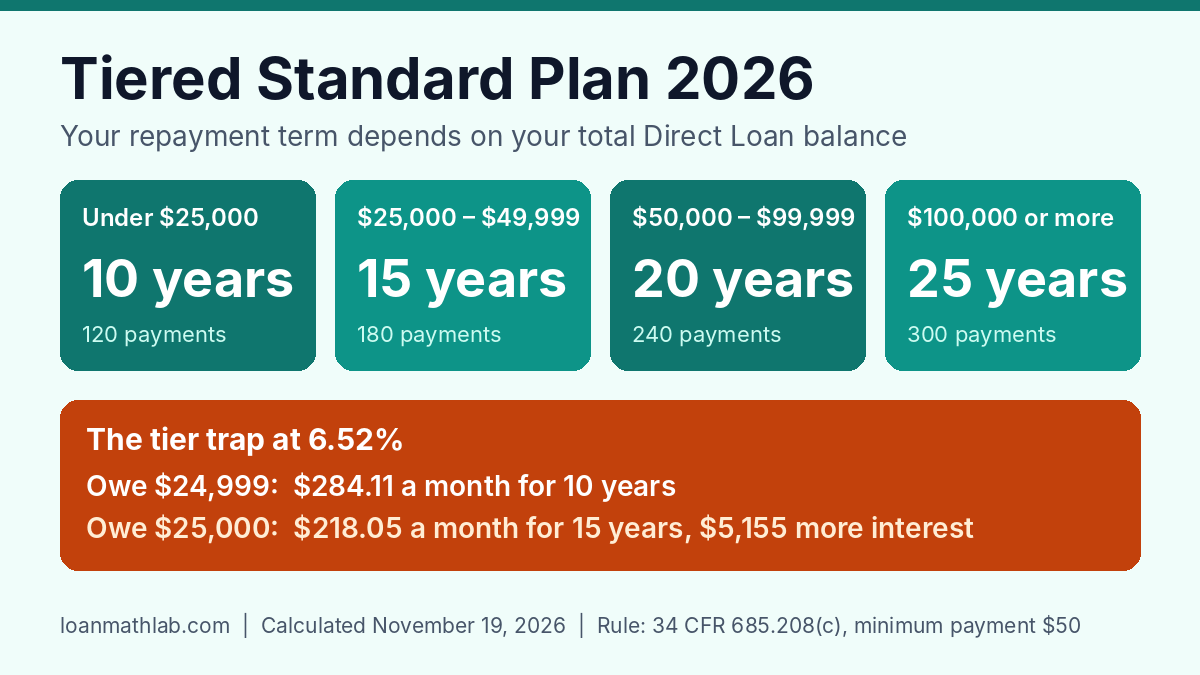
    How long the Tiered Standard plan lasts depends only on the total of your Direct Loans when you enter repayment. These are the four tiers in 34 CFR 685.208(c):

    Total Direct Loan balanceMaximum termNumber of payments
    Less than $25,00010 years120
    $25,000 to $49,99915 years180
    $50,000 to $99,99920 years240
    $100,000 or more25 years300
    Source: 34 CFR 685.208(c) and StudentAid.gov, Tiered Standard Plan definition, read November 19, 2026.

    Three rules sit behind the table. The tier uses the total of all your Direct Loans, not each loan on its own. Months in deferment or forbearance do not count toward the term, so a pause pushes the end date back. And if you add loans to the plan later, or leave it and come back, StudentAid.gov says your maximum term is recalculated on your total outstanding principal at that moment.

    Here is how that last rule plays out. Say you still owe $18,000 on a 10-year Tiered Standard plan, go back to school and borrow $10,000 more. When you re-enter repayment with $28,000, you move to the 15-year tier from that date: at 6.52% the new payment is $244.22 a month for 15 more years.

    Tiered standard plan minimum payment

    The Tiered Standard plan minimum payment is $50 a month. The only exception is a balance under $50, where you pay what is left. On a small loan the minimum can beat the formula: $4,000 at 6.52% over 10 years works out to $45.46, so you pay $50 instead and finish after 106 payments, about 8 years and 10 months, for $5,263 in total.

    Tiered standard plan calculator: payments by balance

    If you came looking for a tiered standard plan calculator, the table below gives the answer for common balances at the three fixed rates for loans first disbursed between July 1, 2026 and June 30, 2027: 6.52% for undergraduates, 8.07% for graduate Direct Unsubsidized Loans and 9.07% for PLUS loans.

    BalanceTerm6.52% undergraduate8.07% graduate9.07% PLUS
    $10,00010 years$113.65
    $3,638 interest
    $121.70
    $4,604 interest
    $127.05
    $5,247 interest
    $20,00010 years$227.30
    $7,276 interest
    $243.40
    $9,207 interest
    $254.11
    $10,493 interest
    $24,99910 years$284.11
    $9,095 interest
    $304.23
    $11,509 interest
    $317.62
    $13,116 interest
    $25,00015 years$218.05
    $14,250 interest
    $239.92
    $18,187 interest
    $254.61
    $20,829 interest
    $40,00015 years$348.88
    $22,799 interest
    $383.88
    $29,098 interest
    $407.37
    $33,328 interest
    $49,99915 years$436.09
    $28,499 interest
    $479.84
    $36,372 interest
    $509.21
    $41,658 interest
    $50,00020 years$373.38
    $39,609 interest
    $420.40
    $50,896 interest
    $452.12
    $58,507 interest
    $80,00020 years$597.40
    $63,376 interest
    $672.64
    $81,435 interest
    $723.39
    $93,611 interest
    $99,99920 years$746.74
    $79,220 interest
    $840.79
    $101,793 interest
    $904.22
    $117,016 interest
    $100,00025 years$676.46
    $102,936 interest
    $776.46
    $132,937 interest
    $844.00
    $153,195 interest
    $150,00025 years$1,014.69
    $154,404 interest
    $1,164.69
    $199,406 interest
    $1,265.99
    $229,800 interest
    Our calculation in Python, November 19, 2026: fixed payment, interest at one twelfth of the yearly rate, payment rounded to the cent, last payment adjusted. Rates from the Federal Student Aid announcement of June 4, 2026; see our federal student loan interest rates table.
    Tiered standard plan 2026: monthly payment by balance at 6.52%, with the term rising from 10 to 15, 20 and 25 years at $25,000, $50,000 and $100,000

    The chart shows the shape of the plan: the payment climbs with the balance, then drops each time a new tier starts, because the same debt is spread over five more years. If you have loans at different rates or want to see the effect of paying extra, our student loan payment calculator lets you pick the Tiered Standard term, and the student loan calculator on our home page compares it with RAP and IBR side by side. This tiered standard repayment plan calculator table is a fixed snapshot; those tools use your own numbers.

    The tier line: a few dollars can add five years

    The most surprising feature of the Tiered Standard plan is what happens right at each threshold. One dollar more in debt can lower your monthly payment and add thousands in interest:

    BalanceTermMonthly paymentTotal interestExtra interest
    $24,999 / $25,00010 / 15 years$284.11 / $218.05$9,095 / $14,250$5,155
    $49,999 / $50,00015 / 20 years$436.09 / $373.38$28,499 / $39,609$11,110
    $99,999 / $100,00020 / 25 years$746.74 / $676.46$79,220 / $102,936$23,716
    Our calculation in Python at 6.52%, November 19, 2026.

    At the first line, owing $25,000 instead of $24,999 cuts the payment by $66.06 a month but adds 60 payments and about $5,155 of interest. The longer term is a maximum, not an obligation. Under 34 CFR 685.211(a)(2), you can prepay all or part of a federal loan at any time without penalty.

    So a borrower who lands just over a line has two ways to keep the shorter payoff. Before entering repayment, paying the balance below the threshold, for example during the grace period, puts you in the lower tier with a fixed shorter term. Or you can stay in the longer tier and pay more each month by choice: $25,000 at 6.52% paid at $284.11 a month instead of $218.05 is gone in 10 years and 1 month, with about $9,096 of interest, almost the same as the 10-year tier. The second way keeps the lower required payment as a safety net if money gets tight.

    One practical point: if an extra payment equals or exceeds your monthly amount, the same rule says the servicer moves your next due date forward unless you ask otherwise. If you want the extra money to cut principal and still pay next month, tell your servicer.

    Tiered standard vs standard repayment plan

    The comparison of Tiered Standard vs Standard repayment plan matters only to borrowers who still have a choice: people whose Direct Loans were all made before July 1, 2026 and who take no new loan. For them, the 10-year Standard plan stays open under 34 CFR 685.208(b), and the Tiered Standard plan is optional. Here is the same balance on both, at 6.52%:

    BalanceStandardTiered StandardInterest, StandardInterest, TieredExtra cost
    $30,000$340.95, 10 years$261.66, 15 years$10,914$17,100$6,186
    $40,000$454.60, 10 years$348.88, 15 years$14,552$22,799$8,248
    $60,000$681.90, 10 years$448.05, 20 years$21,828$47,532$25,704
    Our calculation in Python, November 19, 2026. Same method as the table above.

    Under $25,000 the two plans give the same result. Above it, the Tiered Standard plan lowers the payment, by about $79 a month on $30,000, and costs more in total, about $6,186 on the same loan. If the higher Standard payment fits your budget, it is the cheaper of the two. If it does not, compare the Tiered Standard plan with an income-driven plan before choosing.

    Tiered standard vs RAP: which costs less each month?

    Tiered standard vs RAP is the real choice for most borrowers with new loans. RAP charges 1% to 10% of your adjusted gross income, depending on your income bracket, minus $50 a month for each dependent, with a $10 minimum. Our guide to the Repayment Assistance Plan explains the full rules. Here is the first-year payment for a single borrower with no dependents who owes $30,000 at 6.52%:

    AGIRAP rateRAP paymentTiered Standard, 15 yearsLower payment
    $30,0002%$50.00$261.66RAP
    $40,0003%$100.00$261.66RAP
    $50,0004%$166.67$261.66RAP
    $60,0005%$250.00$261.66RAP
    $75,0007%$437.50$261.66Tiered Standard
    Our calculation in Python, November 19, 2026, with the RAP rules used in our RAP calculator (34 CFR 685.209). Payments are for the first year only; RAP payments change with income every year.

    In this example RAP gives the lower payment up to $60,000 of income, and Tiered Standard wins above that. But the monthly payment is only part of the picture:

    • RAP follows your income. The payment is recalculated every year, so a raise raises it. A Tiered Standard payment never changes.
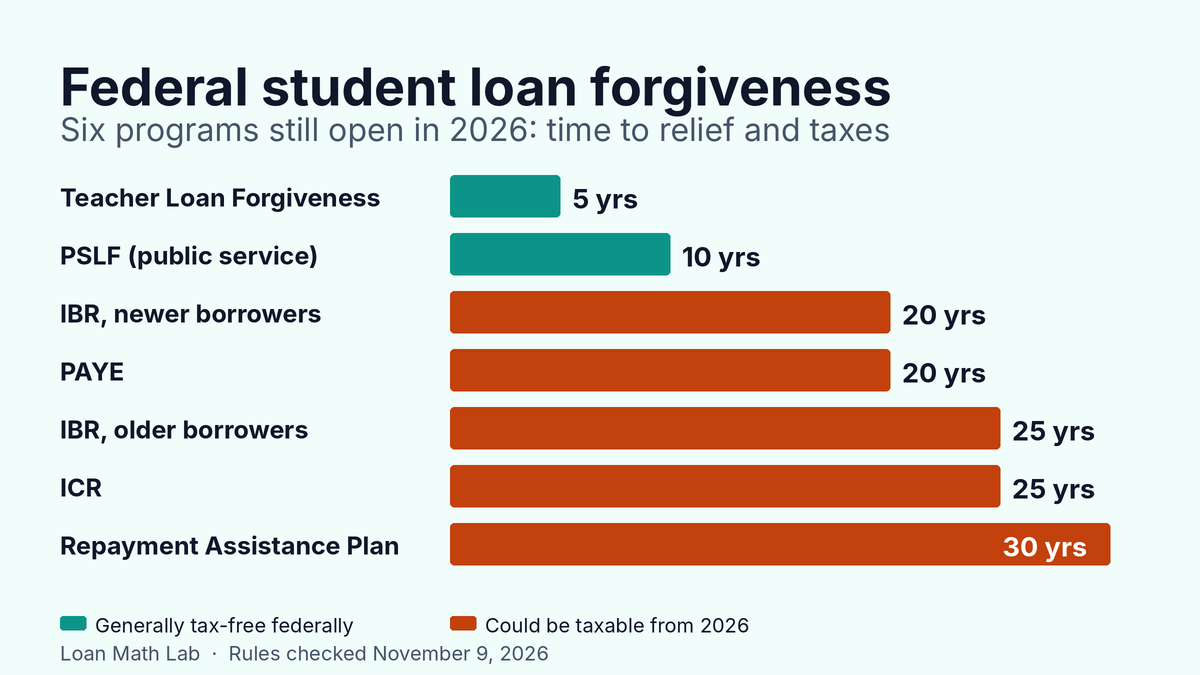
    • RAP can last 30 years. Any balance left after 360 qualifying payments is forgiven, and that forgiveness may be taxable. Tiered Standard ends on a fixed date with the loan paid in full.
    • RAP counts for PSLF. Tiered Standard does not (see below).
    • Parents have no choice. Parent PLUS loans can use only the Tiered Standard plan.

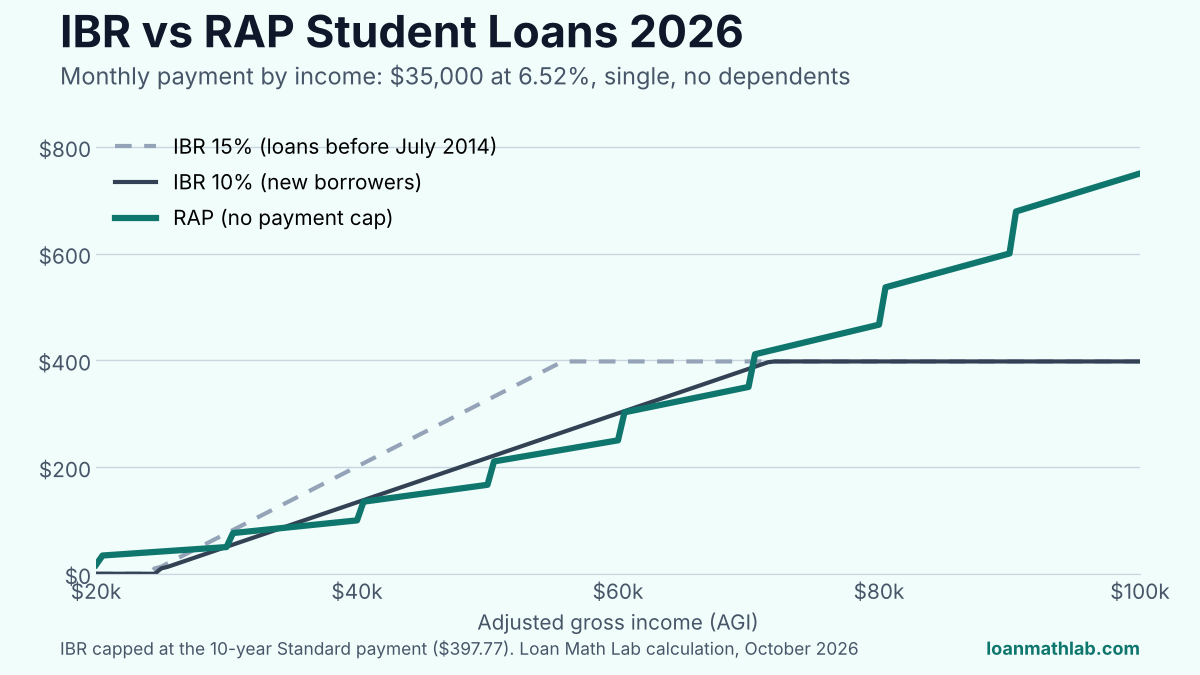
    To run your own numbers, use our RAP student loan calculator for RAP over the full term, and compare it with the Tiered Standard figure above. If you also have older loans that still qualify for IBR, our IBR vs RAP student loans guide shows where each plan wins.

    Tiered Standard plan and PSLF

    This is the rule public-service workers need to know. StudentAid.gov states that payments made while enrolled in the Tiered Standard plan are not qualifying payments for Public Service Loan Forgiveness or for Temporary Expanded PSLF. Ten years of payments on this plan would bring you no closer to PSLF.

    If you work for a government or nonprofit employer and plan to use PSLF, choose RAP, or IBR if your loans still qualify, from your first payment. Our PSLF calculator estimates how much PSLF could cancel on each plan, and our guide to federal student loan forgiveness covers the other programs.

    How to choose or leave the Tiered Standard plan

    1. Check your loans. Log in to StudentAid.gov and note the type, balance, rate and first disbursement date of each loan. Any loan first disbursed on or after July 1, 2026 limits all your Direct Loans to RAP and Tiered Standard.
    2. Add up your Direct Loans. The total decides your tier. If you are just over $25,000, $50,000 or $100,000, decide whether to pay it down before you enter repayment.
    3. Compare the plans. Use the official Repayment Calculator or our calculators to see your Tiered Standard payment next to RAP.
    4. Tell your servicer. Fixed-payment plans are chosen through your loan servicer. If you say nothing, you will be placed on the Tiered Standard plan.
    5. Set up autopay. Autopay cuts your rate by 1 percentage point through June 30, 2028 if you enroll with your servicer by December 31, 2026, as our interest rates page explains. A lower rate means less of each payment goes to interest.

    Thinking of consolidating to change plans? A Direct Consolidation Loan made now counts as a new loan, which leaves you only RAP and Tiered Standard for all your Direct Loans. Our student loan consolidation guide explains when that still makes sense.

    Tiered Standard plan FAQ

    Is the Tiered Standard plan always 10 years?

    No. It is 10 years only when your total Direct Loans are under $25,000. From $25,000 it is 15 years, from $50,000 it is 20 years and from $100,000 it is 25 years, under 34 CFR 685.208(c).

    What is the new standard repayment plan for 2026?

    The new standard repayment plan for loans made from July 1, 2026 is the Tiered Standard plan. The old 10-year Standard plan still exists, but only for borrowers who have not received a Direct Loan on or after that date.

    Can I switch from the Tiered Standard plan to RAP?

    Loans that are eligible for RAP can be repaid under RAP instead; ask your servicer to change your plan. Parent PLUS loans and consolidation loans that repaid them cannot move to RAP: Tiered Standard is their only option.

    Does the Tiered Standard plan forgive anything?

    No. The plan is built to pay the loan in full by the end of the term, so nothing is left to forgive, and its payments do not count toward PSLF or income-driven forgiveness.

    Are Tiered Standard payments ever lower than $50?

    Only when the balance itself is under $50, in which case you pay what is left. Otherwise the required payment is at least $50 a month.

    Sources for this Tiered Standard plan guide

    This Tiered Standard plan guide is general information, not financial or legal advice. Your loan servicer and the U.S. Department of Education decide your plan, term and payment, and rules can change. Loan Math Lab is not affiliated with the U.S. Department of Education. See our How We Verify page and Disclaimer. Information checked on November 19, 2026.

  • Student Loan Default 2026: What Happens, Wage Garnishment and How to Get Out

    Student Loan Default 2026: What Happens, Wage Garnishment and How to Get Out

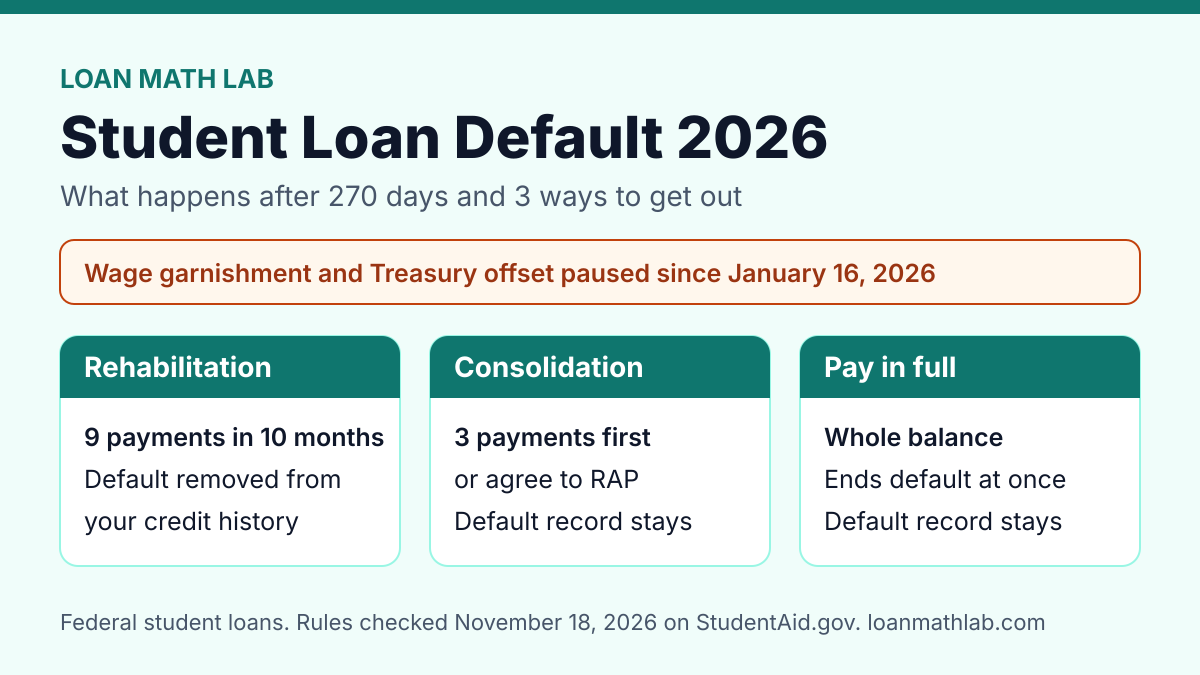
    Student loan default is what happens when a federal student loan goes unpaid for at least 270 days: the whole balance becomes due at once and the government can collect without going to court. In 2026 two things are unusual. The Department of Education paused wage garnishment and tax refund seizures on January 16, 2026, and the Treasury Department has taken over the work of collecting defaulted loans.

    This student loan default guide explains what happens if you default on student loans, how much can be taken from a paycheck or a Social Security check when collections restart, and the three ways to get your loans out of default. We opened every official page cited here on November 18, 2026. It covers federal student loans only; private loans follow your loan contract and state law. For every rule change this year, see our student loan changes log.

    Student loan default at a glance

    QuestionShort answer in November 2026
    When a Direct or FFEL loan defaultsAfter at least 270 days without scheduled payments
    What becomes dueThe entire unpaid balance and interest (“acceleration”)
    Wage garnishmentUp to 15% of disposable pay, without a court order. Paused since January 16, 2026
    Treasury offsetTax refunds and some federal benefits. Also paused since January 16, 2026
    Ways outRehabilitation, consolidation or paying in full
    Rehabilitation paymentBased on income, as low as $5 a month (a $10 minimum from July 1, 2027)
    Who to call about a student loan defaultDefault support, 1-800-621-3115 (TTY 1-877-825-9923)
    Sources: StudentAid.gov, Student Loan Delinquency and Default, Collections on Defaulted Loans and Getting Out of Default, read November 18, 2026.

    In one line: a paused collection is not a cancelled one. Student loan default still damages your credit, still blocks new federal aid and still adds collection costs, and the government can switch garnishment and offset back on after sending the required notices.

    What happens if you default on student loans

    Student loan default does not happen the day you miss a payment. It builds in stages, and each stage has its own consequence. The timeline below is for loans in the Direct Loan and FFEL programs; a Perkins Loan can be declared in default as soon as you miss a payment.

    Days past dueWhat happens
    Day 1The loan is delinquent. Your servicer can still put you on another plan, a deferment or a forbearance
    Day 90The servicer reports the delinquency to the national credit bureaus
    Day 270The loan is in default: the balance is accelerated and you lose deferment, forbearance and the choice of a plan
    Day 360 and laterThe loan moves to the Default Resolution Group, the servicer for defaulted federal loans
    Based on StudentAid.gov, Student Loan Delinquency and Default, read November 18, 2026.

    Once a loan is in student loan default, StudentAid.gov lists these consequences:

    • Acceleration. The full balance and interest are due immediately.
    • Treasury offset. Federal and state tax refunds and some federal benefit payments can be kept and applied to the loan.
    • Wage garnishment. Your employer can be ordered to send part of your pay to the government.
    • No more federal aid. You lose eligibility for Pell Grants and new federal student loans until the default is resolved.
    • Credit damage. The default is reported to the credit bureaus and can stay visible for years.
    • Costs and court. You can be charged collection fees, court costs and attorney fees, and the loan holder can sue you.
    • Transcripts. Your school may withhold your official transcript, though it must give you an unofficial one on request.

    The best time to act is before day 270, when student loan default begins. If you are behind but not yet in default, an income-driven plan can bring the payment down a lot: our RAP student loan calculator and IBR student loan calculator show what you would pay on each plan.

    Student loan collections in 2026: what is paused and what is not

    On January 16, 2026, the Department of Education announced a delay of involuntary collections, naming Administrative Wage Garnishment and the Treasury Offset Program, so that it could put the new repayment rules in place first. It gave no restart date.

    As of November 18, 2026, the official collections page on StudentAid.gov still says that collections through Treasury offset and Administrative Wage Garnishment are paused, and that tax refunds are not being withheld for defaulted federal student loans. Two other changes matter:

    • Treasury now runs default collections. Under an agreement announced on March 19, 2026, Treasury’s Bureau of the Fiscal Service took over operational responsibility for collecting defaulted federal student loans. The loans still belong to the Department of Education.
    • There is a new online portal. On September 30, 2026, Treasury and the Department of Education launched the Defaulted Loans Support Center on StudentAid.gov, where you can apply online to rehabilitate or consolidate a defaulted loan and make payments.

    A paused collection does not end a student loan default. What the pause does not stop: the default itself, interest, credit reporting and the loss of federal aid. No official restart date has been published. If garnishment or offset restarts, you will first get a written notice with a deadline, as described below. We will add any restart date to our changes log the day it is announced.

    Student loan wage garnishment

    Student loan wage garnishment is the government’s power, after a student loan default, to make your employer withhold part of your pay without suing you first. For federal student loans this is called administrative wage garnishment. StudentAid.gov says the loan holder can order your employer to withhold up to 15% of your disposable pay, and the withholding continues until the loan is paid in full or out of default. Disposable pay is what is left after taxes and other deductions the law requires.

    There is also a floor. Under 34 CFR 34.19, the employer withholds the smaller of the amount in the order or the amount by which your disposable pay exceeds 30 times the federal minimum wage. With the minimum wage at $7.25 an hour, that floor is $217.50 a week, $435 every two weeks, $471.25 twice a month or $942.50 a month.

    How much can student loans garnish?

    Here is how much can be garnished from a paycheck paid every two weeks, at five levels of disposable pay. The rule takes the smaller of 15% and the amount above $435.

    Disposable pay every two weeks15% of payPay above the $435 floorGarnished per paycheckGarnished per year (26 paychecks)
    $500$75.00$65.00$65.00$1,690
    $800$120.00$365.00$120.00$3,120
    $1,200$180.00$765.00$180.00$4,680
    $1,600$240.00$1,165.00$240.00$6,240
    $2,500$375.00$2,065.00$375.00$9,750
    Student loan default garnishment examples: our calculation in Python, November 18, 2026, from 34 CFR 34.19 and the 15% limit on StudentAid.gov. Pay levels are examples. A partial garnishment can be lower if a hearing finds financial hardship.
    Student loan default wage garnishment 2026: the most that can be taken from a biweekly paycheck is $65 at $500 of disposable pay, $120 at $800, $180 at $1,200, $240 at $1,600 and $375 at $2,500

    Below about $512 of disposable pay every two weeks, the floor is the limit, so less than 15% is taken. At $435 or less, nothing can be taken. Above that point the 15% cap decides. If you were searching for a student loan wage garnishment calculator, this table is the whole formula: multiply your disposable pay by 0.15, subtract the floor for your pay period from your disposable pay, and the smaller number is the most an order can take.

    How to stop student loan wage garnishment

    Garnishment starts with a letter, not with a smaller paycheck. StudentAid.gov says you must be sent a notice 30 days before the order goes to your employer, explaining the debt and your rights. You then have four ways to stop or end it:

    1. Agree on a repayment plan within 30 days. If the government receives your first payment under an agreed repayment arrangement no later than 30 days after the notice was sent, the garnishment is avoided.
    2. Ask for a hearing in writing within 30 days. A request postmarked within 30 days of the notice holds the garnishment until a decision is made, usually within about 60 days. You can object that you do not owe the debt or the amount, that 15% would cause extreme financial hardship, or that you went back to work less than 12 months after an involuntary job loss.
    3. Start rehabilitation. Under 34 CFR 685.211(f), the garnishment order is withdrawn after your fifth rehabilitation payment, unless you ask otherwise. Until July 1, 2027 you can get this benefit once per loan; from then on, twice.
    4. Leave default another way. Paying in full or consolidating ends the garnishment, but you cannot consolidate a loan while a garnishment order is in force unless the order is lifted first.

    Your employer cannot fire you, refuse to hire you or discipline you because of a student loan garnishment, and it may only receive the information it needs to make the deduction.

    Treasury Offset Program and student loans

    The Treasury Offset Program is the second way the government collects student loan default without a court. It intercepts federal payments due to you and applies them to the loan. Before an offset starts, a notice of intent is sent to your last known address, and you have 65 days to act.

    Student loan tax refund offset

    In a student loan default, StudentAid.gov says offset can take all or part of a federal or state tax refund and apply it to the defaulted loan. Within the 65 days on the notice you can avoid the offset by starting a payment arrangement, starting rehabilitation, sending a signed consolidation application, paying in full, or filing a written objection with the Default Resolution Group. If you ask for copies of your loan documents within 20 days, you get 15 more days after they are mailed to request a review.

    Can student loans garnish Social Security?

    Yes, part of it, if you are in student loan default, through Treasury offset rather than garnishment. Under 31 CFR 285.4, the amount taken from a monthly Social Security benefit is the smallest of the debt, 15% of the benefit, or the amount above $750. Supplemental Security Income (SSI) cannot be offset.

    Monthly Social Security benefit15% of benefitAmount above $750Monthly offset
    $650$97.50$0$0
    $850$127.50$100.00$100.00
    $1,250$187.50$500.00$187.50
    $1,900$285.00$1,150.00$285.00
    Our calculation, November 18, 2026, from 31 CFR 285.4(e). Benefit amounts are examples.

    If your Social Security disability benefit is being offset and the Social Security Administration finds you totally disabled with no expected improvement, StudentAid.gov says the offset is suspended. Discharge programs, including Total and Permanent Disability discharge, are covered in our guide to federal student loan forgiveness.

    How to get student loans out of default

    There are three ways out of student loan default, and they do not give you the same result. Rehabilitation takes longer but cleans up your credit report; consolidation is faster but leaves the default on your record.

    RehabilitationConsolidationPay in full
    What you do9 payments within 10 months3 payments first, or agree to an income-driven planPay the whole balance
    Time to leave defaultAbout 9 to 10 monthsFaster: you can apply right awayAs soon as the payment posts
    Default record on your credit reportRemoved (late payments before default stay)StaysStays
    Plans afterwardsAny plan you are eligible forOnly RAP if you choose the income-driven route; RAP or Tiered Standard for new loansNot needed
    Repeat useOnce per loan; twice from July 1, 2027Special rules for a defaulted consolidation loanNot applicable
    Based on StudentAid.gov, Getting Out of Default, read November 18, 2026.

    Whichever route you choose, you never need to pay a company to do it. StudentAid.gov warns that a firm asking for “enrollment” or “maintenance” fees to get you out of student loan default should be avoided: the Default Resolution Group does it for free.

    Student loan rehabilitation

    Student loan rehabilitation is a deal with the loan holder: you make 9 voluntary, on-time monthly payments within 10 consecutive months, and the student loan default ends. Each payment must arrive within 20 days of its due date. Money taken by garnishment or offset does not count toward the nine.

    The payment is set from your income, not your balance. 34 CFR 685.211(f) says it starts from the payment you would owe on an eligible income-driven plan, with a $5 minimum before July 1, 2027 and a $10 minimum from that date. StudentAid.gov describes it as 10% or 15% of your discretionary income divided by 12, depending on when you received your loans. Discretionary income is your adjusted gross income (AGI) minus 150% of the poverty guideline for your family size. You must send proof of income.

    AGI and familyDiscretionary incomePayment at 15%Payment at 10%Nine payments at 15%
    $20,000, single$0$5.00 (minimum)$5.00 (minimum)$45
    $30,000, single$6,060$75.75$50.50$681.75
    $40,000, single$16,060$200.75$133.83$1,806.75
    $55,000, single$31,060$388.25$258.83$3,494.25
    $55,000, family of 3$14,020$175.25$116.83$1,577.25
    Our calculation in Python, November 18, 2026, with the 2026 HHS poverty guidelines for the 48 contiguous states ($15,960 for one person, $27,320 for three). Your loan holder sets the final amount.

    The written agreement must tell you that you can object to the amount, orally or in writing, and how. After the ninth payment, the record of the default is removed from your credit history and you regain deferment, forbearance, plan choice, forgiveness programs and federal aid. For loans rehabilitated on or after July 1, 2026, the Secretary may move you straight onto the income-driven plan if you applied for both on one form.

    The student loan rehabilitation program has one hard limit today: if a rehabilitated loan defaults again, you cannot rehabilitate it a second time. From July 1, 2027, the One Big Beautiful Bill Act allows two rehabilitations per loan. To start, use the Defaulted Loans Support Center, which lets you apply, upload documents, see an estimated payment and sign the agreement online.

    Consolidate defaulted student loans

    To consolidate defaulted student loans into a new Direct Consolidation Loan, you must either make three consecutive, voluntary, on-time full monthly payments on the defaulted loan first, or agree to repay the new loan on an income-driven plan. For a consolidation loan disbursed on or after July 1, 2026, the only income-driven plan is the Repayment Assistance Plan (RAP), and a consolidation that includes a Parent PLUS loan cannot use any income-driven plan, so it needs the three payments.

    Consolidation is the quicker way out of student loan default, but it has costs. Unpaid interest is added to the new balance, the default stays on your credit report, and the new loan can only be repaid on RAP or Tiered Standard, which closes IBR for all your Direct Loans. Our student loan consolidation guide explains the July 2026 rule and the rate in detail, and our student loan calculator compares RAP and Tiered Standard for your balance.

    Default Resolution Group: who they are and how to reach them

    The Default Resolution Group is the Department of Education’s own servicer for federal loans in student loan default that are more than 360 days delinquent. It is not a private collection agency. It is where you set up rehabilitation, payment arrangements and disputes, and where written objections and document requests are sent.

    • Phone: 1-800-621-3115, TTY 1-877-825-9923.
    • Online: the Defaulted Loans Support Center on StudentAid.gov, and the group’s site, myeddebt.ed.gov.
    • Mail for objections and document requests: U.S. Department of Education, Default Resolution Group, P.O. Box 5227, Greenville, TX 75403-5227.

    Not every defaulted loan is with this group. An FFEL loan may be held by a guaranty agency, and a Perkins Loan by your school. Log in to StudentAid.gov and look at your loan servicers: a name starting with “DEPT OF ED” means the Department holds that loan.

    Student loan default and your credit score

    Student loan default usually does the most lasting damage through your credit report. The late payments reported from day 90 stay for seven years from when they were first reported, and the default adds a separate, serious mark. Only rehabilitation removes the record of the student loan default itself; consolidation and paying in full do not. That is the main reason to choose rehabilitation if you can afford nine payments and do not need the loan out of default within weeks.

    Student loan default FAQ

    How long before student loans go into default?

    Student loan default starts when a Direct Loan or FFEL loan has gone at least 270 days without the scheduled payments, about nine months. The Defaulted Loans Support Center adds that the serious financial consequences come after about a year of missed payments.

    Are student loan collections paused right now?

    Wage garnishment and Treasury offset have been paused since January 16, 2026, and StudentAid.gov still said so on November 18, 2026. Voluntary payments, rehabilitation and consolidation all work during the pause, and it is a good time to fix a student loan default.

    Can I get federal student aid while my loans are in default?

    No. A student loan default blocks new federal aid, including Pell Grants and federal loans. StudentAid.gov says you regain eligibility after rehabilitation or consolidation.

    Does student loan default affect forgiveness?

    Yes. While a loan is in default you lose access to benefits such as forgiveness programs, and StudentAid.gov says you regain them after rehabilitation or consolidation. Our PSLF calculator shows how many qualifying payments you still need once you are back in good standing.

    What changed for student loan default in 2026?

    Four things: involuntary collections were paused on January 16, Treasury took over default collections in March, consolidating out of default now leads to RAP or Tiered Standard for loans disbursed from July 1, and a new online portal opened on September 30. Two more changes start on July 1, 2027: a second rehabilitation per loan and a $10 minimum rehabilitation payment.

    Sources for this student loan default guide

    This student loan default guide is general information, not financial or legal advice. Your loan holder and the U.S. Department of Education decide your payment amounts and collection actions, and rules can change. Loan Math Lab is not affiliated with the U.S. Department of Education or the Treasury. See our How We Verify page and Disclaimer. Information checked on November 18, 2026.

  • Federal Student Loan Consolidation 2026: Should You Consolidate After July 1?

    Federal Student Loan Consolidation 2026: Should You Consolidate After July 1?

    Student loan consolidation combines one or more federal student loans into a single new Direct Consolidation Loan with one fixed rate and one monthly bill. It is free and done through StudentAid.gov, but in 2026 it carries a cost that did not exist before: a consolidation loan you receive on or after July 1, 2026 counts as a new loan, so all of your Direct Loans can then be repaid only on the Repayment Assistance Plan (RAP) or the Tiered Standard Plan.

    This guide explains how federal student loan consolidation works under the 2026 rules, how the interest rate is set, what it does to your forgiveness clock, and when it is worth it. We opened every official page cited here on November 13, 2026. It covers federal loans only; private loans cannot go into a Direct Consolidation Loan. For the full list of rule changes, see our student loan changes log.

    Student loan consolidation at a glance

    QuestionShort answer in 2026
    What it isA new Direct Consolidation Loan pays off the federal loans you choose
    Cost to applyNo application fee
    Interest rateWeighted average of your rates, rounded up to the next 1/8 of a point, fixed for life
    Repayment plans after July 1, 2026Only RAP or Tiered Standard, for all your Direct Loans
    Parent PLUS inside the new loanOnly Tiered Standard, which does not count for PSLF
    Unpaid interestAdded to the principal of the new loan
    Can you undo it?No. The old loans are paid off and no longer exist
    Sources: StudentAid.gov, Consolidating Student Loans and 34 CFR 685.202, read November 13, 2026.

    In one line: student loan consolidation rarely saves money by itself. It is a tool to reach a plan or a program, to leave default, or to merge loans held by different servicers, and in 2026 it closes the door to IBR, PAYE and ICR on the way.

    What a Direct Consolidation Loan is

    A Direct Consolidation Loan is the only form of federal student loan consolidation available today. The Department of Education makes the new loan, sends the money to the holders of the loans you picked, and those loans are discharged. Under 34 CFR 685.220, you can include Direct Subsidized and Unsubsidized Loans, Direct PLUS Loans, older FFEL Stafford and PLUS loans, Federal Perkins Loans, health-profession loans and certain existing consolidation loans.

    Three conditions matter in practice. You can generally consolidate once you graduate, leave school or drop below half-time. The loans must be in repayment or in a grace period. And you cannot reconsolidate a single consolidation loan on its own: StudentAid.gov requires at least one more eligible loan, with narrow exceptions for single FFEL Consolidation Loans, for example to qualify for Public Service Loan Forgiveness (PSLF).

    You do not have to include every loan. Leaving a loan out is how you protect a benefit tied to it, such as a Perkins cancellation or a lower FFEL rate for on-time payments, which consolidation would remove.

    The July 1, 2026 rule: consolidation now makes a new loan

    This is the part that changed most in student loan consolidation. StudentAid.gov now says that if you consolidate Direct Loans, FFEL loans or Perkins loans into a Direct Consolidation Loan received on or after July 1, 2026, you can enroll only in the Tiered Standard Plan and RAP for all of your Direct Loans, including loans you received before that date.

    • IBR, PAYE and ICR close. The repayment plans page says that to use these plans you must not have received any new loan, “including a new consolidation loan,” on or after July 1, 2026. 34 CFR 685.209(d)(5) limits them to Direct Loans made before that date.
    • The old consolidation Standard plan is gone for new loans. Direct Loans disbursed on or after July 1, 2026 are not eligible for the Standard Repayment Plan, according to StudentAid.gov.
    • Tiered Standard sets the term by balance. Under 34 CFR 685.208(c), the term is 10 years below $25,000, 15 years from $25,000, 20 years from $50,000 and 25 years from $100,000 of total Direct Loans, with a minimum payment of $50. Our tiered standard plan guide shows the payment for each tier.
    • RAP stays open for loans that are not parent loans. Our RAP student loan calculator shows what that payment would be.

    Before July 1, 2026, a Direct Consolidation Loan on the Standard plan could run 10 to 30 years depending on your total debt. Loans consolidated before that date keep those terms. If you already consolidated in 2025 or the first half of 2026 and take no new loan, nothing changes for you.

    If IBR gives you a lower payment than RAP, that difference is the real price of consolidating now. Our IBR vs RAP student loans guide shows where each plan wins, and the IBR student loan calculator gives your IBR figure.

    Student loan consolidation interest rate

    The student loan consolidation interest rate is not negotiated and does not depend on your credit. Under 34 CFR 685.202(a)(10), for applications received on or after July 1, 2013, it is the weighted average of the rates on the loans you consolidate, “rounded to the nearest higher one-eighth of one percent,” with no cap. StudentAid.gov adds that the calculation uses each loan’s official rate and ignores any rate reduction you receive now.

    Here is how the weighted average works, step by step, on three loans:

    LoanBalanceRateBalance × rate
    Undergraduate, 2023-24$10,0005.50%550
    Undergraduate, 2024-25$12,0006.53%783.6
    Graduate, 2024-25$8,0008.08%646.4
    Total$30,0001,980
    Rates by year: our federal student loan interest rates table. Balances are an assumption chosen for illustration.

    Divide 1,980 by 30,000 and you get 6.60%. Rounded up to the next eighth, the Direct Consolidation Loan rate would be 6.625%. Rounding up costs about $7.50 of extra interest a year on $30,000, so the rate is not the problem. The problem is the length of the new loan. To run your own loans, the average-rate tool on our interest rates page does this exact step; if you were looking for a student loan consolidation calculator, that is the rate part of it.

    What student loan consolidation costs: a worked example

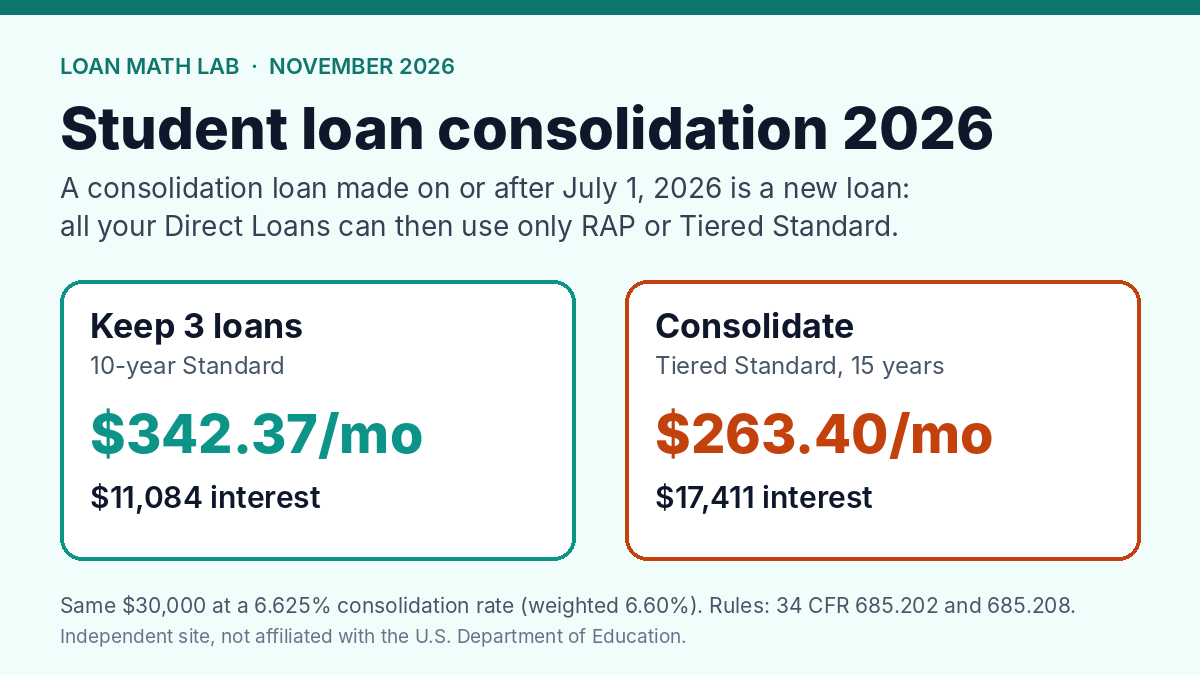
    Take the same three loans, $30,000 in total. Before consolidating, each one is on the 10-year Standard plan. After a student loan consolidation in November 2026, the new $30,000 loan at 6.625% goes on Tiered Standard, which gives 15 years for a balance between $25,000 and $50,000.

    ScenarioMonthly paymentTotal interestTotal paid
    Keep the three loans, 10-year Standard$342.37$11,084$41,084
    Consolidate, Tiered Standard 15 years$263.40$17,411$47,411
    Consolidate with $2,000 of unpaid interest added$280.96$18,572$50,572
    Our calculation in Python, November 13, 2026: fixed payments, interest at one twelfth of the yearly rate, last payment adjusted. The $2,000 of unpaid interest is an assumption; StudentAid.gov confirms that outstanding interest becomes part of the principal.
    Student loan consolidation 2026 example: $30,000 kept on 10-year Standard costs $11,084 of interest; consolidated on Tiered Standard over 15 years it costs $17,411, or $18,572 with $2,000 of unpaid interest added

    The lower payment is real: about $79 less a month. But the longer term adds about $6,300 of interest, and if $2,000 of unpaid interest is folded into the new principal, you pay about $9,500 more in total than if you had kept the loans. StudentAid.gov’s own consolidation checklist makes the same point and suggests paying unpaid interest before you consolidate where you can. You can also prepay a consolidation loan at any time; our student loan payment calculator shows what an extra amount each month saves.

    Student loan consolidation pros and cons

    ProsCons
    One loan and one bill instead of several servicersAfter July 1, 2026, only RAP or Tiered Standard for all your Direct Loans
    FFEL and Perkins loans become Direct Loans, eligible for RAP and PSLFUnpaid interest is added to the principal
    Variable-rate loans become fixed-rateA longer term usually means more total interest
    A route out of defaultLoss of benefits tied to some loans: Perkins cancellation, FFEL rate cuts, rebates
    Lower monthly payment if the term gets longerParent PLUS inside the loan limits you to Tiered Standard
    No application feeIt cannot be reversed
    Based on StudentAid.gov and StudentAid.gov, One Big Beautiful Bill Act updates, read November 13, 2026.

    Should I consolidate my student loans?

    Should I consolidate my student loans? In 2026 the honest answer for most borrowers with only Direct Loans is no, unless one of the reasons below applies to you. Student loan consolidation tends to make sense when:

    • You have FFEL or Perkins loans and want PSLF or an income-driven plan. Those loans only reach RAP and PSLF once they become a Direct Consolidation Loan.
    • You are in default and consolidation is the faster way back to good standing (see below).
    • You have old variable-rate loans and want a fixed rate.
    • You already planned to use RAP or Tiered Standard, so losing IBR costs you nothing, and one bill is worth it to you.

    Student loan consolidation is usually a poor fit when:

    • You are on IBR and it gives you a lower payment than RAP, or you want to keep the option.
    • You have Parent PLUS loans and would mix them with loans for your own education.
    • You have Perkins loans that you are earning cancellation on through your job.
    • You have a lot of unpaid interest that would be added to the principal.
    • Your only goal is a lower rate. The consolidation rate is never below your current average.

    If you want a lower payment without consolidating, StudentAid.gov suggests an income-driven plan instead. Borrowers with only pre-July 2026 loans can already opt into RAP without a new loan, and our student loan calculator compares the plans you can choose side by side.

    Consolidating student loans for PSLF and income-driven forgiveness

    Consolidation no longer wipes out your progress toward forgiveness the way it once did, but it can lower your count. Under 34 CFR 685.219(c)(3), when you consolidate Direct Loans, the weighted average of the qualifying PSLF payments you made on them counts on the new loan. The rule for income-driven forgiveness, 34 CFR 685.209(k)(4)(vi), gives you the weighted average of qualifying months, rounded up to the next whole month, and also counts qualifying payments made on FFEL loans.

    An example: $20,000 with 48 qualifying payments and $10,000 with 12. The weighted average is (20,000 × 48 + 10,000 × 12) ÷ 30,000 = 36 payments, not 48. If a large, newer loan has few payments, consolidating it with an older loan pulls the count down. When the newer loan is small, the effect is smaller. Certify your employment before you apply, so the payments you already have are on record.

    The 2026 plan limits matter here too. Payments under Tiered Standard do not count toward PSLF, according to StudentAid.gov, so a borrower who consolidates after July 1, 2026 to pursue PSLF needs RAP, where only on-time payments in full count. Our PSLF calculator estimates how much PSLF could cancel on RAP or IBR, and our guide to federal student loan forgiveness covers the other programs.

    Consolidate FFEL loans and Perkins loans

    To consolidate FFEL loans is still the way to bring them into PSLF and RAP, because those programs cover Direct Loans. A single FFEL Consolidation Loan can even be reconsolidated alone for PSLF. If you consolidate Perkins loans, the Perkins cancellation for teachers, nurses and other jobs no longer applies to that money. StudentAid.gov’s advice is direct: if you are working toward those benefits, leave those loans out.

    Consolidate Parent PLUS loans: keep them apart

    Parents need the most care. StudentAid.gov says that if you consolidate on or after July 1, 2026 and the new loan includes parent PLUS loans, you will only have access to Tiered Standard, which does not qualify for PSLF. RAP is closed to parent PLUS loans and to any consolidation loan that repaid one, including a double consolidation.

    Two practical rules follow. Do not put parent PLUS loans and loans for your own education in the same Direct Consolidation Loan: StudentAid.gov recommends consolidating them separately so your own loans keep RAP. And if you consolidated parent PLUS loans before July 1, 2026, ICR remains your bridge to IBR: StudentAid.gov lists IBR as open to those loans if at least one payment was made under ICR between July 4, 2025 and July 1, 2028, and if you take no new loan, a new consolidation loan included. Our guide to the Parent PLUS loan changes explains these steps and the double consolidation history in detail.

    Defaulted loans and consolidation

    Student loan consolidation is one of the two ways out of default. According to StudentAid.gov, you must either make three consecutive monthly payments on the defaulted loan before you consolidate, or agree to repay the new loan on an income-driven plan. After July 1, 2026, that plan is RAP. You cannot consolidate a defaulted loan while your wages are being garnished for it or while a court judgment is in force, unless the garnishment order is lifted or the judgment vacated. Our student loan default guide compares consolidation with rehabilitation, the other way out, which also removes the default from your credit history.

    How to consolidate student loans, step by step

    1. List your loans. Log in to StudentAid.gov and note each loan’s type, balance, rate, servicer and any unpaid interest. Mark parent PLUS, Perkins and FFEL loans.
    2. Check your forgiveness counts first. Look at your IDR and PSLF counts and certify employment if you are pursuing PSLF.
    3. Compare plans before you commit. Run the official Repayment Calculator or our calculators. Steps 1 and 2 of the application also show your weighted rate and payment, and you can stop at any point before submitting.
    4. Apply online. The Direct Consolidation Loan Application is free and most people finish it in under 30 minutes. Choose which loans to include and a repayment plan.
    5. Keep paying. Unless your loans are in deferment, forbearance or a grace period, keep making payments until the consolidation servicer tells you the old loans are paid off.
    6. Watch for the first bill. Repayment starts within 60 days after the new loan is disbursed. You can ask to add eligible loans within 180 days after it is made, under 34 CFR 685.220(e).

    If a loan is still in its grace period, the application lets you ask the servicer to wait until close to the end of the grace period before consolidating, so your payments do not start early. Never pay a company to consolidate federal loans: the application is free, and questions before you apply go to the Federal Student Aid Information Center at 1-800-433-3243.

    Student loan consolidation vs refinancing

    The two words are often mixed up. Federal student loan consolidation keeps your loans federal: the government makes the new loan at the weighted average rate. Refinancing means a private lender pays off your loans with a new private loan at a rate based on your credit. A refinanced federal loan is no longer federal, so it leaves RAP, PSLF, federal deferment and discharge programs behind for good. Our guide on whether to refinance federal student loans puts a price on each of those losses with worked examples. We do not list lenders or their rates. To see whether an offer pays off after fees and when you break even, use our student loan refinance calculator, which also lists the federal protections a refinance gives up.

    Student loan consolidation FAQ

    Is student loan consolidation a good idea?

    It is a good idea when it unlocks something you need: PSLF or RAP for FFEL and Perkins loans, a way out of default, or a fixed rate. It is rarely a good idea just to tidy up Direct Loans in 2026, because it ends IBR access for all of them.

    How long does student loan consolidation take?

    The online application usually takes less than 30 minutes. Processing time after that is not fixed, so keep paying your old loans until the servicer confirms they are paid off. Your first payment on the new loan is due within 60 days after it is disbursed.

    Is there a student loan consolidation deadline?

    The key date has passed: a consolidation loan had to be disbursed before July 1, 2026 to keep access to IBR, PAYE and ICR. You can still consolidate today with no deadline, under the newer plan limits. Parents with consolidated parent PLUS loans should watch for the ICR enrollment deadlines that StudentAid.gov says it will publish before ICR ends, no later than July 1, 2028.

    Can I undo a Direct Consolidation Loan?

    No. Once the new loan is made, the loans it paid off no longer exist. You can add eligible loans within 180 days, but you cannot split it back into the original loans. Joint consolidation loans for spouses are the one exception, under a 2022 law that lets each borrower separate.

    Can I consolidate private student loans with federal loans?

    No. Private education loans are not eligible for a Direct Consolidation Loan. They can, however, be listed on the application as other debt that helps set the term on the old Standard plan for loans consolidated before July 1, 2026.

    Sources for this student loan consolidation guide

    This student loan consolidation guide is general information, not financial or legal advice. Your loan servicer and the U.S. Department of Education decide your plan, rate and counts, and rules can change. Loan Math Lab is not affiliated with the U.S. Department of Education. See our How We Verify page and Disclaimer. Information checked on November 13, 2026.

  • Federal Student Loan Forgiveness Programs 2026: What Is Open, Key Dates and Taxes

    Federal Student Loan Forgiveness Programs 2026: What Is Open, Key Dates and Taxes

    Federal student loan forgiveness still exists in 2026, but it comes through specific programs written into law and regulation, not through one-time mass cancellation. Six main routes are open: Public Service Loan Forgiveness, income-driven repayment forgiveness, Teacher Loan Forgiveness, and discharges for disability, a closed school or school misconduct. Each has its own clock, and since January 1, 2026 some of them can leave you with a federal tax bill.

    This guide shows where each federal student loan forgiveness program stands as of November 9, 2026, who qualifies, which dates matter and what forgiven debt can cost at tax time. We opened every official page cited here on that date. It covers federal loans only; private loans follow the terms of your lender’s contract. For the running list of rule changes, see our student loan changes log.

    Federal student loan forgiveness at a glance

    ProgramStatus, November 9, 2026How long it takesWhat is forgivenFederal income tax
    Public Service Loan ForgivenessOpen; employer rule struck down in court120 qualifying payments, at least 10 yearsRemaining Direct Loan balanceNot taxed
    IBR, PAYE and ICR forgivenessOpen; discharges being processed20 or 25 years of paymentsRemaining balanceCould be taxed if you reach the milestone in 2026 or later
    Repayment Assistance Plan (RAP)Open since July 1, 2026360 qualifying payments, at least 30 yearsRemaining balanceCould be taxed
    Teacher Loan ForgivenessOpen5 complete, consecutive academic yearsUp to $5,000 or $17,500Generally not taxed
    Total and permanent disability dischargeOpen; some discharges are automaticNo payment periodEligible federal loansNot taxed; your Social Security number must be on the return
    Closed school dischargeOpen under older rulesDepends on the closure dateLoans for that schoolNot taxed
    Borrower defense dischargeOpen; individual reviewCase by caseLoans for that school, if approvedLong treated as not taxed
    Our summary of federal student loan forgiveness rules from the program pages at StudentAid.gov, 34 CFR 685.209 and the tax sources listed below, read November 9, 2026. State income tax can differ.
    Federal student loan forgiveness 2026 chart: years of payments or service for Teacher Loan Forgiveness, PSLF, IBR, PAYE, ICR and RAP, and whether the amount can be taxed

    Student loan forgiveness update: what changed in 2026

    If you last looked at federal student loan forgiveness in 2025, these are the changes that matter, newest first:

    • October 21-23, 2026: the PSLF employer fight ends. The administration dropped all three appeals over a rule that would have let the Education Department remove employers from PSLF: two on October 21, as AACOM reported (November 2, 2026), and the one in the states’ case, announced by Wisconsin’s attorney general on October 23. The June 30 court rulings that threw out the rule before it took effect now stand.
    • September 29, 2026: official status of income-driven forgiveness. StudentAid.gov says IBR discharges resumed in September 2025 and its systems now process PAYE and ICR too. The payment counters are still being rebuilt.
    • July 17, 2026: Sweet v. McMahon. A federal appeals court rejected the Department’s bid to delay relief for more than 170,000 borrower defense applicants, as the borrowers’ lawyers reported.
    • July 1, 2026: RAP opens. Loans made from this date cannot use IBR, PAYE or ICR. Income-based relief for them runs through the Repayment Assistance Plan.
    • March 10, 2026: SAVE ends. A court order blocked discharges under SAVE. Borrowers in SAVE forbearance must pick another plan; our SAVE plan update covers the steps.
    • January 1, 2026: the tax break ends. The temporary rule that kept most forgiven student debt out of federal taxable income expired.

    One thing has not come back: broad, one-time cancellation. The Supreme Court struck down the 2022 plan in Biden v. Nebraska on June 30, 2023. Any message promising a new mass federal student loan forgiveness program should be checked against StudentAid.gov before you act on it.

    Student loan forgiveness programs tied to repayment

    Two federal student loan forgiveness programs reward years of payments: one for public service, the other for staying on an income-driven plan. They can overlap, and the first is much faster.

    Public Service Loan Forgiveness

    PSLF forgives the remaining balance on Direct Loans after the equivalent of 120 qualifying monthly payments made while you work full time for an eligible employer. The payments do not have to be consecutive. To see how much PSLF could cancel in your case and when your 120th payment falls, use our PSLF calculator. The official requirements are:

    • Employer: a U.S. federal, state, local or tribal government, including the military; a 501(c)(3) nonprofit; or another nonprofit that provides certain qualifying public services. For-profit contractors, labor unions and partisan political groups do not count.
    • Hours: a weekly average of at least 30 hours, alone or combined across qualifying employers.
    • Loans: Direct Loans. FFEL and Perkins loans only become eligible if you consolidate them into a Direct Consolidation Loan.
    • Repayment plan: RAP, IBR, ICR, PAYE or the 10-year Standard plan. Payments on the Tiered Standard, Graduated and Extended plans do not qualify for PSLF.

    You must still work for a qualifying employer when you submit the form for forgiveness, so do not leave the job before you apply. The Department advises certifying your employment every year and whenever you change employers. If you have 120 months of qualifying employment but some of them were spent in a deferment or forbearance, our PSLF buyback guide explains how to pay for those months so they count. Parents should read the fine print: StudentAid.gov now says parent PLUS loans, and consolidation loans that include one, are ineligible for RAP and cannot continue to qualify for PSLF, even if they qualified before through IBR or ICR. If that is you, confirm your position with your servicer and read our guide to the Parent PLUS loan changes.

    The employer rule that worried many nonprofit workers never applied. A federal court vacated it on June 30, 2026, finding that it exceeded the Department’s authority and violated the First Amendment, and Michigan’s attorney general reported in October that the appeal in the states’ case had been dropped.

    Income-driven repayment forgiveness

    Income-driven federal student loan forgiveness cancels what is left after a long repayment period. The clock depends on the plan, under 34 CFR 685.209(k) and the Department’s court actions page:

    PlanForgiveness afterGood to know
    IBR, first loans after July 1, 201420 years of paymentsOnly Direct Loans made before July 1, 2026 can use IBR
    IBR, first loans before July 1, 201425 years of paymentsSame cutoff
    PAYE20 years of paymentsPlan ends: choose another by June 30, 2028
    ICR25 years of paymentsPlan ends: choose another by June 30, 2028
    RAP360 qualifying payments over at least 30 yearsCertain earlier payments on other plans can count
    SAVENoneDischarges under SAVE were blocked by the March 10, 2026 order
    Sources: 34 CFR 685.209(c), (d) and (k) and StudentAid.gov (page updated September 29, 2026).

    You do not apply for this type of federal student loan forgiveness: the regulation says the Department tracks your progress and forgives eligible loans without an application. It will notify you when your loan is identified as eligible, and you then have 21 days to opt out. Loans in default are not eligible for discharge under an income-driven plan, so getting out of default comes first.

    Processing of income-driven federal student loan forgiveness has been uneven. Student loan lawyer Stanley Tate’s summary of the court reports counts 21,200 discharges in March 2026 (10,500 IBR, 9,900 ICR and 800 PAYE), followed by months with none, because eligibility is checked in batches. Court-ordered reporting ended in May 2026, so no public source can give a current processing time. To see what you would pay along the way, try our IBR calculator or our RAP calculator, or read IBR vs RAP with worked examples.

    Teacher loan forgiveness

    Teacher Loan Forgiveness is the form of federal student loan forgiveness that pays a fixed amount rather than your whole balance. You need five complete and consecutive academic years as a full-time, highly qualified teacher at a low-income school or educational service agency.

    You taughtMaximum forgiven
    Mathematics or science at the secondary level, as a highly qualified full-time teacher$17,500
    Special education at the elementary or secondary level, as a highly qualified teacher$17,500
    Other elementary or secondary subjects, as a highly qualified full-time teacher$5,000
    Source: StudentAid.gov, Teacher Loan Forgiveness, read November 9, 2026. The amount is a combined maximum across Direct and FFEL loans.

    It covers Direct and FFEL Subsidized and Unsubsidized Loans; PLUS and Perkins loans are excluded. You also must have had no outstanding Direct or FFEL balance on October 1, 1998, or on the date of your next such loan after it. You apply through your servicer once the five years are done, and your school’s chief administrative officer certifies the service.

    The trap is the overlap with PSLF. The same period of service cannot count for both. The Department gives this example: if you receive Teacher Loan Forgiveness after five years, payments made during those years do not count toward your 120, so you would need 120 more. A public school teacher with a large balance should run the numbers before applying, because the Department says it cannot change this once the forgiveness is granted.

    Federal student loan forgiveness when something went wrong

    Discharges are the part of federal student loan forgiveness that does not depend on years of payments. They respond to an event: a disability, a school that closed or a school that misled you.

    Total and permanent disability discharge

    A total and permanent disability discharge cancels Direct, FFEL and Perkins loans and any TEACH Grant service obligation. You can qualify with documentation from the Department of Veterans Affairs, from the Social Security Administration or from an authorized medical professional. The Department also matches records with VA and Social Security and sends a letter; the discharge is then automatic unless you opt out.

    Applying, or telling the Department you plan to apply, can pause your payments for 120 days. StudentAid.gov states that a three-year monitoring period applies to discharges based on Social Security or medical certifications, and that the loans may be reinstated if its conditions are not met.

    Closed school discharge

    If your school closed and you could not finish, a closed school discharge can cancel the Direct, FFEL or Perkins loans you took to attend it. StudentAid.gov lists three situations: you were enrolled when it closed, you were on an approved leave of absence, or it closed within 180 days after you withdrew. You generally do not qualify if you finished the program, or if you are completing it through a teach-out or at another branch.

    Do not count on the automatic route. That page describes an automatic discharge one year after closures from July 1, 2023, while its own notice says a court delayed the 2023 rule. Federal Student Aid letter GEN-25-04 then confirmed that the rules in effect on July 1, 2020 apply to loans originated before July 1, 2035. Our practical reading: contact your servicer and apply as soon as the closure is confirmed. The page also says to keep paying while the application is processed.

    Borrower defense discharge

    Borrower defense applies when a school’s misconduct, usually a misrepresentation about jobs, salaries or transferable credits, harmed you. If approved, the Department discharges the remaining balance on loans for that school and may refund payments. Parent PLUS borrowers can apply too. You must have an outstanding federal loan tied to the school, and you sign the application under penalty of perjury.

    The standard depends on when the loan was made. The more generous 2022 rules are blocked and delayed by law, so according to Tate Law (updated October 4, 2026), loans made after July 1, 2020 fall under the 2019 rules: a general limit of three years after leaving the school, and proof of a knowing or reckless misrepresentation, your reliance on it and financial harm beyond owing the loan. Separately, the Sweet v. McMahon settlement covers people who applied by late 2022; if that is you, look for a notice about your application.

    Other routes exist for narrower cases. 34 CFR 685.212 also lists discharges for death, bankruptcy, false certification, unpaid refunds and survivors of the September 11 attacks.

    Who qualifies for student loan forgiveness

    Federal student loan forgiveness depends on your job, your plan or what happened to you. Start with the row that sounds like your situation:

    Your situationLook first atCheck before relying on it
    Full-time government or nonprofit jobPSLFYour employer in the PSLF Employer Search; loans must be Direct
    Teacher at a low-income schoolPSLF or Teacher Loan ForgivenessBalance size; the same years cannot count for both
    Low income compared with your debtIBR or RAPWhether any loan was made on or after July 1, 2026; your likely tax
    Disability that stops you from workingTotal and permanent disability dischargeWhich proof you have: VA, Social Security or a medical professional
    School closed before you finishedClosed school dischargeYour withdrawal date and whether you finished elsewhere
    School lied about something centralBorrower defenseEvidence, such as ads and emails, and when you left the school
    Where to start with federal student loan forgiveness. Eligibility is decided by the Department of Education and your servicer.

    Federal student loan forgiveness dates to know

    Most federal student loan forgiveness programs have no single deadline, but these dates change who gets what:

    DateWhat it means
    January 1, 2026Income-driven milestones reached before this date stay free of federal tax, even if the discharge posts later
    January 28 and April 15, 2026Decision deadlines for Sweet v. McMahon post-class applicants; missed decisions trigger relief under the settlement
    June 30, 2026Courts vacate the PSLF employer rule
    July 1, 2026Loans made from this date cannot use IBR, PAYE or ICR; RAP opens
    June 30, 2028Last day for PAYE and ICR borrowers to choose a new plan; after that the Department assigns one
    July 1, 2035The 2020-era closed school rules apply to loans originated before this date
    Sources: StudentAid.gov, 34 CFR 685.209(c)(7) and (d)(5), Project on Predatory Student Lending and GEN-25-04.

    Is federal student loan forgiveness taxable?

    Whether federal student loan forgiveness is taxed depends on the program. The law that kept most forgiven student debt out of federal income covered discharges through December 31, 2025. Here is where federal student loan forgiveness stands now:

    • Income-driven plans: the Department says a discharge “could create a federal tax liability” depending on its effective date. If you met your milestone before January 1, 2026, it is not subject to federal tax even if the loan is discharged later.
    • Disability and death: the 2025 law made this exclusion permanent, under section 108(f)(5) of the tax code, and requires your Social Security number on the return.
    • Work-based forgiveness: section 108(f)(1) excludes loans discharged for working a set period in certain professions for a broad class of employers. PSLF has long been treated as tax-free federally, as student loan attorney Adam Minsky explains, along with closed school and borrower defense discharges.
    • State tax: a federal exclusion does not bind your state. The Department warns that some discharges can count as income for state tax.

    Worked example. Suppose $40,000 is forgiven under IBR after a milestone reached in 2027, and all of it is taxed at a 22% rate. The federal bill is about $8,800 ($40,000 × 0.22). A large forgiven amount can also push part of your income into a higher bracket, so the real figure may differ. Our example is simplified and uses an assumed rate.

    There is one common way to reduce that. Under IRS Publication 4681 (2025 edition), you are insolvent to the extent your total liabilities exceed the fair market value of your total assets immediately before the cancellation, and you can exclude the smaller of the canceled debt or that shortfall by filing Form 982 and checking line 1b. In the same example, with liabilities of $120,000 and assets of $90,000, you are insolvent by $30,000. You would exclude $30,000, leaving $10,000 taxable and about $2,200 of tax at 22%, or $6,600 less. Have a tax professional confirm this before you file.

    How to get student loans forgiven, step by step

    Federal student loan forgiveness rarely happens by accident. Whichever route fits you, these steps apply to most borrowers:

    1. Identify your loans. Log in to StudentAid.gov and note which loans are Direct, FFEL, Perkins or parent PLUS, and the date of each. Private loans will not appear there.
    2. Get out of default first. Default blocks income-driven forgiveness and, unless you make satisfactory arrangements, Teacher Loan Forgiveness.
    3. Choose the plan that fits the goal. Compare your options with our student loan calculator. A plan that does not count, such as Tiered Standard for PSLF, can cost you years.
    4. Document everything. Submit the PSLF form every year, and keep your payment records. The Department says it is still changing how income-driven payment counters are displayed, so your own records matter.
    5. Apply through official channels. Use StudentAid.gov or your servicer. Be wary of any company that charges a fee to do this for you, and never share your StudentAid.gov login.
    6. Plan for the tax. If your federal student loan forgiveness could be taxable, estimate the bill years ahead and check your state’s rule.

    Federal student loan forgiveness FAQ

    Is student loan forgiveness still happening in 2026?

    Yes, federal student loan forgiveness continues through the programs above. As of November 9, 2026, StudentAid.gov lists PSLF, Teacher Loan Forgiveness and the discharge programs as available and says it is processing IBR, PAYE and ICR discharges. SAVE forgiveness and broad one-time cancellation are not available.

    Can I get Teacher Loan Forgiveness and PSLF?

    Yes, but not for the same period of service. The five years used for Teacher Loan Forgiveness do not count toward your 120 PSLF payments.

    Do loans made after July 1, 2026 qualify for federal student loan forgiveness?

    Direct Loans for students can reach forgiveness through RAP after 360 qualifying payments, or through PSLF while on RAP. For those loans, only full payments made by the due date count toward PSLF. Parent PLUS loans cannot use RAP.

    Are private student loans eligible?

    No. Federal student loan forgiveness only covers federal loans. StudentAid.gov lists loans from private lenders as ineligible for PSLF, and any relief on a private loan depends on your lender’s contract.

    Is student loan forgiveness taxable if I reach IBR forgiveness next year?

    It could be. A milestone reached on or after January 1, 2026 falls outside the expired federal exclusion, so the forgiven amount can count as income unless another exclusion, such as insolvency, applies.

    Sources for federal student loan forgiveness

    This guide to federal student loan forgiveness is general information, not financial, legal or tax advice. Eligibility is decided by the U.S. Department of Education and your loan servicer, and rules can change. Loan Math Lab is not affiliated with the U.S. Department of Education. See our How We Verify page and Disclaimer. Information checked on November 9, 2026.

  • Grad PLUS Loan Limit 2026: What Replaced It and the Gap in Dollars

    Grad PLUS Loan Limit 2026: What Replaced It and the Gap in Dollars

    The Grad PLUS loan limit used to be generous: a graduate or professional student could borrow up to the full cost of attendance minus other aid. For anyone starting a graduate program on or after July 1, 2026, that loan is gone. New borrowers now rely on one federal loan, the Direct Unsubsidized Loan, with fixed yearly and total caps, and many will face a gap that Grad PLUS used to fill.

    This guide explains what replaced the Grad PLUS loan limit, who can still borrow under the old rules, and how large the gap is for a master’s degree, a law degree and a medical degree, in dollars. Every limit comes from the federal regulations or Federal Student Aid, and the worked examples were checked in Python. If your family is also borrowing for an undergraduate, our guide to the Parent PLUS loan changes covers the parent side.

    Grad PLUS loan limit at a glance

    Before July 1, 2026New borrowers from July 1, 2026
    Grad PLUS loan limitCost of attendance minus other aid, every yearNo new Grad PLUS loans
    Direct Unsubsidized, graduate student$20,500 a year; $138,500 total including undergraduate loans$20,500 a year; $100,000 total, not counting undergraduate loans
    Direct Unsubsidized, professional student$20,500 a year; $138,500 total including undergraduate loans$50,000 a year; $200,000 total, not counting undergraduate loans
    Lifetime cap on federal student loansNone$257,500, including undergraduate loans
    Interest rate (2026-27)Fixed rate set each award year8.07% fixed for graduate and professional Direct Unsubsidized Loans
    Repayment plans for new loansSeveral, including IBRRepayment Assistance Plan (RAP) or Tiered Standard
    The Grad PLUS loan limit and its replacement in one table. Sources: 34 CFR 685.200(b), 34 CFR 685.203, FSA Loan Limits FAQs (May 20, 2026), FSA GENERAL-26-33 and 34 CFR 685.209. Read on November 3, 2026.

    Two numbers drive everything below: $20,500 a year for most graduate students and $50,000 a year for professional students such as future doctors and lawyers. Neither is tied to what your program costs, which is the whole difference from the old Grad PLUS loan limit.

    Is Grad PLUS going away?

    Yes, for new borrowers. The federal regulation now says that beginning on July 1, 2026, a graduate or professional student may not borrow a Direct PLUS Loan, in 34 CFR 685.200(b)(2). The final rule published in the Federal Register on May 1, 2026 describes the same change: the law ended the authority to make new Graduate PLUS loans and set a lifetime borrowing cap of $257,500 for most borrowers.

    So for a student who enters a program in fall 2026 or later, the Grad PLUS loan limit is effectively zero. Existing Grad PLUS loans are not cancelled or changed; you keep repaying them under their own terms. And one group of current students can keep borrowing Grad PLUS for a while, under the interim exception explained below.

    Grad PLUS loan changes in five points

    Here is what changed around the Grad PLUS loan limit, in five points:

    • No new Grad PLUS. Graduate and professional students cannot take a new Grad PLUS loan for periods of enrollment from July 1, 2026, unless they qualify for the interim exception.
    • Two student categories. The new graduate unsubsidized loan limit depends on whether you are a graduate student or a professional student, as defined in the regulations.
    • Total caps that ignore undergraduate debt. The new $100,000 and $200,000 totals do not count what you borrowed as an undergraduate; the separate $257,500 lifetime cap does.
    • Schools can set lower limits. From July 1, 2026, a school may cap Direct Loans for a specific program below the federal limits, as long as it applies the cap to every student in that program.
    • New loans, new repayment rules. Loans made on or after July 1, 2026 cannot use IBR, PAYE or ICR; they are repaid on RAP or Tiered Standard.

    The new graduate unsubsidized loan limit

    With Grad PLUS gone and no Grad PLUS loan limit to fall back on, the Direct Unsubsidized Loan is the only federal loan most new graduate students can take. Federal Student Aid’s Loan Limits FAQs list the limits that apply to periods of enrollment starting on or after July 1, 2026:

    Student typeYearly limitTotal limitExamples of programs
    Graduate student$20,500$100,000Master’s degrees, most Ph.D. programs, M.B.A.
    Professional student$50,000$200,000M.D., D.O., J.D., D.D.S. or D.M.D., Pharm.D., D.V.M., O.D. and others listed in the regulations
    New Direct Unsubsidized limits for graduate and professional students, from the FSA Loan Limits FAQs (question LMALL-Q3). Undergraduate loans and Grad PLUS loans do not count toward the $100,000 or $200,000 total (question GPSLL-Q2). Some health programs are placed in one category or the other by program.

    Three rules sit on top of these numbers. First, no federal loan can exceed your cost of attendance minus other financial assistance, so the limit is a ceiling, not an amount you are owed. Second, students enrolled less than full time receive reduced limits, which schools calculate under a schedule of reductions that starts with the 2026-27 award year. Third, your school may set a lower limit for your program.

    Who counts as a professional student

    The higher $50,000 graduate unsubsidized loan limit only applies to professional students. Under 34 CFR 685.102, a professional degree generally signifies readiness to begin practice in a profession, is usually at the doctoral level, requires at least six years of postsecondary study including two after the bachelor’s, and generally needs a license to practice.

    The regulation lists the fields: pharmacy (Pharm.D.), dentistry (D.D.S. or D.M.D.), veterinary medicine (D.V.M.), chiropractic, law (J.D.), medicine (M.D.), optometry (O.D.), osteopathic medicine (D.O.), podiatry, theology (M.Div. or M.H.L.) and clinical psychology (Psy.D. or Ph.D.). A master’s degree, even an expensive one, is a graduate program and gets the $20,500 limit, with no Grad PLUS loan limit above it. If you are not sure which category your program falls into, ask your school’s financial aid office before you plan your budget.

    Who keeps the old Grad PLUS loan limit: the interim exception

    Current students get a transition period. According to 34 CFR 685.200(b)(2)(ii) and the FSA Loan Limits FAQs, you keep the old Grad PLUS loan limit if both of these are true:

    • you were enrolled in your program of study at a school on June 30, 2026; and
    • a Direct Loan was made to you for that program before July 1, 2026.

    A student who qualifies can keep borrowing Grad PLUS up to the cost of attendance minus other aid, alongside the old $20,500 unsubsidized limit and the old $138,500 total. The exception lasts for your expected time to credential: three academic years or the time left in your program, whichever is shorter. The $257,500 lifetime cap does not apply while the exception lasts, but any Grad PLUS you borrow during it counts toward the cap afterward.

    Your situation on July 1, 2026Interim exceptionOld Grad PLUS loan limit for
    Medical student who finished year 1 with a Direct LoanYesUp to 3 academic years (years 2 to 4)
    Law student who finished year 2 with a Direct LoanYesUp to 1 academic year (year 3)
    Enrolled on June 30, 2026, but never took a Direct Loan for the programNoNew limits from the start
    Starting a graduate program in fall 2026 or laterNoNew limits from the start
    Our reading of the expected time to credential rule in the FSA Loan Limits FAQs (questions IE-Q1, ETC-Q2 and ETC-Q15).

    The exception ends early if you withdraw or stop being enrolled in the program, under 685.200(b)(3). After that, the new graduate unsubsidized loan limit applies to any further borrowing, so think carefully before taking time off or switching programs.

    What the new limits cover: three worked examples

    To see how far the federal loans go without the old Grad PLUS loan limit, we took three typical programs and assumed a yearly need, meaning cost of attendance minus grants and scholarships. The students are new borrowers in fall 2026, so the interim exception does not apply, and they have no other federal loans for the program.

    ProgramYearly need (assumed)Federal loans each yearFederal totalTotal needGap to fill
    Master’s degree, 2 years (graduate)$60,000$20,500$41,000$120,000$79,000
    Law degree (J.D.), 3 years (professional)$75,000$50,000$150,000$225,000$75,000
    Medical degree (M.D.), 4 years (professional)$90,000$50,000$200,000$360,000$160,000
    Our calculation in Python, November 3, 2026. Yearly need figures are assumptions chosen for illustration; limits from the FSA Loan Limits FAQs. Before July 2026, the old Grad PLUS loan limit could have covered each gap.
    Grad PLUS loan limit 2026 chart: federal Direct Unsubsidized loans versus total need for a master's, a law degree and a medical degree

    The medical student hits the $200,000 professional total exactly at the end of year four, so in a five-year program the fifth year would have no federal loan at all. The master’s student meets the yearly $20,500 cap long before the $100,000 total. In both cases, the end of the Grad PLUS loan limit moves most of the cost of an expensive program onto savings, school aid, work or private loans.

    The $257,500 lifetime limit

    The lifetime cap counts every federal student loan you borrow as a student, undergraduate and graduate, and, unlike the old Grad PLUS loan limit, it does not reset when you repay. Parent PLUS loans you take for your own children are excluded. For most single-degree students the program totals bind first, but the lifetime cap matters for second degrees.

    Worked example: an independent undergraduate who borrowed the full $57,500 and then a two-year master’s at $41,000 has used $98,500. If that person later starts medical school, the lifetime cap leaves room for at most $159,000 more ($257,500 minus $98,500), less than the $200,000 professional total. That is our arithmetic on the rules in the FSA FAQs; your school’s financial aid office will confirm your own remaining eligibility.

    What graduate loans made after July 2026 cost to repay

    Direct Unsubsidized Loans for graduate and professional students first disbursed from July 1, 2026 to June 30, 2027 carry a fixed 8.07% rate, set in FSA announcement GENERAL-26-33. A loan fee of 1.057% is taken from each disbursement, according to FSA announcement GENERAL-26-28 (May 13, 2026), so a $20,500 loan pays out $20,283.32 and you repay the full $20,500. Students who still borrow under the old Grad PLUS loan limit pay 9.07% on new Grad PLUS loans for 2026-27, under the same announcement.

    Interest starts on each disbursement while you are in school. In our examples, if each year’s loan is paid out at the start of that year, simple interest by the end of the six-month grace period comes to about $6,617 for the master’s student, $30,262 for the law student and $48,420 for the medical student. New loans are repaid on the Repayment Assistance Plan or on Tiered Standard, whose term is set by your total Direct Loan balance.

    Federal totalTiered Standard termMonthly paymentTotal paidIf paid in 10 years
    $41,00015 years$393.48$70,825$498.96 a month, $59,875 total
    $150,00025 years$1,164.69$349,406$1,825.47 a month, $219,056 total
    $200,00025 years$1,552.92$465,874$2,433.96 a month, $292,074 total
    Our calculation in Python, November 3, 2026. Rate 8.07% fixed, monthly interest at 8.07% / 12, payments rounded to the cent. The balances leave out interest built up during school and assume no other Direct Loans, which would change the Tiered Standard term.

    The 25-year term lowers the monthly payment but more than doubles the interest compared with ten years. Our student loan payment calculator shows the payment and total interest for any balance and term, and our RAP student loan calculator estimates the income-based payment instead. To compare RAP and the fixed plans side by side, use our student loan calculator.

    How to fill the gap without Grad PLUS

    Without the Grad PLUS loan limit, the gap has to come from somewhere else. Our college cost calculator shows the gap for your own program, with an optional monthly payment if you borrow it. These steps go roughly from cheapest to most expensive:

    • Ask the school first. Scholarships, assistantships, tuition waivers and fellowships do not need to be repaid. Ask also whether your program has its own lower loan limit, because that changes your plan before you start.
    • Ask for a review of your aid. StudentAid.gov’s checklist of options when financial aid is not enough includes asking the school to adjust your aid when your circumstances changed, and asking the billing office about payment plans.
    • Compare the full cost of the program. A cheaper program, living costs in a different city or part-time study while working can shrink the gap, but less-than-full-time enrollment also reduces your federal loan limits.
    • Treat private loans as the last step. StudentAid.gov notes that private loans often need a cosigner and may not offer deferment or forbearance, and Edfinancial explains that private loan rates depend on credit history and are often variable. They do not qualify for federal plans such as RAP.
    • Watch the rules. We log every federal change with its date and source on our student loan changes page.

    Grad PLUS loan limit FAQ

    What was the Grad PLUS loan limit before July 2026?

    The cost of attendance minus other financial assistance, every academic year, with no fixed dollar cap. That rule still applies to students who qualify for the interim exception.

    Can I still get a Grad PLUS loan in 2026-27?

    Only if you were enrolled in your program on June 30, 2026 and received a Direct Loan for it before July 1, 2026. Everyone else is limited to Direct Unsubsidized Loans.

    What is the graduate unsubsidized loan limit for 2026-27?

    $20,500 a year and $100,000 in total for graduate students, and $50,000 a year and $200,000 in total for professional students, for periods of enrollment from July 1, 2026. Undergraduate loans do not count toward those totals.

    Do my undergraduate loans count against the new limits?

    Not against the $100,000 or $200,000 program totals. They do count toward the $257,500 lifetime limit on federal student loans.

    Can new graduate loans use income-driven repayment?

    Yes, through RAP. Under 34 CFR 685.209, Direct Unsubsidized Loans can be repaid on the Repayment Assistance Plan, but only Direct Loans made before July 1, 2026 can use IBR, PAYE or ICR.

    Sources for the Grad PLUS loan limit

    This guide to the Grad PLUS loan limit is general information, not financial, legal or tax advice. Your school sets your actual loan amounts and may use a lower program limit; check with its financial aid office before you plan your borrowing. Loan Math Lab is not affiliated with the U.S. Department of Education. See our How We Verify page and Disclaimer. Information checked on November 3, 2026.

  • Parent PLUS Loan Changes 2026: New Limits, Repayment Rules and Worked Examples

    Parent PLUS Loan Changes 2026: New Limits, Repayment Rules and Worked Examples

    The Parent PLUS loan changes that took effect on July 1, 2026 do two things at once: they put a dollar cap on how much parents can borrow for a child’s undergraduate degree, and they shrink the list of repayment plans for new parent loans. Until June 2026, a parent could borrow up to the full cost of attendance minus other aid, with no total limit. That open-ended loan is gone for most new borrowers.

    This guide explains the Parent PLUS loan changes in the order a family meets them: how much you can borrow now, who keeps the old rules for a while, how the new loans are repaid, and what it all costs in dollars. Every figure comes from the federal regulations or Federal Student Aid, and the worked examples were checked in Python. For your own numbers on student loans, our student loan calculator compares the main repayment plans side by side.

    Parent PLUS loan changes at a glance

    Before July 1, 2026New Parent PLUS loans from July 1, 2026
    Yearly limitCost of attendance minus other aid$20,000 per dependent student (and never more than cost of attendance minus other aid)
    Total limitNone$65,000 per dependent student, counting all past Parent PLUS borrowing for that child
    Fixed repayment plansStandard (10 years), Graduated, ExtendedTiered Standard only (10 to 25 years, by balance)
    Income-driven repaymentICR after a Direct Consolidation LoanNone for loans made on or after July 1, 2026
    Interest rate (2026-27)Fixed rate set for each award year9.07% fixed for loans first disbursed from July 1, 2026 to June 30, 2027
    Parent PLUS loan changes in one table. Sources: 34 CFR 685.203, 685.208 and 685.209; FSA Loan Limits FAQs (May 20, 2026); FSA GENERAL-26-33. Read on October 31, 2026.

    Two groups are partly shielded from the Parent PLUS loan changes: families who already had a federal loan for the student’s current program before July 1, 2026, and parents who keep their older loans and never borrow again. Both are covered below.

    The five Parent PLUS loan changes that matter most

    • A yearly cap. New Parent PLUS borrowing is limited to $20,000 per dependent student each academic year.
    • A lifetime cap per child. All parents together can borrow at most $65,000 for one dependent student, without regard to any amount already repaid or forgiven.
    • A temporary exception. Families already borrowing for a program on June 30, 2026 keep the old limits for up to three more academic years.
    • One repayment plan for new loans. A Parent PLUS loan made on or after July 1, 2026 is repaid on the Tiered Standard plan, with no income-driven option.
    • A closed back door. Consolidating Parent PLUS loans on or after July 1, 2026 no longer leads to income-contingent repayment, so the old consolidation strategies stop working.

    New Parent PLUS loan limits: $20,000 a year and $65,000 per student

    The new Parent PLUS loan limits apply per child, not per parent. Federal Student Aid’s loan limits FAQs answer the most common question directly: two parents cannot each borrow $20,000 for the same student. The $20,000 yearly and $65,000 total limits cover all parent borrowing for that child combined.

    The yearly limit also sits under the old ceiling rather than replacing it. The school still starts from the cost of attendance and subtracts other financial assistance; the Parent PLUS loan can then cover the remaining gap or $20,000, whichever is less. A family with a $12,000 gap can borrow $12,000, not $20,000.

    • Past borrowing counts. The $65,000 total includes every Parent PLUS loan already taken for that child, including at other schools.
    • Paying it off does not reset it. Amounts repaid, forgiven or discharged still count toward the $65,000.
    • Each child has a separate cap. A parent with two children in college can borrow up to $65,000 for each one.
    • No extra student loan once the cap is reached. A dependent student whose parent hits the $65,000 limit does not qualify for the additional Direct Unsubsidized Loan that students get when a parent is denied a PLUS loan.

    Worked example: a $30,000 gap for four years

    Here is how the Parent PLUS loan changes play out for a dependent student whose cost of attendance minus grants, scholarships and the student’s own federal loans leaves a $30,000 gap each year. The parent is a new borrower, so the interim exception does not apply.

    YearGapBefore July 2026Under the new limitsLeft uncovered
    1$30,000$30,000$20,000$10,000
    2$30,000$30,000$20,000$10,000
    3$30,000$30,000$20,000$10,000
    4$30,000$30,000$5,000$25,000
    Total$120,000$120,000$65,000$55,000
    Our calculation, October 31, 2026. The $30,000 gap is an assumption chosen for illustration; limits from 34 CFR 685.203 as explained in the FSA Loan Limits FAQs.
    Parent PLUS loan changes chart: yearly Parent PLUS borrowing before July 2026 and under the new $20,000 and $65,000 caps for a $30,000 yearly gap

    The squeeze from the Parent PLUS loan changes arrives in year four. After three years at $20,000, only $5,000 of the $65,000 total is left, so the family must find $25,000 that year from savings, income, a payment plan with the school or a private loan. Our college cost calculator works out that gap from your own school’s cost, grants and family money. If the gap were $15,000 a year instead, the total would be $60,000 and the new limits would not bite at all.

    Who keeps the old limits: the interim exception

    The law gives families who were already borrowing a transition period from the Parent PLUS loan changes, which Federal Student Aid calls the interim exception. Parents qualify when both conditions in the FSA FAQs are met:

    • the student was enrolled in a program of study at a school on June 30, 2026; and
    • a Direct Loan for that program, to the student or to the parent, was disbursed before July 1, 2026.

    A qualifying parent can keep borrowing up to the cost of attendance minus other aid, with no $65,000 cap, during the student’s expected time to credential. That period starts on July 1, 2026 and lasts three academic years or the time left in the program, whichever is shorter. It cannot be extended, and families cannot opt out of it.

    Student on July 1, 2026 (four-year program)Interim exceptionOld limits for
    Finished year 1, had a Direct LoanYesUp to 3 academic years
    Finished year 2, had a Direct LoanYesUp to 2 academic years
    Finished year 1, no federal loan before July 2026NoNew limits from the start
    Starting college in fall 2026 or laterNoNew limits from the start
    Our reading of the expected time to credential rule in the FSA Loan Limits FAQs (questions IE-Q2, IE-Q5 and ETC-Q10).

    The exception is fragile. A student who withdraws from the program, switches to a different program of study or breaks enrollment loses it, and the parent moves to the new $20,000 and $65,000 limits. Changing majors inside the same degree does not count as a change of program, according to the same FAQs.

    Parent PLUS loan repayment changes after July 1, 2026

    The repayment side of the Parent PLUS loan changes depends on one date: whether you have any federal Direct Loan made on or after July 1, 2026. Under 34 CFR 685.209, only Direct Loans made before that date can use the ICR, IBR and PAYE plans, and Parent PLUS loans are excluded from the new Repayment Assistance Plan (RAP) entirely.

    Your situationRepayment plans openIncome-driven option
    Only Parent PLUS loans made before July 1, 2026, not consolidatedStandard (10 years), Graduated, ExtendedNone
    Parent PLUS consolidated before July 1, 2026, no new loans sinceFixed plans plus ICR through June 30, 2028ICR; IBR once you have made an ICR payment
    Any new Direct Loan (yours or a new Parent PLUS) on or after July 1, 2026Tiered StandardNone
    Parent PLUS consolidated on or after July 1, 2026Tiered StandardNone
    Sources: 34 CFR 685.208 paragraphs (b) and (c), 34 CFR 685.209 paragraphs (b)(6), (c)(5), (c)(7) and (d). Read on October 31, 2026.

    New Parent PLUS loans: Tiered Standard only

    Under the Parent PLUS loan changes, a Parent PLUS loan made on or after July 1, 2026 is repaid on the Tiered Standard plan in 34 CFR 685.208: fixed monthly payments of at least $50, over a term set by the total of your Direct Loans when you enter repayment.

    Total Direct Loans entering repaymentRepayment term
    Less than $25,00010 years
    $25,000 to $49,99915 years
    $50,000 to $99,99920 years
    $100,000 or more25 years
    Tiered Standard terms, 34 CFR 685.208(c)(1).

    One of the least-known Parent PLUS loan changes: borrowing one new loan also affects the older ones. The Standard, Graduated and Extended plans are written for borrowers who have not received a Direct Loan on or after July 1, 2026. A parent who takes a new Parent PLUS loan in 2026-27 on top of older ones is moved to the Tiered Standard rules for the whole balance, and loses ICR access on a consolidation loan too. Our tiered standard plan guide shows the payment for each balance tier and what crossing $25,000 costs.

    Parent PLUS loan income-driven repayment: what is left

    Parent PLUS loans are not eligible for income-driven repayment on their own under 34 CFR 685.209. The route was to consolidate them into a Direct Consolidation Loan and choose Income-Contingent Repayment (ICR), which charges up to 20% of discretionary income. After the Parent PLUS loan changes, that route survives only for consolidation loans made before July 1, 2026.

    • Already consolidated and on ICR: ICR closes on July 1, 2028. If you made at least one ICR payment on or after July 4, 2025, the rules let your consolidation loan move to Income-Based Repayment (IBR); you must pick a new plan before July 1, 2028.
    • Consolidated but never enrolled in ICR: you can still choose ICR through June 30, 2028, as long as you take no new Direct Loan on or after July 1, 2026.
    • Not consolidated yet: a consolidation made now is a loan made after July 1, 2026, so it can only be repaid on the Tiered Standard plan. It does not open any income-driven option.
    • Double consolidation: the two-step strategy some parents used to reach other income-driven plans relied on consolidations that the new date rule now excludes. Our student loan consolidation guide explains what consolidating still does in 2026.

    What the Parent PLUS loan changes cost: four repayment examples

    New Parent PLUS loans for 2026-27 carry a fixed rate of 9.07%, set by Federal Student Aid in electronic announcement GENERAL-26-33. These examples show what the Parent PLUS loan changes mean for a monthly budget. They assume the whole balance enters repayment at once at that rate; interest that builds while the student is in school would add to it.

    Balance entering repaymentTiered Standard termMonthly paymentTotal paidInterest
    $20,00010 years$254.11$30,493$10,493
    $49,00015 years$499.03$89,825$40,825
    $50,00020 years$452.12$108,507$58,507
    $65,00020 years$587.75$141,060$76,060
    Our calculation in Python, October 31, 2026. Rate 9.07% fixed, monthly interest at 9.07% / 12, payments rounded to the cent; balances are assumptions chosen for illustration.

    Look at the $49,000 and $50,000 rows. One extra thousand dollars crosses a tier, stretches the term from 15 to 20 years and lowers the payment by $46.91 a month, but it adds about $17,700 of interest. A lower payment is not always the cheaper choice. Our student loan payment calculator shows the payment and interest for any balance, rate and term. To see how much you can borrow under the new limits, what the loan fee takes and your Tiered Standard payment, use our Parent PLUS loan calculator.

    Are Parent PLUS loans going away?

    No. Parent PLUS loans are still available for parents of dependent undergraduates in 2026-27; the FSA FAQs set out the limits that apply to them this year. The Parent PLUS loan changes cover the amount, the repayment plans and the interest rate, not the loan itself. The program that did end is Grad PLUS: the final rule published in the Federal Register on May 1, 2026 phases out new Grad PLUS loans for graduate and professional students, with the same kind of interim exception for current students. Our guide to the Grad PLUS loan limit explains what replaced it and the gap in dollars.

    We log every rule change with its date and source on our student loan changes page, so you can check whether anything has moved since this guide was written.

    What to do now after the Parent PLUS loan changes

    Which of the Parent PLUS loan changes affect you depends on where your family stands today:

    • Your child starts college in 2027 or later: estimate the yearly gap for all four years now. If it averages more than $16,250, the $65,000 cap will leave part of it uncovered.
    • Your child is already enrolled and you qualify for the interim exception: keep the student in the same program; a withdrawal or a change of program ends the old limits.
    • You hold older Parent PLUS loans: before borrowing any new federal loan, compare what you would lose. A new loan moves your older loans to the Tiered Standard rules.
    • You are on ICR with a consolidation loan: plan the switch to IBR or a fixed plan before July 1, 2028.
    • Your student borrows in their own name: their options are different; our guide to the Repayment Assistance Plan explains the new income-driven plan for student loans.

    Parent PLUS loan changes FAQ

    When did the Parent PLUS loan changes take effect?

    On July 1, 2026. The new limits apply to Parent PLUS loans for periods of enrollment from that date, and the repayment rules apply to loans made on or after it.

    Can both parents borrow $20,000 each?

    No. The $20,000 yearly and $65,000 total limits apply to all parents combined for each dependent student.

    Do Parent PLUS loans taken before July 2026 count toward the $65,000 limit?

    Yes. The total counts all past Parent PLUS borrowing for that child, including at other schools, even if part of it was repaid.

    Can Parent PLUS loans use the Repayment Assistance Plan?

    No. Parent PLUS loans are not eligible for RAP under 34 CFR 685.209, and neither are most consolidation loans that repaid them. The rules carve out consolidation loans already being repaid on ICR, PAYE or IBR, so ask your servicer if that is your case.

    What is the Parent PLUS interest rate for 2026-27?

    9.07% fixed for loans first disbursed from July 1, 2026 to June 30, 2027, according to Federal Student Aid.

    What happens if a Parent PLUS loan is denied?

    The rule that lets a dependent student borrow an additional Direct Unsubsidized Loan when a parent cannot get a PLUS loan is unchanged, according to Federal Student Aid. That extra loan is not available when the parent simply reaches the $65,000 cap.

    Does consolidating Parent PLUS loans still help?

    Not for income-driven repayment. A consolidation made on or after July 1, 2026 can only be repaid on the Tiered Standard plan.

    Sources for these Parent PLUS loan changes

    This guide to the Parent PLUS loan changes is general information, not financial, legal or tax advice. Your school sets your actual borrowing limit and your servicer sets your payment; check both before you borrow or consolidate. Loan Math Lab is not affiliated with the U.S. Department of Education. See our How We Verify page and Disclaimer. Information checked on October 31, 2026.

  • IBR vs RAP Student Loans: 4 Worked Examples for 2026

    IBR vs RAP Student Loans: 4 Worked Examples for 2026

    Comparing IBR vs RAP student loans comes down to one question: which plan gives you the lower payment and the better finish line with your income, family and loans? Both are federal income-driven plans, and both stay open in 2026. They just measure your income in very different ways, so the same borrower can pay $100 a month on one and $134 on the other, or the reverse.

    This IBR vs RAP student loans guide runs the numbers instead of listing pros and cons. You will see the two formulas side by side, four worked examples checked in Python, what happens to your balance in the first year, and a short checklist to decide. If you want your own figures, our student loan calculator puts both plans next to each other in one screen.

    IBR vs RAP student loans at a glance

    IBR (Income-Based Repayment)RAP (Repayment Assistance Plan)
    Who can use itOnly Direct Loans made before July 1, 2026Any Direct Loan borrower with eligible loans
    How income countsAGI minus 150% of the poverty line for your family sizeA percentage of your whole AGI, from 1% to 10%
    Share charged10% (new borrowers) or 15% (earlier borrowers) of discretionary income1% to 10% of AGI, by $10,000 bracket
    FamilyFamily size raises the protected amount$50 a month off for each dependent on your tax return
    Payment capNever more than the 10-year Standard paymentNo cap
    Minimum$0 below $5; $10 between $5 and $10$10 a month
    Unpaid interestCharged, except 3 years on subsidized loansNot charged if you pay on time
    PrincipalNo helpUp to $50 a month added to principal if your payment does not cut it
    Forgiveness20 years (new borrowers) or 25 years30 years (360 payments)
    IBR vs RAP student loans rules. Source: 34 CFR 685.209, read on October 26, 2026.

    The rest of this page explains each row with numbers, because the table alone hides the most important point: which plan is cheaper changes as your income changes.

    Can you choose IBR? Check this first

    Before comparing anything, check whether IBR is still open to you. Under the federal rules in 34 CFR 685.209, only Direct Loans made before July 1, 2026 can be repaid under IBR. RAP has no such limit: any borrower with eligible Direct Loans can choose it.

    • All your loans were paid out before July 1, 2026. You can choose either plan, so the comparison below applies to you.
    • You borrowed a new Direct Loan on or after July 1, 2026. That loan cannot go on IBR. Student loan lawyer Stanley Tate writes that a new loan or consolidation after that date closes IBR for your whole Direct Loan portfolio, so check with your servicer before you borrow or consolidate.
    • You have Parent PLUS loans. They are not eligible for RAP, and they are a separate case not covered by this page. Our guide to the Parent PLUS loan changes explains their new limits and repayment plans.

    Borrowers still on SAVE, PAYE or ICR have a different starting point and a deadline; our SAVE plan update explains the steps.

    How IBR vs RAP student loans set your payment

    The IBR formula

    IBR starts from your adjusted gross income (AGI) and first protects 150% of the federal poverty line for your family size. Only the rest, called discretionary income, is charged. Then it takes 10% of that amount if you are a new borrower, or 15% if you are not, and divides by 12.

    A “new borrower” for IBR is someone who had no federal student loan balance on July 1, 2014 or who had none left when they borrowed again after that date (before July 1, 2026). For a single person in the 48 contiguous states, 150% of the 2026 HHS poverty guideline is $23,940; for a family of three it is $40,980. Alaska and Hawaii have higher figures.

    One more rule matters a lot: the IBR payment never goes above what you would pay on the 10-year Standard plan for the balance you had when you entered IBR. Higher earners hit that cap and stop paying more.

    The RAP formula

    RAP ignores the poverty line. It takes a percentage of your whole AGI, from 1% at $10,001 to 10% above $100,000, divides by 12 and subtracts $50 for each dependent you claim on your tax return. The minimum is $10 a month, and there is no cap.

    In exchange, RAP protects your balance: if your on-time payment does not cover the month’s interest, the rest is not charged, and if your payment reduces principal by less than $50, the government adds the difference up to $50. Our guide to the Repayment Assistance Plan explains these rules step by step.

    IBR vs RAP student loans chart: monthly payment by income for RAP, IBR 10% and IBR 15% on $35,000 at 6.52%

    The chart shows the pattern for a single borrower with $35,000 at 6.52%. Between about $35,000 and $70,000 of income, RAP is the lowest line; below that, the poverty-line protection makes IBR cheaper. Above roughly $75,000, both IBR lines flatten at the $397.77 cap while RAP keeps rising.

    Repayment assistance plan vs IBR: four worked examples

    All four IBR vs RAP student loans examples use the same loan, $35,000 in Direct Loans at 6.52%, so only the borrower changes. The 10-year Standard payment for that balance is $397.77, which is the IBR cap. Each example shows what both plans charge in the first month.

    BorrowerAGIRAPIBR 10% (new)IBR 15% (older loans)
    A. Single, no children$40,000$100.00$133.83$200.75
    B. Single, no children$75,000$437.50$397.77 (cap)$397.77 (cap)
    C. Single parent, 2 children$55,000$129.17$116.83$175.25
    D. Single, part-time job$25,000$41.67$10.00$13.25
    IBR vs RAP student loans, first-month payment. Our calculation, checked in Python on October 26, 2026. Balance, rate and incomes are assumptions chosen for illustration; 2026 poverty guidelines for the 48 contiguous states.

    Example A: $40,000 income

    RAP charges 3% of $40,000, which is $1,200 a year or $100.00 a month. IBR first protects $23,940 and charges 10% of the remaining $16,060, so $133.83 a month for a new borrower and $200.75 for an older one. RAP is cheaper here, by $33.83 to $100.75 a month.

    Example B: $75,000 income

    RAP charges 7% of all $75,000: $437.50 a month. Both IBR versions would charge more than $397.77, so the cap applies and the payment stays at $397.77. At this income, IBR saves $39.73 a month, and the gap grows as income rises: at $90,000, RAP asks $600.00.

    Example C: single parent with two children

    With two dependents, RAP takes 5% of $55,000 ($229.17) and subtracts $100, for $129.17. IBR protects $40,980 for a family of three, leaving $14,020: $116.83 at 10% and $175.25 at 15%. A new borrower pays less on IBR; an older borrower pays less on RAP. Your loan dates decide the winner.

    Example D: low income

    At $25,000, RAP charges 2% ($41.67). IBR protects almost all of that income: the 10% version works out to $8.83, which the rules round up to the $10 minimum, and the 15% version to $13.25. For very low incomes, IBR usually asks less each month.

    Your balance after year one

    The monthly payment is only half of the IBR vs RAP student loans comparison. Take borrower A, whose payment is lower than the monthly interest of $190.17 on either plan:

    After 12 monthsIBR 10%RAP
    Paid in the year$1,605.96$1,200.00
    Unpaid interest added$676.08$0
    Principal$35,000.00$34,400.00
    Total owed$35,676.08$34,400.00
    Our calculation, checked in Python on October 26, 2026. Unsubsidized loans; on-time payments; monthly interest at 6.52% / 12.

    Borrower A pays $405.96 less on RAP and ends the year owing $1,276.08 less, because RAP waives the uncovered interest and adds a $50 principal match every month. On IBR, unpaid interest keeps building and can be added to the principal later, for example if you leave the plan. To follow the RAP side over the full 30 years, use our RAP student loan calculator; for the IBR side over 20 or 25 years, use our IBR student loan calculator.

    Which student loan repayment plan is best for you?

    There is no single winner in IBR vs RAP student loans. Use these rules of thumb, then confirm with your own numbers:

    • RAP tends to win for middle incomes (roughly $35,000 to $70,000 for a single borrower with $35,000 of debt), when your payment does not cover the interest, and when you claim dependents, since each one takes $50 off.
    • IBR tends to win at very low incomes, at high incomes where the 10-year cap applies, and for new borrowers with large families, because the poverty line protects more income.
    • Forgiveness changes the long view. IBR forgives what is left after 20 or 25 years; RAP after 30. A borrower with a high balance and low income may finish years earlier on IBR, even if the payments look similar.
    • Your balance size matters. The IBR cap is set by your balance, so a larger debt raises the cap and moves the point where IBR becomes cheaper.

    The break-even incomes above are for this one example. A different balance, rate or family size moves them, which is why a side-by-side calculation is safer than a rule of thumb.

    Forgiveness and PSLF: IBR vs RAP student loans

    For Public Service Loan Forgiveness, the RAP plan is named as a qualifying repayment plan in 34 CFR 685.219, and income-driven plans under 685.209, which include IBR, also qualify. If you expect PSLF after 120 payments, the 20, 25 or 30-year forgiveness date matters less, and the lowest monthly payment usually decides.

    Outside PSLF, the timelines differ by a decade: 20 years for new IBR borrowers, 25 for older ones and 30 years (360 payments) on RAP. Months already made on an income-driven plan can count toward later forgiveness, but the exact credit depends on your history, so check your count in your StudentAid.gov account before switching.

    Married borrowers: IBR vs RAP student loans

    Both plans use your joint income if you file taxes jointly, and only your own income if you file separately, according to 34 CFR 685.209. When both spouses have federal loans and file jointly, RAP splits the payment by each spouse’s share of the combined loan balance.

    Filing separately can lower your loan payment on either plan, but it can raise your tax bill, for example by losing credits available only to joint filers. Compare both before deciding, ideally with a tax professional.

    Switching plans after comparing IBR vs RAP student loans

    • When. A borrower on an income-driven plan may change to another eligible plan at any time, under 34 CFR 685.209. You ask your loan servicer or use the application on StudentAid.gov.
    • One-way doors. If you take a new Direct Loan on or after July 1, 2026, IBR is no longer available for that loan, so moving from RAP back to IBR may not be possible later.
    • Deadline for older plans. Borrowers on PAYE or ICR must choose RAP, IBR or another listed plan before July 1, 2028; if they do not, they are placed on RAP for RAP-eligible loans, or on IBR for others.
    • Interest on leaving IBR. Unpaid interest on IBR can be added to your principal when you leave the plan, which raises the balance RAP starts from.

    If a fixed payment fits your budget better than either income-driven plan, compare the 10-year Standard or Tiered Standard term with our student loan payment calculator.

    IBR vs RAP student loans FAQ

    Is RAP better than IBR?

    For many single borrowers with middle incomes, RAP has the lower payment and better interest protection. At very low or high incomes, IBR often asks less each month, and it forgives the balance sooner.

    Can I switch from IBR to RAP?

    Yes. A borrower on an income-driven plan may change plans at any time. Ask your servicer how any unpaid interest will be treated before you switch.

    Can I still enroll in IBR in 2026?

    Yes, if your loans were made before July 1, 2026. Direct Loans made on or after that date cannot be repaid under IBR.

    Does RAP have a payment cap like IBR?

    No. RAP has no cap, so a high income can push the RAP payment above the 10-year Standard payment. IBR never charges more than that amount.

    Which plan counts for PSLF?

    Both. RAP is listed as a qualifying plan for Public Service Loan Forgiveness, and so are the income-driven plans that include IBR.

    Sources for this IBR vs RAP student loans guide

    This comparison of IBR vs RAP student loans is general information, not financial, legal or tax advice. Your servicer calculates your real payment; check it with the official Repayment Calculator on StudentAid.gov or a qualified professional before you change plans. Loan Math Lab is not affiliated with the U.S. Department of Education. See our How We Verify page and Disclaimer. Information checked on October 26, 2026.

  • SAVE Plan Update 2026: Your Deadline and What to Do Now

    SAVE Plan Update 2026: Your Deadline and What to Do Now

    Here is the SAVE plan update for October 2026: the SAVE plan is over. A federal court ended it in March 2026, no new borrowers can join, and the roughly 7.5 million people still enrolled are being moved to other repayment plans. Each borrower gets a notice with a 90-day deadline to pick a plan. If you do nothing, your servicer chooses for you, and the plan it picks is usually the most expensive one each month.

    This SAVE plan update guide explains what happened, how the deadline works, what happens if you miss it, and how to choose between the plans you can still use, with a worked example. Every date below comes from the U.S. Department of Education or from the court record as reported, and we checked each source on October 22, 2026. Rule changes are also listed in our student loan changes log.

    SAVE plan update at a glance

    QuestionShort answer
    Is the SAVE plan still running?No. A court order ended it in March 2026
    Can I still enroll in SAVE?No. Pending SAVE applications are being denied
    Is my interest paused?No. Interest has been charged on SAVE loans since August 1, 2025
    How long do I have to choose?At least 90 days from your servicer’s notice, then a final 30-day notice
    What if I do nothing?10-year Standard plan, or Tiered Standard if you have a loan paid out on or after July 1, 2026
    Which plans can I choose?Usually RAP, IBR or a fixed plan, depending on when your loans were paid out
    Do SAVE forbearance months count toward forgiveness?No, not toward PSLF or IDR forgiveness
    Sources: Department of Education, next steps for SAVE borrowers and The College Investor. Checked October 22, 2026.

    What happened to the SAVE plan: the full timeline

    SAVE (Saving on a Valuable Education) was an income-driven plan created in 2023. Republican-led states sued, and courts froze it in the summer of 2024. Since then, SAVE borrowers have been in a special forbearance: no payments due, but also no progress toward forgiveness. The table lists every SAVE plan update since then, in order.

    DateWhat happened
    August 2024SAVE borrowers placed in a general forbearance while the courts decided
    July 4, 2025The One Big Beautiful Bill Act becomes law and sets July 1, 2028 as the last date for SAVE, PAYE and ICR
    August 1, 2025Interest starts being charged again on loans in the SAVE forbearance
    December 9, 2025The Department and Missouri sign a settlement to end SAVE
    March 9-10, 2026The Eighth Circuit orders the settlement entered, and the district court signs the final judgment
    July 1, 2026RAP and Tiered Standard open, and servicers start sending 90-day notices to SAVE borrowers
    November 13, 2026The Department says more than 2 million SAVE borrowers have picked a new plan and that anyone who does not switch will be placed on the standard plan. The servicers’ trade group told Money that no one had been moved off SAVE manually yet, even where both notices had run out. Do not count on that lasting: choose a plan yourself
    By December 31, 2026Every SAVE borrower should have received a notice, according to Department guidance reported by The College Investor in October 2026. Each servicer sets its own schedule within that window
    Sources: Department of Education, July 2025, Department of Education, December 9, 2025, The College Investor, March 10, 2026 and Department of Education, March 27, 2026; the December 31 date: The College Investor, October 2026. Checked again October 25, 2026, when we corrected the source given for the December 31 date (see our Corrections Policy).

    Under the settlement, the Department stops enrolling anyone in SAVE, denies pending SAVE applications, moves every SAVE borrower into another plan and will repeal the SAVE rule. Individual borrowers cannot enforce the settlement themselves; it is an agreement between the Department and the states.

    The SAVE plan lawsuit: is there any chance SAVE comes back?

    Searches for the SAVE plan lawsuit have risen this year, so this SAVE plan update separates the two cases. The states’ lawsuit is what ended SAVE. In March 2026, a group of borrowers filed a separate suit asking the courts to force the Department to restart the plan, as reported by the American Counseling Association. As of October 22, 2026, we found no ruling that brings SAVE back, and the Department keeps moving borrowers out.

    Even if a court restored SAVE, the 2025 budget law ends it on July 1, 2028. Waiting for a court is a gamble on a plan with less than two years left. Choosing a plan now, as the SAVE plan update asks, protects you either way.

    SAVE plan update on deadlines: the 90-day and 30-day notices

    Servicers send the notices in batches, so deadlines differ from borrower to borrower. According to the Department and The College Investor:

    • First notice: the subject line reads “You Have 90 Days to Select a New Repayment Plan.” Your 90 days start on the date of your servicer’s notice. An email from Federal Student Aid does not start or reset the clock.
    • Final notice: if the 90 days pass without a choice, you get “Final Notice – You will be Placed into a New Repayment Plan in 30 Days.” Borrowers from the first July wave began receiving it around October 1, 2026, as reported by Student Loan Professor.
    • New payment: your servicer must tell you the new amount at least 21 days before the first payment is due.
    • You do not have to wait: you can contact your servicer and change plans before your notice arrives.

    The Department has not announced a general extension of the 90-day window. The most important SAVE plan update for you is the date on your own notice: treat it as the real deadline.

    What happens if you ignore the SAVE plan update

    If you ignore both notices, the servicer places you in a fixed plan, and that is the SAVE plan update most borrowers notice first, because the bill goes up:

    • All your federal loans were paid out before July 1, 2026: the 10-year Standard plan.
    • You have a loan paid out on or after July 1, 2026: the Tiered Standard plan, with a term of 10 to 25 years set by your balance.

    Fixed plans pay the loan off with no forgiveness, so the monthly payment is often much higher than an income-driven payment. You can still switch to another plan afterwards, but the months spent in the default plan may not help you toward forgiveness. Our student loan calculator shows the 10-year Standard and Tiered Standard amounts for your balance, and our student loan payment calculator shows how much interest a fixed plan costs and what extra payments save.

    Which plans you can choose after the SAVE plan update

    The plans open to you depend on one date: whether any of your federal loans were paid out on or after July 1, 2026.

    Your loansPlans you can chooseDefault if you do nothing
    All paid out before July 1, 2026RAP, IBR, or a legacy fixed plan such as the 10-year Standard10-year Standard
    At least one paid out on or after July 1, 2026RAP or Tiered StandardTiered Standard
    Parent PLUS, or a consolidation loan that repaid oneNot covered by RAP or IBR; ask your servicerSet by your servicer
    Based on 34 CFR 685.209 and the Department’s guidance for SAVE borrowers. PAYE and ICR close by July 1, 2028.

    Most borrowers affected by the SAVE plan update took out their loans before July 2026, so the usual choice is between the Repayment Assistance Plan and Income-Based Repayment. Be careful with new borrowing: a new federal loan or a new consolidation loan after July 1, 2026 closes IBR and the legacy plans to you. Our guide to the Repayment Assistance Plan explains RAP in detail.

    SAVE plan update example: same borrower, four plans

    A single borrower owes $35,000 at 6.52%, has an adjusted gross income (AGI) of $55,000, no dependents, and all loans from before July 1, 2026. Here is the first-year monthly payment on each plan:

    SAVE plan update chart: monthly payment on the 10-year Standard, IBR and RAP for a $35,000 balance and $55,000 income
    PlanMonthly paymentHow it is worked out
    10-year Standard (default)$397.77$35,000 at 6.52% over 120 months; $47,733 paid in total
    IBR at 15%$388.2515% of ($55,000 minus $23,940, which is 150% of the 2026 poverty guideline for 1 person), divided by 12
    IBR at 10%$258.83Same, at 10%. Only for borrowers with no federal loan balance on July 1, 2014
    RAP$229.175% of $55,000 = $2,750 a year, divided by 12
    Our calculation, checked in Python on October 22, 2026. Income, balance and rate are assumptions chosen for illustration.

    In this case, ignoring the SAVE plan update costs about $168 a month compared with RAP, or roughly $2,000 in the first year. With two dependents, RAP drops to $129.17 and IBR at 10% to $116.83, so the cheapest plan changes with your family. Run your own numbers in our plan comparison calculator, and use the RAP student loan calculator to see how a RAP loan ends over 30 years.

    Interest, forbearance and forgiveness in the SAVE plan update

    • Interest: loans in the SAVE forbearance have been charged interest since August 1, 2025, with nothing charged back for earlier months, according to the Department of Education. Your balance has probably grown since then.
    • Forgiveness clock: months in the SAVE forbearance do not count toward Public Service Loan Forgiveness (PSLF) or toward IDR forgiveness after 20 to 30 years.
    • PSLF buyback: if you already have 120 months of qualifying public service employment, you can ask to buy back months spent in forbearance by paying what you would have owed. Our PSLF buyback guide shows who qualifies and how the cost is set.
    • On RAP: unpaid interest is waived in every month you pay on time, so your balance stops growing once you are on the plan and paying.

    If you work toward PSLF, act on the SAVE plan update now and choose an income-driven plan yourself rather than waiting to be placed in a fixed plan. Every month you stay in forbearance is a month that does not count.

    How to act on the SAVE plan update, step by step

    1. Log in at StudentAid.gov with your FSA ID and check which servicer holds your loans and when they were paid out.
    2. Open the latest message from your servicer and write down the deadline on your 90-day notice.
    3. Compare plans with our student loan calculator or the official Repayment Calculator on StudentAid.gov (formerly called the Loan Simulator).
    4. Apply for the income-driven plan you chose on StudentAid.gov, or ask your servicer to move you to a fixed plan.
    5. Allow the IRS to share your tax information. The Department says this speeds up processing and makes yearly recertification automatic.
    6. Keep the confirmation, and check that your servicer account shows the new plan before your deadline.
    7. Set up autopay. Since July 1, 2026, autopay cuts your interest rate by 1 percentage point, as a temporary benefit through June 30, 2028, if you enroll with your servicer by December 31, 2026 (our federal student loan interest rates table has the details).

    If your account still shows SAVE after you applied, call your servicer and keep a note of the date and the agent’s name. The Department posts each official SAVE plan update on its court actions page on StudentAid.gov.

    SAVE plan update FAQ

    Is the SAVE plan ending or already over?

    It is already over. That is the core SAVE plan update: the court entered the settlement in March 2026, and the Department is moving every SAVE borrower to another plan during 2026.

    When does the SAVE forbearance end for me?

    When you enter a new plan, either because you chose one or because your servicer placed you after the final notice. Your first new payment is due at least 21 days after the servicer tells you the amount.

    Will I lose my SAVE forgiveness progress?

    Months you paid under SAVE before the forbearance generally keep counting toward forgiveness under the plan you move to. Forbearance months do not count.

    Can I go back to SAVE if the lawsuit changes?

    Not today. No court has restored SAVE as of October 22, 2026, and the 2025 budget law ends SAVE on July 1, 2028 in any case.

    Is RAP always the best choice after SAVE?

    No. RAP has no payment cap, so at high incomes IBR or a fixed plan can cost less. Compare your own numbers before you choose.

    Sources for this SAVE plan update

    Information checked on October 22, 2026; timeline and autopay deadline updated on November 19, 2026. We will revise this page with each new SAVE plan update from the Department. Our How We Verify page explains how we check every figure.

    This guide explains federal rules in general terms and is not financial, legal or tax advice; your servicer and a qualified professional can confirm what applies to you. Read our Disclaimer.