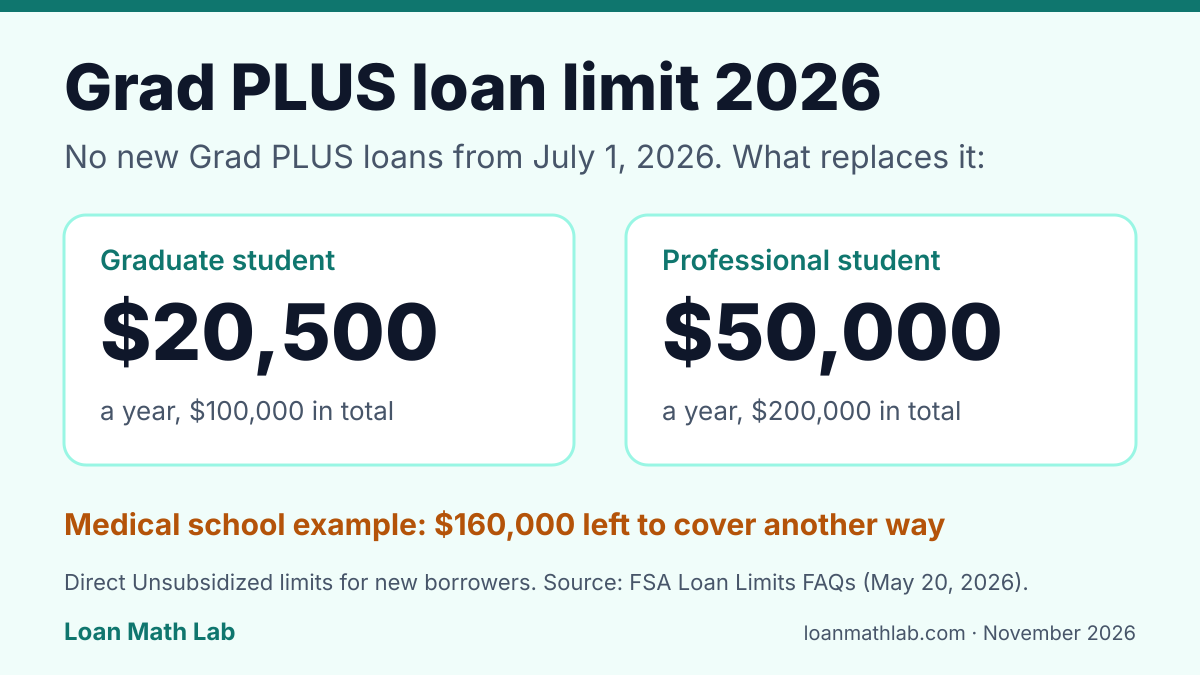
The Grad PLUS loan limit used to be generous: a graduate or professional student could borrow up to the full cost of attendance minus other aid. For anyone starting a graduate program on or after July 1, 2026, that loan is gone. New borrowers now rely on one federal loan, the Direct Unsubsidized Loan, with fixed yearly and total caps, and many will face a gap that Grad PLUS used to fill.
This guide explains what replaced the Grad PLUS loan limit, who can still borrow under the old rules, and how large the gap is for a master’s degree, a law degree and a medical degree, in dollars. Every limit comes from the federal regulations or Federal Student Aid, and the worked examples were checked in Python. If your family is also borrowing for an undergraduate, our guide to the Parent PLUS loan changes covers the parent side.
Table of Contents
Grad PLUS loan limit at a glance
| Before July 1, 2026 | New borrowers from July 1, 2026 | |
|---|---|---|
| Grad PLUS loan limit | Cost of attendance minus other aid, every year | No new Grad PLUS loans |
| Direct Unsubsidized, graduate student | $20,500 a year; $138,500 total including undergraduate loans | $20,500 a year; $100,000 total, not counting undergraduate loans |
| Direct Unsubsidized, professional student | $20,500 a year; $138,500 total including undergraduate loans | $50,000 a year; $200,000 total, not counting undergraduate loans |
| Lifetime cap on federal student loans | None | $257,500, including undergraduate loans |
| Interest rate (2026-27) | Fixed rate set each award year | 8.07% fixed for graduate and professional Direct Unsubsidized Loans |
| Repayment plans for new loans | Several, including IBR | Repayment Assistance Plan (RAP) or Tiered Standard |
Two numbers drive everything below: $20,500 a year for most graduate students and $50,000 a year for professional students such as future doctors and lawyers. Neither is tied to what your program costs, which is the whole difference from the old Grad PLUS loan limit.
Is Grad PLUS going away?
Yes, for new borrowers. The federal regulation now says that beginning on July 1, 2026, a graduate or professional student may not borrow a Direct PLUS Loan, in 34 CFR 685.200(b)(2). The final rule published in the Federal Register on May 1, 2026 describes the same change: the law ended the authority to make new Graduate PLUS loans and set a lifetime borrowing cap of $257,500 for most borrowers.
So for a student who enters a program in fall 2026 or later, the Grad PLUS loan limit is effectively zero. Existing Grad PLUS loans are not cancelled or changed; you keep repaying them under their own terms. And one group of current students can keep borrowing Grad PLUS for a while, under the interim exception explained below.
Grad PLUS loan changes in five points
Here is what changed around the Grad PLUS loan limit, in five points:
- No new Grad PLUS. Graduate and professional students cannot take a new Grad PLUS loan for periods of enrollment from July 1, 2026, unless they qualify for the interim exception.
- Two student categories. The new graduate unsubsidized loan limit depends on whether you are a graduate student or a professional student, as defined in the regulations.
- Total caps that ignore undergraduate debt. The new $100,000 and $200,000 totals do not count what you borrowed as an undergraduate; the separate $257,500 lifetime cap does.
- Schools can set lower limits. From July 1, 2026, a school may cap Direct Loans for a specific program below the federal limits, as long as it applies the cap to every student in that program.
- New loans, new repayment rules. Loans made on or after July 1, 2026 cannot use IBR, PAYE or ICR; they are repaid on RAP or Tiered Standard.
The new graduate unsubsidized loan limit
With Grad PLUS gone and no Grad PLUS loan limit to fall back on, the Direct Unsubsidized Loan is the only federal loan most new graduate students can take. Federal Student Aid’s Loan Limits FAQs list the limits that apply to periods of enrollment starting on or after July 1, 2026:
| Student type | Yearly limit | Total limit | Examples of programs |
|---|---|---|---|
| Graduate student | $20,500 | $100,000 | Master’s degrees, most Ph.D. programs, M.B.A. |
| Professional student | $50,000 | $200,000 | M.D., D.O., J.D., D.D.S. or D.M.D., Pharm.D., D.V.M., O.D. and others listed in the regulations |
Three rules sit on top of these numbers. First, no federal loan can exceed your cost of attendance minus other financial assistance, so the limit is a ceiling, not an amount you are owed. Second, students enrolled less than full time receive reduced limits, which schools calculate under a schedule of reductions that starts with the 2026-27 award year. Third, your school may set a lower limit for your program.
Who counts as a professional student
The higher $50,000 graduate unsubsidized loan limit only applies to professional students. Under 34 CFR 685.102, a professional degree generally signifies readiness to begin practice in a profession, is usually at the doctoral level, requires at least six years of postsecondary study including two after the bachelor’s, and generally needs a license to practice.
The regulation lists the fields: pharmacy (Pharm.D.), dentistry (D.D.S. or D.M.D.), veterinary medicine (D.V.M.), chiropractic, law (J.D.), medicine (M.D.), optometry (O.D.), osteopathic medicine (D.O.), podiatry, theology (M.Div. or M.H.L.) and clinical psychology (Psy.D. or Ph.D.). A master’s degree, even an expensive one, is a graduate program and gets the $20,500 limit, with no Grad PLUS loan limit above it. If you are not sure which category your program falls into, ask your school’s financial aid office before you plan your budget.
Who keeps the old Grad PLUS loan limit: the interim exception
Current students get a transition period. According to 34 CFR 685.200(b)(2)(ii) and the FSA Loan Limits FAQs, you keep the old Grad PLUS loan limit if both of these are true:
- you were enrolled in your program of study at a school on June 30, 2026; and
- a Direct Loan was made to you for that program before July 1, 2026.
A student who qualifies can keep borrowing Grad PLUS up to the cost of attendance minus other aid, alongside the old $20,500 unsubsidized limit and the old $138,500 total. The exception lasts for your expected time to credential: three academic years or the time left in your program, whichever is shorter. The $257,500 lifetime cap does not apply while the exception lasts, but any Grad PLUS you borrow during it counts toward the cap afterward.
| Your situation on July 1, 2026 | Interim exception | Old Grad PLUS loan limit for |
|---|---|---|
| Medical student who finished year 1 with a Direct Loan | Yes | Up to 3 academic years (years 2 to 4) |
| Law student who finished year 2 with a Direct Loan | Yes | Up to 1 academic year (year 3) |
| Enrolled on June 30, 2026, but never took a Direct Loan for the program | No | New limits from the start |
| Starting a graduate program in fall 2026 or later | No | New limits from the start |
The exception ends early if you withdraw or stop being enrolled in the program, under 685.200(b)(3). After that, the new graduate unsubsidized loan limit applies to any further borrowing, so think carefully before taking time off or switching programs.
What the new limits cover: three worked examples
To see how far the federal loans go without the old Grad PLUS loan limit, we took three typical programs and assumed a yearly need, meaning cost of attendance minus grants and scholarships. The students are new borrowers in fall 2026, so the interim exception does not apply, and they have no other federal loans for the program.
| Program | Yearly need (assumed) | Federal loans each year | Federal total | Total need | Gap to fill |
|---|---|---|---|---|---|
| Master’s degree, 2 years (graduate) | $60,000 | $20,500 | $41,000 | $120,000 | $79,000 |
| Law degree (J.D.), 3 years (professional) | $75,000 | $50,000 | $150,000 | $225,000 | $75,000 |
| Medical degree (M.D.), 4 years (professional) | $90,000 | $50,000 | $200,000 | $360,000 | $160,000 |

The medical student hits the $200,000 professional total exactly at the end of year four, so in a five-year program the fifth year would have no federal loan at all. The master’s student meets the yearly $20,500 cap long before the $100,000 total. In both cases, the end of the Grad PLUS loan limit moves most of the cost of an expensive program onto savings, school aid, work or private loans.
The $257,500 lifetime limit
The lifetime cap counts every federal student loan you borrow as a student, undergraduate and graduate, and, unlike the old Grad PLUS loan limit, it does not reset when you repay. Parent PLUS loans you take for your own children are excluded. For most single-degree students the program totals bind first, but the lifetime cap matters for second degrees.
Worked example: an independent undergraduate who borrowed the full $57,500 and then a two-year master’s at $41,000 has used $98,500. If that person later starts medical school, the lifetime cap leaves room for at most $159,000 more ($257,500 minus $98,500), less than the $200,000 professional total. That is our arithmetic on the rules in the FSA FAQs; your school’s financial aid office will confirm your own remaining eligibility.
What graduate loans made after July 2026 cost to repay
Direct Unsubsidized Loans for graduate and professional students first disbursed from July 1, 2026 to June 30, 2027 carry a fixed 8.07% rate, set in FSA announcement GENERAL-26-33. A loan fee of 1.057% is taken from each disbursement, according to FSA announcement GENERAL-26-28 (May 13, 2026), so a $20,500 loan pays out $20,283.32 and you repay the full $20,500. Students who still borrow under the old Grad PLUS loan limit pay 9.07% on new Grad PLUS loans for 2026-27, under the same announcement.
Interest starts on each disbursement while you are in school. In our examples, if each year’s loan is paid out at the start of that year, simple interest by the end of the six-month grace period comes to about $6,617 for the master’s student, $30,262 for the law student and $48,420 for the medical student. New loans are repaid on the Repayment Assistance Plan or on Tiered Standard, whose term is set by your total Direct Loan balance.
| Federal total | Tiered Standard term | Monthly payment | Total paid | If paid in 10 years |
|---|---|---|---|---|
| $41,000 | 15 years | $393.48 | $70,825 | $498.96 a month, $59,875 total |
| $150,000 | 25 years | $1,164.69 | $349,406 | $1,825.47 a month, $219,056 total |
| $200,000 | 25 years | $1,552.92 | $465,874 | $2,433.96 a month, $292,074 total |
The 25-year term lowers the monthly payment but more than doubles the interest compared with ten years. Our student loan payment calculator shows the payment and total interest for any balance and term, and our RAP student loan calculator estimates the income-based payment instead. To compare RAP and the fixed plans side by side, use our student loan calculator.
How to fill the gap without Grad PLUS
Without the Grad PLUS loan limit, the gap has to come from somewhere else. Our college cost calculator shows the gap for your own program, with an optional monthly payment if you borrow it. These steps go roughly from cheapest to most expensive:
- Ask the school first. Scholarships, assistantships, tuition waivers and fellowships do not need to be repaid. Ask also whether your program has its own lower loan limit, because that changes your plan before you start.
- Ask for a review of your aid. StudentAid.gov’s checklist of options when financial aid is not enough includes asking the school to adjust your aid when your circumstances changed, and asking the billing office about payment plans.
- Compare the full cost of the program. A cheaper program, living costs in a different city or part-time study while working can shrink the gap, but less-than-full-time enrollment also reduces your federal loan limits.
- Treat private loans as the last step. StudentAid.gov notes that private loans often need a cosigner and may not offer deferment or forbearance, and Edfinancial explains that private loan rates depend on credit history and are often variable. They do not qualify for federal plans such as RAP.
- Watch the rules. We log every federal change with its date and source on our student loan changes page.
Grad PLUS loan limit FAQ
What was the Grad PLUS loan limit before July 2026?
The cost of attendance minus other financial assistance, every academic year, with no fixed dollar cap. That rule still applies to students who qualify for the interim exception.
Can I still get a Grad PLUS loan in 2026-27?
Only if you were enrolled in your program on June 30, 2026 and received a Direct Loan for it before July 1, 2026. Everyone else is limited to Direct Unsubsidized Loans.
What is the graduate unsubsidized loan limit for 2026-27?
$20,500 a year and $100,000 in total for graduate students, and $50,000 a year and $200,000 in total for professional students, for periods of enrollment from July 1, 2026. Undergraduate loans do not count toward those totals.
Do my undergraduate loans count against the new limits?
Not against the $100,000 or $200,000 program totals. They do count toward the $257,500 lifetime limit on federal student loans.
Can new graduate loans use income-driven repayment?
Yes, through RAP. Under 34 CFR 685.209, Direct Unsubsidized Loans can be repaid on the Repayment Assistance Plan, but only Direct Loans made before July 1, 2026 can use IBR, PAYE or ICR.
Sources for the Grad PLUS loan limit
- Frequently Asked Questions: Loan Limits (Federal Student Aid, May 20, 2026; new graduate and professional limits, lifetime limit, interim exception)
- 34 CFR 685.200, Borrower eligibility (Cornell LII; end of new Grad PLUS loans from July 1, 2026 and the interim exception)
- 34 CFR 685.203, Loan limits (Cornell LII, as amended May 1, 2026; previous limits, $257,500 lifetime cap, institution-set limits)
- 34 CFR 685.102, Definitions (Cornell LII; graduate student and professional student)
- 34 CFR 685.209, Income-driven repayment plans (Cornell LII; RAP eligibility and the July 1, 2026 cutoff for IBR, PAYE and ICR)
- GENERAL-26-33: Interest Rates for Direct Loans First Disbursed Between July 1, 2026 and June 30, 2027 (Federal Student Aid, June 4, 2026)
- GENERAL-26-28: FY27 Sequester-Required Changes (Federal Student Aid, May 13, 2026; loan fees)
- Reimagining and Improving Student Education: Final Regulations (Federal Register, May 1, 2026)
- Options if You Did Not Receive Enough Financial Aid (StudentAid.gov) and Private Loans Explained (Edfinancial, a federal loan servicer)
This guide to the Grad PLUS loan limit is general information, not financial, legal or tax advice. Your school sets your actual loan amounts and may use a lower program limit; check with its financial aid office before you plan your borrowing. Loan Math Lab is not affiliated with the U.S. Department of Education. See our How We Verify page and Disclaimer. Information checked on November 3, 2026.