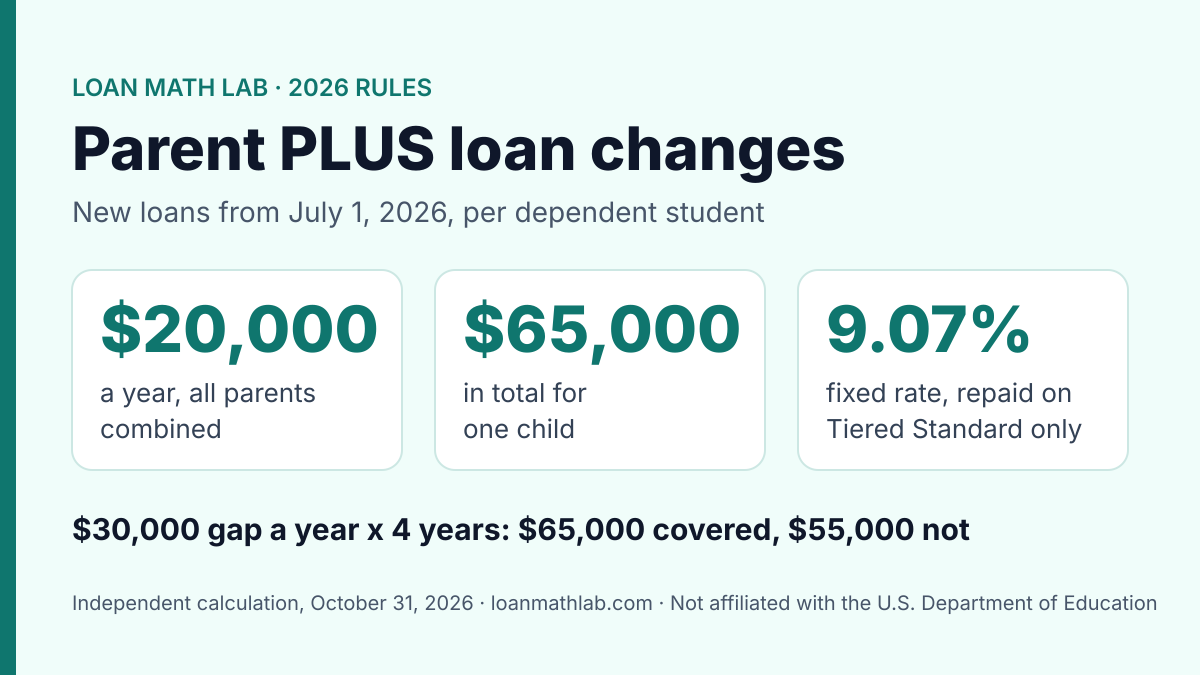
The Parent PLUS loan changes that took effect on July 1, 2026 do two things at once: they put a dollar cap on how much parents can borrow for a child’s undergraduate degree, and they shrink the list of repayment plans for new parent loans. Until June 2026, a parent could borrow up to the full cost of attendance minus other aid, with no total limit. That open-ended loan is gone for most new borrowers.
This guide explains the Parent PLUS loan changes in the order a family meets them: how much you can borrow now, who keeps the old rules for a while, how the new loans are repaid, and what it all costs in dollars. Every figure comes from the federal regulations or Federal Student Aid, and the worked examples were checked in Python. For your own numbers on student loans, our student loan calculator compares the main repayment plans side by side.
Table of Contents
Parent PLUS loan changes at a glance
| Before July 1, 2026 | New Parent PLUS loans from July 1, 2026 | |
|---|---|---|
| Yearly limit | Cost of attendance minus other aid | $20,000 per dependent student (and never more than cost of attendance minus other aid) |
| Total limit | None | $65,000 per dependent student, counting all past Parent PLUS borrowing for that child |
| Fixed repayment plans | Standard (10 years), Graduated, Extended | Tiered Standard only (10 to 25 years, by balance) |
| Income-driven repayment | ICR after a Direct Consolidation Loan | None for loans made on or after July 1, 2026 |
| Interest rate (2026-27) | Fixed rate set for each award year | 9.07% fixed for loans first disbursed from July 1, 2026 to June 30, 2027 |
Two groups are partly shielded from the Parent PLUS loan changes: families who already had a federal loan for the student’s current program before July 1, 2026, and parents who keep their older loans and never borrow again. Both are covered below.
The five Parent PLUS loan changes that matter most
- A yearly cap. New Parent PLUS borrowing is limited to $20,000 per dependent student each academic year.
- A lifetime cap per child. All parents together can borrow at most $65,000 for one dependent student, without regard to any amount already repaid or forgiven.
- A temporary exception. Families already borrowing for a program on June 30, 2026 keep the old limits for up to three more academic years.
- One repayment plan for new loans. A Parent PLUS loan made on or after July 1, 2026 is repaid on the Tiered Standard plan, with no income-driven option.
- A closed back door. Consolidating Parent PLUS loans on or after July 1, 2026 no longer leads to income-contingent repayment, so the old consolidation strategies stop working.
New Parent PLUS loan limits: $20,000 a year and $65,000 per student
The new Parent PLUS loan limits apply per child, not per parent. Federal Student Aid’s loan limits FAQs answer the most common question directly: two parents cannot each borrow $20,000 for the same student. The $20,000 yearly and $65,000 total limits cover all parent borrowing for that child combined.
The yearly limit also sits under the old ceiling rather than replacing it. The school still starts from the cost of attendance and subtracts other financial assistance; the Parent PLUS loan can then cover the remaining gap or $20,000, whichever is less. A family with a $12,000 gap can borrow $12,000, not $20,000.
- Past borrowing counts. The $65,000 total includes every Parent PLUS loan already taken for that child, including at other schools.
- Paying it off does not reset it. Amounts repaid, forgiven or discharged still count toward the $65,000.
- Each child has a separate cap. A parent with two children in college can borrow up to $65,000 for each one.
- No extra student loan once the cap is reached. A dependent student whose parent hits the $65,000 limit does not qualify for the additional Direct Unsubsidized Loan that students get when a parent is denied a PLUS loan.
Worked example: a $30,000 gap for four years
Here is how the Parent PLUS loan changes play out for a dependent student whose cost of attendance minus grants, scholarships and the student’s own federal loans leaves a $30,000 gap each year. The parent is a new borrower, so the interim exception does not apply.
| Year | Gap | Before July 2026 | Under the new limits | Left uncovered |
|---|---|---|---|---|
| 1 | $30,000 | $30,000 | $20,000 | $10,000 |
| 2 | $30,000 | $30,000 | $20,000 | $10,000 |
| 3 | $30,000 | $30,000 | $20,000 | $10,000 |
| 4 | $30,000 | $30,000 | $5,000 | $25,000 |
| Total | $120,000 | $120,000 | $65,000 | $55,000 |

The squeeze from the Parent PLUS loan changes arrives in year four. After three years at $20,000, only $5,000 of the $65,000 total is left, so the family must find $25,000 that year from savings, income, a payment plan with the school or a private loan. Our college cost calculator works out that gap from your own school’s cost, grants and family money. If the gap were $15,000 a year instead, the total would be $60,000 and the new limits would not bite at all.
Who keeps the old limits: the interim exception
The law gives families who were already borrowing a transition period from the Parent PLUS loan changes, which Federal Student Aid calls the interim exception. Parents qualify when both conditions in the FSA FAQs are met:
- the student was enrolled in a program of study at a school on June 30, 2026; and
- a Direct Loan for that program, to the student or to the parent, was disbursed before July 1, 2026.
A qualifying parent can keep borrowing up to the cost of attendance minus other aid, with no $65,000 cap, during the student’s expected time to credential. That period starts on July 1, 2026 and lasts three academic years or the time left in the program, whichever is shorter. It cannot be extended, and families cannot opt out of it.
| Student on July 1, 2026 (four-year program) | Interim exception | Old limits for |
|---|---|---|
| Finished year 1, had a Direct Loan | Yes | Up to 3 academic years |
| Finished year 2, had a Direct Loan | Yes | Up to 2 academic years |
| Finished year 1, no federal loan before July 2026 | No | New limits from the start |
| Starting college in fall 2026 or later | No | New limits from the start |
The exception is fragile. A student who withdraws from the program, switches to a different program of study or breaks enrollment loses it, and the parent moves to the new $20,000 and $65,000 limits. Changing majors inside the same degree does not count as a change of program, according to the same FAQs.
Parent PLUS loan repayment changes after July 1, 2026
The repayment side of the Parent PLUS loan changes depends on one date: whether you have any federal Direct Loan made on or after July 1, 2026. Under 34 CFR 685.209, only Direct Loans made before that date can use the ICR, IBR and PAYE plans, and Parent PLUS loans are excluded from the new Repayment Assistance Plan (RAP) entirely.
| Your situation | Repayment plans open | Income-driven option |
|---|---|---|
| Only Parent PLUS loans made before July 1, 2026, not consolidated | Standard (10 years), Graduated, Extended | None |
| Parent PLUS consolidated before July 1, 2026, no new loans since | Fixed plans plus ICR through June 30, 2028 | ICR; IBR once you have made an ICR payment |
| Any new Direct Loan (yours or a new Parent PLUS) on or after July 1, 2026 | Tiered Standard | None |
| Parent PLUS consolidated on or after July 1, 2026 | Tiered Standard | None |
New Parent PLUS loans: Tiered Standard only
Under the Parent PLUS loan changes, a Parent PLUS loan made on or after July 1, 2026 is repaid on the Tiered Standard plan in 34 CFR 685.208: fixed monthly payments of at least $50, over a term set by the total of your Direct Loans when you enter repayment.
| Total Direct Loans entering repayment | Repayment term |
|---|---|
| Less than $25,000 | 10 years |
| $25,000 to $49,999 | 15 years |
| $50,000 to $99,999 | 20 years |
| $100,000 or more | 25 years |
One of the least-known Parent PLUS loan changes: borrowing one new loan also affects the older ones. The Standard, Graduated and Extended plans are written for borrowers who have not received a Direct Loan on or after July 1, 2026. A parent who takes a new Parent PLUS loan in 2026-27 on top of older ones is moved to the Tiered Standard rules for the whole balance, and loses ICR access on a consolidation loan too. Our tiered standard plan guide shows the payment for each balance tier and what crossing $25,000 costs.
Parent PLUS loan income-driven repayment: what is left
Parent PLUS loans are not eligible for income-driven repayment on their own under 34 CFR 685.209. The route was to consolidate them into a Direct Consolidation Loan and choose Income-Contingent Repayment (ICR), which charges up to 20% of discretionary income. After the Parent PLUS loan changes, that route survives only for consolidation loans made before July 1, 2026.
- Already consolidated and on ICR: ICR closes on July 1, 2028. If you made at least one ICR payment on or after July 4, 2025, the rules let your consolidation loan move to Income-Based Repayment (IBR); you must pick a new plan before July 1, 2028.
- Consolidated but never enrolled in ICR: you can still choose ICR through June 30, 2028, as long as you take no new Direct Loan on or after July 1, 2026.
- Not consolidated yet: a consolidation made now is a loan made after July 1, 2026, so it can only be repaid on the Tiered Standard plan. It does not open any income-driven option.
- Double consolidation: the two-step strategy some parents used to reach other income-driven plans relied on consolidations that the new date rule now excludes. Our student loan consolidation guide explains what consolidating still does in 2026.
What the Parent PLUS loan changes cost: four repayment examples
New Parent PLUS loans for 2026-27 carry a fixed rate of 9.07%, set by Federal Student Aid in electronic announcement GENERAL-26-33. These examples show what the Parent PLUS loan changes mean for a monthly budget. They assume the whole balance enters repayment at once at that rate; interest that builds while the student is in school would add to it.
| Balance entering repayment | Tiered Standard term | Monthly payment | Total paid | Interest |
|---|---|---|---|---|
| $20,000 | 10 years | $254.11 | $30,493 | $10,493 |
| $49,000 | 15 years | $499.03 | $89,825 | $40,825 |
| $50,000 | 20 years | $452.12 | $108,507 | $58,507 |
| $65,000 | 20 years | $587.75 | $141,060 | $76,060 |
Look at the $49,000 and $50,000 rows. One extra thousand dollars crosses a tier, stretches the term from 15 to 20 years and lowers the payment by $46.91 a month, but it adds about $17,700 of interest. A lower payment is not always the cheaper choice. Our student loan payment calculator shows the payment and interest for any balance, rate and term. To see how much you can borrow under the new limits, what the loan fee takes and your Tiered Standard payment, use our Parent PLUS loan calculator.
Are Parent PLUS loans going away?
No. Parent PLUS loans are still available for parents of dependent undergraduates in 2026-27; the FSA FAQs set out the limits that apply to them this year. The Parent PLUS loan changes cover the amount, the repayment plans and the interest rate, not the loan itself. The program that did end is Grad PLUS: the final rule published in the Federal Register on May 1, 2026 phases out new Grad PLUS loans for graduate and professional students, with the same kind of interim exception for current students. Our guide to the Grad PLUS loan limit explains what replaced it and the gap in dollars.
We log every rule change with its date and source on our student loan changes page, so you can check whether anything has moved since this guide was written.
What to do now after the Parent PLUS loan changes
Which of the Parent PLUS loan changes affect you depends on where your family stands today:
- Your child starts college in 2027 or later: estimate the yearly gap for all four years now. If it averages more than $16,250, the $65,000 cap will leave part of it uncovered.
- Your child is already enrolled and you qualify for the interim exception: keep the student in the same program; a withdrawal or a change of program ends the old limits.
- You hold older Parent PLUS loans: before borrowing any new federal loan, compare what you would lose. A new loan moves your older loans to the Tiered Standard rules.
- You are on ICR with a consolidation loan: plan the switch to IBR or a fixed plan before July 1, 2028.
- Your student borrows in their own name: their options are different; our guide to the Repayment Assistance Plan explains the new income-driven plan for student loans.
Parent PLUS loan changes FAQ
When did the Parent PLUS loan changes take effect?
On July 1, 2026. The new limits apply to Parent PLUS loans for periods of enrollment from that date, and the repayment rules apply to loans made on or after it.
Can both parents borrow $20,000 each?
No. The $20,000 yearly and $65,000 total limits apply to all parents combined for each dependent student.
Do Parent PLUS loans taken before July 2026 count toward the $65,000 limit?
Yes. The total counts all past Parent PLUS borrowing for that child, including at other schools, even if part of it was repaid.
Can Parent PLUS loans use the Repayment Assistance Plan?
No. Parent PLUS loans are not eligible for RAP under 34 CFR 685.209, and neither are most consolidation loans that repaid them. The rules carve out consolidation loans already being repaid on ICR, PAYE or IBR, so ask your servicer if that is your case.
What is the Parent PLUS interest rate for 2026-27?
9.07% fixed for loans first disbursed from July 1, 2026 to June 30, 2027, according to Federal Student Aid.
What happens if a Parent PLUS loan is denied?
The rule that lets a dependent student borrow an additional Direct Unsubsidized Loan when a parent cannot get a PLUS loan is unchanged, according to Federal Student Aid. That extra loan is not available when the parent simply reaches the $65,000 cap.
Does consolidating Parent PLUS loans still help?
Not for income-driven repayment. A consolidation made on or after July 1, 2026 can only be repaid on the Tiered Standard plan.
Sources for these Parent PLUS loan changes
- Frequently Asked Questions: Loan Limits (Federal Student Aid, May 20, 2026; yearly and total Parent PLUS limits, interim exception, expected time to credential)
- 34 CFR 685.209, Income-driven repayment plans (Cornell LII, text of May 1, 2026; RAP, ICR and IBR eligibility for Parent PLUS and consolidation loans)
- 34 CFR 685.208, Fixed payment repayment plans (Cornell LII, text of May 1, 2026; Standard, Graduated, Extended and Tiered Standard plans)
- GENERAL-26-33: Interest Rates for Direct Loans First Disbursed Between July 1, 2026 and June 30, 2027 (Federal Student Aid, June 4, 2026)
- Reimagining and Improving Student Education: Final Rule (Federal Register, May 1, 2026; new loan limits and Grad PLUS phase-out)
This guide to the Parent PLUS loan changes is general information, not financial, legal or tax advice. Your school sets your actual borrowing limit and your servicer sets your payment; check both before you borrow or consolidate. Loan Math Lab is not affiliated with the U.S. Department of Education. See our How We Verify page and Disclaimer. Information checked on October 31, 2026.