Category: Borrowing for College

  • Grad PLUS Loan Limit 2026: What Replaced It and the Gap in Dollars

    Grad PLUS Loan Limit 2026: What Replaced It and the Gap in Dollars

    The Grad PLUS loan limit used to be generous: a graduate or professional student could borrow up to the full cost of attendance minus other aid. For anyone starting a graduate program on or after July 1, 2026, that loan is gone. New borrowers now rely on one federal loan, the Direct Unsubsidized Loan, with fixed yearly and total caps, and many will face a gap that Grad PLUS used to fill.

    This guide explains what replaced the Grad PLUS loan limit, who can still borrow under the old rules, and how large the gap is for a master’s degree, a law degree and a medical degree, in dollars. Every limit comes from the federal regulations or Federal Student Aid, and the worked examples were checked in Python. If your family is also borrowing for an undergraduate, our guide to the Parent PLUS loan changes covers the parent side.

    Grad PLUS loan limit at a glance

    Before July 1, 2026New borrowers from July 1, 2026
    Grad PLUS loan limitCost of attendance minus other aid, every yearNo new Grad PLUS loans
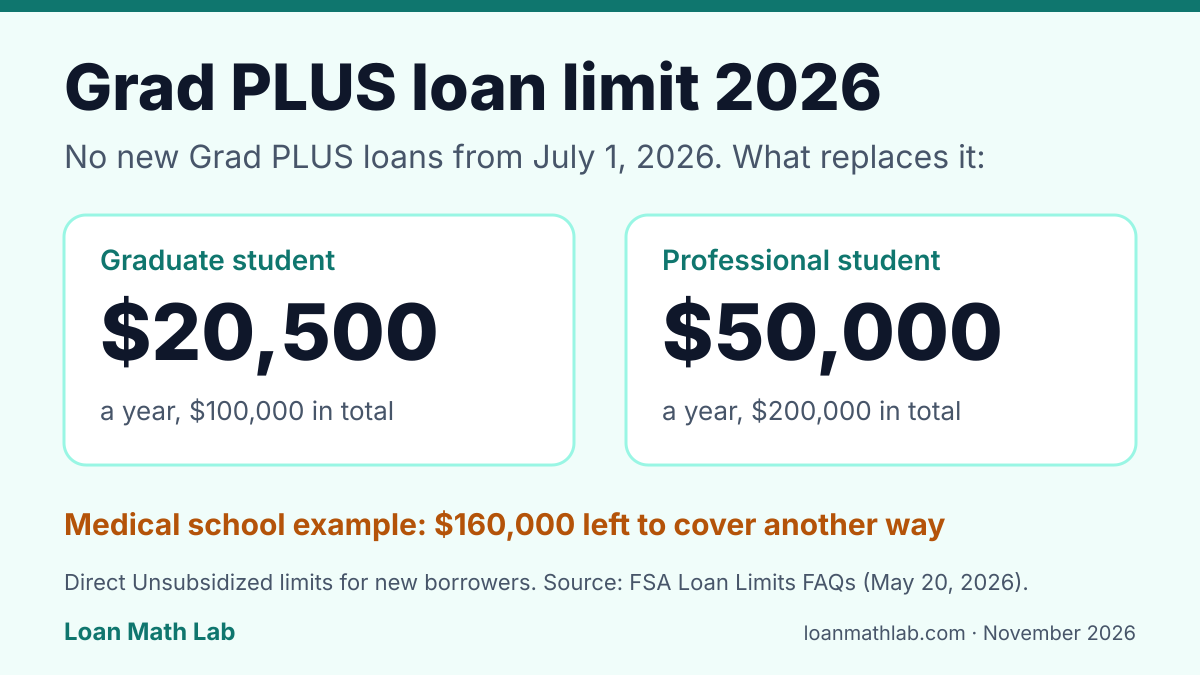
    Direct Unsubsidized, graduate student$20,500 a year; $138,500 total including undergraduate loans$20,500 a year; $100,000 total, not counting undergraduate loans
    Direct Unsubsidized, professional student$20,500 a year; $138,500 total including undergraduate loans$50,000 a year; $200,000 total, not counting undergraduate loans
    Lifetime cap on federal student loansNone$257,500, including undergraduate loans
    Interest rate (2026-27)Fixed rate set each award year8.07% fixed for graduate and professional Direct Unsubsidized Loans
    Repayment plans for new loansSeveral, including IBRRepayment Assistance Plan (RAP) or Tiered Standard
    The Grad PLUS loan limit and its replacement in one table. Sources: 34 CFR 685.200(b), 34 CFR 685.203, FSA Loan Limits FAQs (May 20, 2026), FSA GENERAL-26-33 and 34 CFR 685.209. Read on November 3, 2026.

    Two numbers drive everything below: $20,500 a year for most graduate students and $50,000 a year for professional students such as future doctors and lawyers. Neither is tied to what your program costs, which is the whole difference from the old Grad PLUS loan limit.

    Is Grad PLUS going away?

    Yes, for new borrowers. The federal regulation now says that beginning on July 1, 2026, a graduate or professional student may not borrow a Direct PLUS Loan, in 34 CFR 685.200(b)(2). The final rule published in the Federal Register on May 1, 2026 describes the same change: the law ended the authority to make new Graduate PLUS loans and set a lifetime borrowing cap of $257,500 for most borrowers.

    So for a student who enters a program in fall 2026 or later, the Grad PLUS loan limit is effectively zero. Existing Grad PLUS loans are not cancelled or changed; you keep repaying them under their own terms. And one group of current students can keep borrowing Grad PLUS for a while, under the interim exception explained below.

    Grad PLUS loan changes in five points

    Here is what changed around the Grad PLUS loan limit, in five points:

    • No new Grad PLUS. Graduate and professional students cannot take a new Grad PLUS loan for periods of enrollment from July 1, 2026, unless they qualify for the interim exception.
    • Two student categories. The new graduate unsubsidized loan limit depends on whether you are a graduate student or a professional student, as defined in the regulations.
    • Total caps that ignore undergraduate debt. The new $100,000 and $200,000 totals do not count what you borrowed as an undergraduate; the separate $257,500 lifetime cap does.
    • Schools can set lower limits. From July 1, 2026, a school may cap Direct Loans for a specific program below the federal limits, as long as it applies the cap to every student in that program.
    • New loans, new repayment rules. Loans made on or after July 1, 2026 cannot use IBR, PAYE or ICR; they are repaid on RAP or Tiered Standard.

    The new graduate unsubsidized loan limit

    With Grad PLUS gone and no Grad PLUS loan limit to fall back on, the Direct Unsubsidized Loan is the only federal loan most new graduate students can take. Federal Student Aid’s Loan Limits FAQs list the limits that apply to periods of enrollment starting on or after July 1, 2026:

    Student typeYearly limitTotal limitExamples of programs
    Graduate student$20,500$100,000Master’s degrees, most Ph.D. programs, M.B.A.
    Professional student$50,000$200,000M.D., D.O., J.D., D.D.S. or D.M.D., Pharm.D., D.V.M., O.D. and others listed in the regulations
    New Direct Unsubsidized limits for graduate and professional students, from the FSA Loan Limits FAQs (question LMALL-Q3). Undergraduate loans and Grad PLUS loans do not count toward the $100,000 or $200,000 total (question GPSLL-Q2). Some health programs are placed in one category or the other by program.

    Three rules sit on top of these numbers. First, no federal loan can exceed your cost of attendance minus other financial assistance, so the limit is a ceiling, not an amount you are owed. Second, students enrolled less than full time receive reduced limits, which schools calculate under a schedule of reductions that starts with the 2026-27 award year. Third, your school may set a lower limit for your program.

    Who counts as a professional student

    The higher $50,000 graduate unsubsidized loan limit only applies to professional students. Under 34 CFR 685.102, a professional degree generally signifies readiness to begin practice in a profession, is usually at the doctoral level, requires at least six years of postsecondary study including two after the bachelor’s, and generally needs a license to practice.

    The regulation lists the fields: pharmacy (Pharm.D.), dentistry (D.D.S. or D.M.D.), veterinary medicine (D.V.M.), chiropractic, law (J.D.), medicine (M.D.), optometry (O.D.), osteopathic medicine (D.O.), podiatry, theology (M.Div. or M.H.L.) and clinical psychology (Psy.D. or Ph.D.). A master’s degree, even an expensive one, is a graduate program and gets the $20,500 limit, with no Grad PLUS loan limit above it. If you are not sure which category your program falls into, ask your school’s financial aid office before you plan your budget.

    Who keeps the old Grad PLUS loan limit: the interim exception

    Current students get a transition period. According to 34 CFR 685.200(b)(2)(ii) and the FSA Loan Limits FAQs, you keep the old Grad PLUS loan limit if both of these are true:

    • you were enrolled in your program of study at a school on June 30, 2026; and
    • a Direct Loan was made to you for that program before July 1, 2026.

    A student who qualifies can keep borrowing Grad PLUS up to the cost of attendance minus other aid, alongside the old $20,500 unsubsidized limit and the old $138,500 total. The exception lasts for your expected time to credential: three academic years or the time left in your program, whichever is shorter. The $257,500 lifetime cap does not apply while the exception lasts, but any Grad PLUS you borrow during it counts toward the cap afterward.

    Your situation on July 1, 2026Interim exceptionOld Grad PLUS loan limit for
    Medical student who finished year 1 with a Direct LoanYesUp to 3 academic years (years 2 to 4)
    Law student who finished year 2 with a Direct LoanYesUp to 1 academic year (year 3)
    Enrolled on June 30, 2026, but never took a Direct Loan for the programNoNew limits from the start
    Starting a graduate program in fall 2026 or laterNoNew limits from the start
    Our reading of the expected time to credential rule in the FSA Loan Limits FAQs (questions IE-Q1, ETC-Q2 and ETC-Q15).

    The exception ends early if you withdraw or stop being enrolled in the program, under 685.200(b)(3). After that, the new graduate unsubsidized loan limit applies to any further borrowing, so think carefully before taking time off or switching programs.

    What the new limits cover: three worked examples

    To see how far the federal loans go without the old Grad PLUS loan limit, we took three typical programs and assumed a yearly need, meaning cost of attendance minus grants and scholarships. The students are new borrowers in fall 2026, so the interim exception does not apply, and they have no other federal loans for the program.

    ProgramYearly need (assumed)Federal loans each yearFederal totalTotal needGap to fill
    Master’s degree, 2 years (graduate)$60,000$20,500$41,000$120,000$79,000
    Law degree (J.D.), 3 years (professional)$75,000$50,000$150,000$225,000$75,000
    Medical degree (M.D.), 4 years (professional)$90,000$50,000$200,000$360,000$160,000
    Our calculation in Python, November 3, 2026. Yearly need figures are assumptions chosen for illustration; limits from the FSA Loan Limits FAQs. Before July 2026, the old Grad PLUS loan limit could have covered each gap.
    Grad PLUS loan limit 2026 chart: federal Direct Unsubsidized loans versus total need for a master's, a law degree and a medical degree

    The medical student hits the $200,000 professional total exactly at the end of year four, so in a five-year program the fifth year would have no federal loan at all. The master’s student meets the yearly $20,500 cap long before the $100,000 total. In both cases, the end of the Grad PLUS loan limit moves most of the cost of an expensive program onto savings, school aid, work or private loans.

    The $257,500 lifetime limit

    The lifetime cap counts every federal student loan you borrow as a student, undergraduate and graduate, and, unlike the old Grad PLUS loan limit, it does not reset when you repay. Parent PLUS loans you take for your own children are excluded. For most single-degree students the program totals bind first, but the lifetime cap matters for second degrees.

    Worked example: an independent undergraduate who borrowed the full $57,500 and then a two-year master’s at $41,000 has used $98,500. If that person later starts medical school, the lifetime cap leaves room for at most $159,000 more ($257,500 minus $98,500), less than the $200,000 professional total. That is our arithmetic on the rules in the FSA FAQs; your school’s financial aid office will confirm your own remaining eligibility.

    What graduate loans made after July 2026 cost to repay

    Direct Unsubsidized Loans for graduate and professional students first disbursed from July 1, 2026 to June 30, 2027 carry a fixed 8.07% rate, set in FSA announcement GENERAL-26-33. A loan fee of 1.057% is taken from each disbursement, according to FSA announcement GENERAL-26-28 (May 13, 2026), so a $20,500 loan pays out $20,283.32 and you repay the full $20,500. Students who still borrow under the old Grad PLUS loan limit pay 9.07% on new Grad PLUS loans for 2026-27, under the same announcement.

    Interest starts on each disbursement while you are in school. In our examples, if each year’s loan is paid out at the start of that year, simple interest by the end of the six-month grace period comes to about $6,617 for the master’s student, $30,262 for the law student and $48,420 for the medical student. New loans are repaid on the Repayment Assistance Plan or on Tiered Standard, whose term is set by your total Direct Loan balance.

    Federal totalTiered Standard termMonthly paymentTotal paidIf paid in 10 years
    $41,00015 years$393.48$70,825$498.96 a month, $59,875 total
    $150,00025 years$1,164.69$349,406$1,825.47 a month, $219,056 total
    $200,00025 years$1,552.92$465,874$2,433.96 a month, $292,074 total
    Our calculation in Python, November 3, 2026. Rate 8.07% fixed, monthly interest at 8.07% / 12, payments rounded to the cent. The balances leave out interest built up during school and assume no other Direct Loans, which would change the Tiered Standard term.

    The 25-year term lowers the monthly payment but more than doubles the interest compared with ten years. Our student loan payment calculator shows the payment and total interest for any balance and term, and our RAP student loan calculator estimates the income-based payment instead. To compare RAP and the fixed plans side by side, use our student loan calculator.

    How to fill the gap without Grad PLUS

    Without the Grad PLUS loan limit, the gap has to come from somewhere else. Our college cost calculator shows the gap for your own program, with an optional monthly payment if you borrow it. These steps go roughly from cheapest to most expensive:

    • Ask the school first. Scholarships, assistantships, tuition waivers and fellowships do not need to be repaid. Ask also whether your program has its own lower loan limit, because that changes your plan before you start.
    • Ask for a review of your aid. StudentAid.gov’s checklist of options when financial aid is not enough includes asking the school to adjust your aid when your circumstances changed, and asking the billing office about payment plans.
    • Compare the full cost of the program. A cheaper program, living costs in a different city or part-time study while working can shrink the gap, but less-than-full-time enrollment also reduces your federal loan limits.
    • Treat private loans as the last step. StudentAid.gov notes that private loans often need a cosigner and may not offer deferment or forbearance, and Edfinancial explains that private loan rates depend on credit history and are often variable. They do not qualify for federal plans such as RAP.
    • Watch the rules. We log every federal change with its date and source on our student loan changes page.

    Grad PLUS loan limit FAQ

    What was the Grad PLUS loan limit before July 2026?

    The cost of attendance minus other financial assistance, every academic year, with no fixed dollar cap. That rule still applies to students who qualify for the interim exception.

    Can I still get a Grad PLUS loan in 2026-27?

    Only if you were enrolled in your program on June 30, 2026 and received a Direct Loan for it before July 1, 2026. Everyone else is limited to Direct Unsubsidized Loans.

    What is the graduate unsubsidized loan limit for 2026-27?

    $20,500 a year and $100,000 in total for graduate students, and $50,000 a year and $200,000 in total for professional students, for periods of enrollment from July 1, 2026. Undergraduate loans do not count toward those totals.

    Do my undergraduate loans count against the new limits?

    Not against the $100,000 or $200,000 program totals. They do count toward the $257,500 lifetime limit on federal student loans.

    Can new graduate loans use income-driven repayment?

    Yes, through RAP. Under 34 CFR 685.209, Direct Unsubsidized Loans can be repaid on the Repayment Assistance Plan, but only Direct Loans made before July 1, 2026 can use IBR, PAYE or ICR.

    Sources for the Grad PLUS loan limit

    This guide to the Grad PLUS loan limit is general information, not financial, legal or tax advice. Your school sets your actual loan amounts and may use a lower program limit; check with its financial aid office before you plan your borrowing. Loan Math Lab is not affiliated with the U.S. Department of Education. See our How We Verify page and Disclaimer. Information checked on November 3, 2026.
  • Parent PLUS Loan Changes 2026: New Limits, Repayment Rules and Worked Examples

    Parent PLUS Loan Changes 2026: New Limits, Repayment Rules and Worked Examples

    The Parent PLUS loan changes that took effect on July 1, 2026 do two things at once: they put a dollar cap on how much parents can borrow for a child’s undergraduate degree, and they shrink the list of repayment plans for new parent loans. Until June 2026, a parent could borrow up to the full cost of attendance minus other aid, with no total limit. That open-ended loan is gone for most new borrowers.

    This guide explains the Parent PLUS loan changes in the order a family meets them: how much you can borrow now, who keeps the old rules for a while, how the new loans are repaid, and what it all costs in dollars. Every figure comes from the federal regulations or Federal Student Aid, and the worked examples were checked in Python. For your own numbers on student loans, our student loan calculator compares the main repayment plans side by side.

    Parent PLUS loan changes at a glance

    Before July 1, 2026New Parent PLUS loans from July 1, 2026
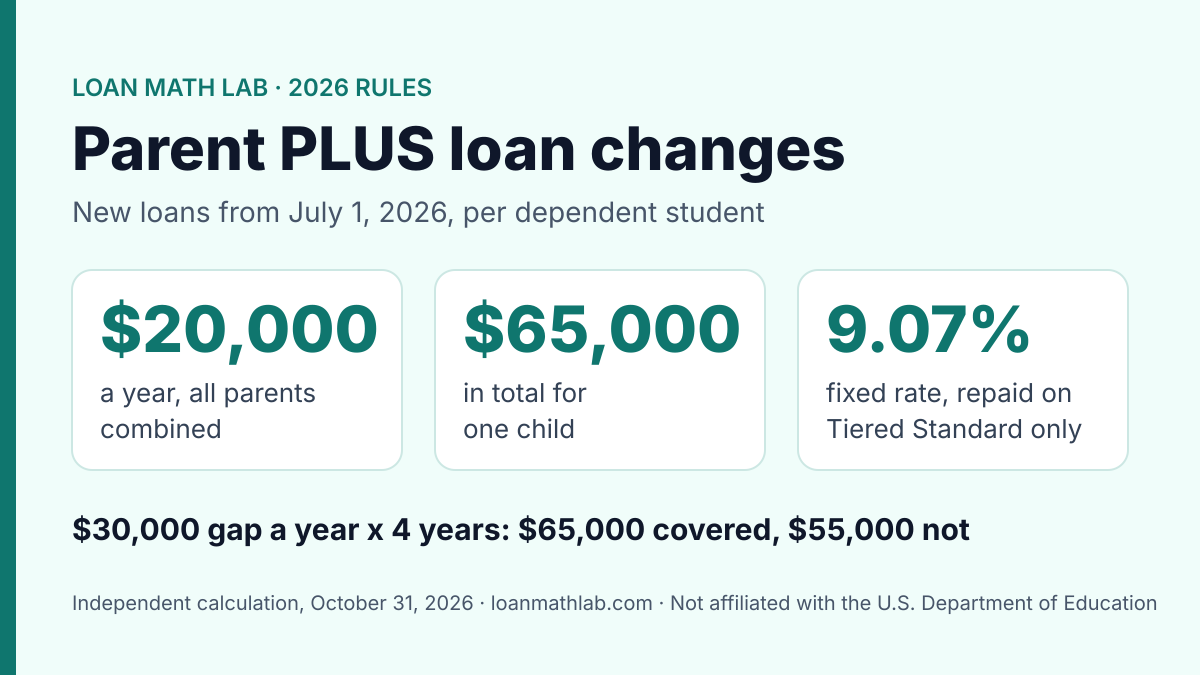
    Yearly limitCost of attendance minus other aid$20,000 per dependent student (and never more than cost of attendance minus other aid)
    Total limitNone$65,000 per dependent student, counting all past Parent PLUS borrowing for that child
    Fixed repayment plansStandard (10 years), Graduated, ExtendedTiered Standard only (10 to 25 years, by balance)
    Income-driven repaymentICR after a Direct Consolidation LoanNone for loans made on or after July 1, 2026
    Interest rate (2026-27)Fixed rate set for each award year9.07% fixed for loans first disbursed from July 1, 2026 to June 30, 2027
    Parent PLUS loan changes in one table. Sources: 34 CFR 685.203, 685.208 and 685.209; FSA Loan Limits FAQs (May 20, 2026); FSA GENERAL-26-33. Read on October 31, 2026.

    Two groups are partly shielded from the Parent PLUS loan changes: families who already had a federal loan for the student’s current program before July 1, 2026, and parents who keep their older loans and never borrow again. Both are covered below.

    The five Parent PLUS loan changes that matter most

    • A yearly cap. New Parent PLUS borrowing is limited to $20,000 per dependent student each academic year.
    • A lifetime cap per child. All parents together can borrow at most $65,000 for one dependent student, without regard to any amount already repaid or forgiven.
    • A temporary exception. Families already borrowing for a program on June 30, 2026 keep the old limits for up to three more academic years.
    • One repayment plan for new loans. A Parent PLUS loan made on or after July 1, 2026 is repaid on the Tiered Standard plan, with no income-driven option.
    • A closed back door. Consolidating Parent PLUS loans on or after July 1, 2026 no longer leads to income-contingent repayment, so the old consolidation strategies stop working.

    New Parent PLUS loan limits: $20,000 a year and $65,000 per student

    The new Parent PLUS loan limits apply per child, not per parent. Federal Student Aid’s loan limits FAQs answer the most common question directly: two parents cannot each borrow $20,000 for the same student. The $20,000 yearly and $65,000 total limits cover all parent borrowing for that child combined.

    The yearly limit also sits under the old ceiling rather than replacing it. The school still starts from the cost of attendance and subtracts other financial assistance; the Parent PLUS loan can then cover the remaining gap or $20,000, whichever is less. A family with a $12,000 gap can borrow $12,000, not $20,000.

    • Past borrowing counts. The $65,000 total includes every Parent PLUS loan already taken for that child, including at other schools.
    • Paying it off does not reset it. Amounts repaid, forgiven or discharged still count toward the $65,000.
    • Each child has a separate cap. A parent with two children in college can borrow up to $65,000 for each one.
    • No extra student loan once the cap is reached. A dependent student whose parent hits the $65,000 limit does not qualify for the additional Direct Unsubsidized Loan that students get when a parent is denied a PLUS loan.

    Worked example: a $30,000 gap for four years

    Here is how the Parent PLUS loan changes play out for a dependent student whose cost of attendance minus grants, scholarships and the student’s own federal loans leaves a $30,000 gap each year. The parent is a new borrower, so the interim exception does not apply.

    YearGapBefore July 2026Under the new limitsLeft uncovered
    1$30,000$30,000$20,000$10,000
    2$30,000$30,000$20,000$10,000
    3$30,000$30,000$20,000$10,000
    4$30,000$30,000$5,000$25,000
    Total$120,000$120,000$65,000$55,000
    Our calculation, October 31, 2026. The $30,000 gap is an assumption chosen for illustration; limits from 34 CFR 685.203 as explained in the FSA Loan Limits FAQs.
    Parent PLUS loan changes chart: yearly Parent PLUS borrowing before July 2026 and under the new $20,000 and $65,000 caps for a $30,000 yearly gap

    The squeeze from the Parent PLUS loan changes arrives in year four. After three years at $20,000, only $5,000 of the $65,000 total is left, so the family must find $25,000 that year from savings, income, a payment plan with the school or a private loan. Our college cost calculator works out that gap from your own school’s cost, grants and family money. If the gap were $15,000 a year instead, the total would be $60,000 and the new limits would not bite at all.

    Who keeps the old limits: the interim exception

    The law gives families who were already borrowing a transition period from the Parent PLUS loan changes, which Federal Student Aid calls the interim exception. Parents qualify when both conditions in the FSA FAQs are met:

    • the student was enrolled in a program of study at a school on June 30, 2026; and
    • a Direct Loan for that program, to the student or to the parent, was disbursed before July 1, 2026.

    A qualifying parent can keep borrowing up to the cost of attendance minus other aid, with no $65,000 cap, during the student’s expected time to credential. That period starts on July 1, 2026 and lasts three academic years or the time left in the program, whichever is shorter. It cannot be extended, and families cannot opt out of it.

    Student on July 1, 2026 (four-year program)Interim exceptionOld limits for
    Finished year 1, had a Direct LoanYesUp to 3 academic years
    Finished year 2, had a Direct LoanYesUp to 2 academic years
    Finished year 1, no federal loan before July 2026NoNew limits from the start
    Starting college in fall 2026 or laterNoNew limits from the start
    Our reading of the expected time to credential rule in the FSA Loan Limits FAQs (questions IE-Q2, IE-Q5 and ETC-Q10).

    The exception is fragile. A student who withdraws from the program, switches to a different program of study or breaks enrollment loses it, and the parent moves to the new $20,000 and $65,000 limits. Changing majors inside the same degree does not count as a change of program, according to the same FAQs.

    Parent PLUS loan repayment changes after July 1, 2026

    The repayment side of the Parent PLUS loan changes depends on one date: whether you have any federal Direct Loan made on or after July 1, 2026. Under 34 CFR 685.209, only Direct Loans made before that date can use the ICR, IBR and PAYE plans, and Parent PLUS loans are excluded from the new Repayment Assistance Plan (RAP) entirely.

    Your situationRepayment plans openIncome-driven option
    Only Parent PLUS loans made before July 1, 2026, not consolidatedStandard (10 years), Graduated, ExtendedNone
    Parent PLUS consolidated before July 1, 2026, no new loans sinceFixed plans plus ICR through June 30, 2028ICR; IBR once you have made an ICR payment
    Any new Direct Loan (yours or a new Parent PLUS) on or after July 1, 2026Tiered StandardNone
    Parent PLUS consolidated on or after July 1, 2026Tiered StandardNone
    Sources: 34 CFR 685.208 paragraphs (b) and (c), 34 CFR 685.209 paragraphs (b)(6), (c)(5), (c)(7) and (d). Read on October 31, 2026.

    New Parent PLUS loans: Tiered Standard only

    Under the Parent PLUS loan changes, a Parent PLUS loan made on or after July 1, 2026 is repaid on the Tiered Standard plan in 34 CFR 685.208: fixed monthly payments of at least $50, over a term set by the total of your Direct Loans when you enter repayment.

    Total Direct Loans entering repaymentRepayment term
    Less than $25,00010 years
    $25,000 to $49,99915 years
    $50,000 to $99,99920 years
    $100,000 or more25 years
    Tiered Standard terms, 34 CFR 685.208(c)(1).

    One of the least-known Parent PLUS loan changes: borrowing one new loan also affects the older ones. The Standard, Graduated and Extended plans are written for borrowers who have not received a Direct Loan on or after July 1, 2026. A parent who takes a new Parent PLUS loan in 2026-27 on top of older ones is moved to the Tiered Standard rules for the whole balance, and loses ICR access on a consolidation loan too. Our tiered standard plan guide shows the payment for each balance tier and what crossing $25,000 costs.

    Parent PLUS loan income-driven repayment: what is left

    Parent PLUS loans are not eligible for income-driven repayment on their own under 34 CFR 685.209. The route was to consolidate them into a Direct Consolidation Loan and choose Income-Contingent Repayment (ICR), which charges up to 20% of discretionary income. After the Parent PLUS loan changes, that route survives only for consolidation loans made before July 1, 2026.

    • Already consolidated and on ICR: ICR closes on July 1, 2028. If you made at least one ICR payment on or after July 4, 2025, the rules let your consolidation loan move to Income-Based Repayment (IBR); you must pick a new plan before July 1, 2028.
    • Consolidated but never enrolled in ICR: you can still choose ICR through June 30, 2028, as long as you take no new Direct Loan on or after July 1, 2026.
    • Not consolidated yet: a consolidation made now is a loan made after July 1, 2026, so it can only be repaid on the Tiered Standard plan. It does not open any income-driven option.
    • Double consolidation: the two-step strategy some parents used to reach other income-driven plans relied on consolidations that the new date rule now excludes. Our student loan consolidation guide explains what consolidating still does in 2026.

    What the Parent PLUS loan changes cost: four repayment examples

    New Parent PLUS loans for 2026-27 carry a fixed rate of 9.07%, set by Federal Student Aid in electronic announcement GENERAL-26-33. These examples show what the Parent PLUS loan changes mean for a monthly budget. They assume the whole balance enters repayment at once at that rate; interest that builds while the student is in school would add to it.

    Balance entering repaymentTiered Standard termMonthly paymentTotal paidInterest
    $20,00010 years$254.11$30,493$10,493
    $49,00015 years$499.03$89,825$40,825
    $50,00020 years$452.12$108,507$58,507
    $65,00020 years$587.75$141,060$76,060
    Our calculation in Python, October 31, 2026. Rate 9.07% fixed, monthly interest at 9.07% / 12, payments rounded to the cent; balances are assumptions chosen for illustration.

    Look at the $49,000 and $50,000 rows. One extra thousand dollars crosses a tier, stretches the term from 15 to 20 years and lowers the payment by $46.91 a month, but it adds about $17,700 of interest. A lower payment is not always the cheaper choice. Our student loan payment calculator shows the payment and interest for any balance, rate and term. To see how much you can borrow under the new limits, what the loan fee takes and your Tiered Standard payment, use our Parent PLUS loan calculator.

    Are Parent PLUS loans going away?

    No. Parent PLUS loans are still available for parents of dependent undergraduates in 2026-27; the FSA FAQs set out the limits that apply to them this year. The Parent PLUS loan changes cover the amount, the repayment plans and the interest rate, not the loan itself. The program that did end is Grad PLUS: the final rule published in the Federal Register on May 1, 2026 phases out new Grad PLUS loans for graduate and professional students, with the same kind of interim exception for current students. Our guide to the Grad PLUS loan limit explains what replaced it and the gap in dollars.

    We log every rule change with its date and source on our student loan changes page, so you can check whether anything has moved since this guide was written.

    What to do now after the Parent PLUS loan changes

    Which of the Parent PLUS loan changes affect you depends on where your family stands today:

    • Your child starts college in 2027 or later: estimate the yearly gap for all four years now. If it averages more than $16,250, the $65,000 cap will leave part of it uncovered.
    • Your child is already enrolled and you qualify for the interim exception: keep the student in the same program; a withdrawal or a change of program ends the old limits.
    • You hold older Parent PLUS loans: before borrowing any new federal loan, compare what you would lose. A new loan moves your older loans to the Tiered Standard rules.
    • You are on ICR with a consolidation loan: plan the switch to IBR or a fixed plan before July 1, 2028.
    • Your student borrows in their own name: their options are different; our guide to the Repayment Assistance Plan explains the new income-driven plan for student loans.

    Parent PLUS loan changes FAQ

    When did the Parent PLUS loan changes take effect?

    On July 1, 2026. The new limits apply to Parent PLUS loans for periods of enrollment from that date, and the repayment rules apply to loans made on or after it.

    Can both parents borrow $20,000 each?

    No. The $20,000 yearly and $65,000 total limits apply to all parents combined for each dependent student.

    Do Parent PLUS loans taken before July 2026 count toward the $65,000 limit?

    Yes. The total counts all past Parent PLUS borrowing for that child, including at other schools, even if part of it was repaid.

    Can Parent PLUS loans use the Repayment Assistance Plan?

    No. Parent PLUS loans are not eligible for RAP under 34 CFR 685.209, and neither are most consolidation loans that repaid them. The rules carve out consolidation loans already being repaid on ICR, PAYE or IBR, so ask your servicer if that is your case.

    What is the Parent PLUS interest rate for 2026-27?

    9.07% fixed for loans first disbursed from July 1, 2026 to June 30, 2027, according to Federal Student Aid.

    What happens if a Parent PLUS loan is denied?

    The rule that lets a dependent student borrow an additional Direct Unsubsidized Loan when a parent cannot get a PLUS loan is unchanged, according to Federal Student Aid. That extra loan is not available when the parent simply reaches the $65,000 cap.

    Does consolidating Parent PLUS loans still help?

    Not for income-driven repayment. A consolidation made on or after July 1, 2026 can only be repaid on the Tiered Standard plan.

    Sources for these Parent PLUS loan changes

    This guide to the Parent PLUS loan changes is general information, not financial, legal or tax advice. Your school sets your actual borrowing limit and your servicer sets your payment; check both before you borrow or consolidate. Loan Math Lab is not affiliated with the U.S. Department of Education. See our How We Verify page and Disclaimer. Information checked on October 31, 2026.