Category: Repayment Plans

  • Tiered Standard Repayment Plan 2026: Terms by Balance, Payments and Who Gets It

    Tiered Standard Repayment Plan 2026: Terms by Balance, Payments and Who Gets It

    The Tiered Standard plan is the fixed-payment federal student loan plan created for loans made on or after July 1, 2026: you pay the same amount every month, and the length of the plan, from 10 to 25 years, depends on how much you owe in Direct Loans when you start. It replaced the old 10-year Standard plan for new loans, and it is the plan your servicer uses if you do not pick one.

    This guide explains who is on the Tiered Standard repayment plan, how the term is set, what it costs at each balance, how it compares with RAP and the old Standard plan, and why it does not help with Public Service Loan Forgiveness. We opened every official page cited here on November 19, 2026. For every rule change of 2026 in one place, see our student loan changes log.

    Tiered Standard plan at a glance

    QuestionShort answer in 2026
    Who gets itAnyone with a Direct Loan first disbursed on or after July 1, 2026, and any Direct Loan borrower who chooses it
    PaymentFixed every month, at least $50
    How long10, 15, 20 or 25 years, set by your total Direct Loan balance
    Default plan?Yes. If you do not choose, your servicer places you on it
    Parent PLUS loansThe only plan open to them
    Counts for PSLF?No, not for PSLF or TEPSLF
    Prepay without penalty?Yes, at any time
    Sources: StudentAid.gov, One Big Beautiful Bill Act definitions, 34 CFR 685.208(c) and 34 CFR 685.211(a), read November 19, 2026.

    In one line: the Tiered Standard plan is simple and finishes on a fixed date, but a bigger balance buys a longer term, and a longer term means more interest.

    What is the Tiered Standard repayment plan?

    The Tiered Standard repayment plan comes from the One Big Beautiful Bill Act of 2025 and is written into federal regulation at 34 CFR 685.208(c). Like any standard plan, it divides your loan into equal monthly payments that pay off the principal and the interest by the end of the term. What is new is the tier: instead of one 10-year term for everyone, the term grows with your debt.

    According to StudentAid.gov, three things set your payment on the Tiered Standard plan: the principal balance you owe when you enter the plan, the interest rate on your loans, and the length of the repayment period. Your income plays no part. That is the main difference from the Repayment Assistance Plan (RAP), the other plan for new loans, where the payment follows your adjusted gross income.

    One detail can confuse you. A summary line on the StudentAid.gov repayment plans page calls it a 10-year fixed plan, while the same page’s comparison table and the regulation give 10 to 25 years depending on the amount borrowed. The 10-year figure is only right for balances under $25,000. We follow the regulation.

    Who is on the Tiered Standard plan?

    The rules on who uses the Tiered Standard plan are short, but each one has consequences:

    • New loans. Direct Loans first disbursed on or after July 1, 2026 can be repaid only under RAP or the Tiered Standard plan. The old Standard, Graduated and Extended plans are closed to them, according to the Standard plan page.
    • One new loan changes all your loans. StudentAid.gov says that if you have a single loan, including a Direct Consolidation Loan, first disbursed on or after July 1, 2026, your only choices for all your Direct Loans are RAP and Tiered Standard, older loans included. Going back to school for one more term can close IBR and the 10-year Standard plan for your undergraduate loans.
    • Everyone else can opt in. All Direct Loan borrowers have access to this plan, even with loans made before July 2026.
    • The default plan. You can be put on this plan without choosing it, when you enter or return to repayment without picking a plan, or when you must leave a plan and your loan type fits only this one.
    • Not for older loan programs. FFEL, Perkins and HEAL loans cannot be repaid under RAP or Tiered Standard. They stay on the older plans they qualify for, while your Direct Loans can use the new ones.

    Tiered standard repayment plan for Parent PLUS loans

    For parents, the Tiered Standard repayment plan is not one choice among several: it is the only one. StudentAid.gov lists three loan types that can be repaid only under the Tiered Standard plan: Direct PLUS Loans for parents, Direct Consolidation Loans that paid off a parent PLUS loan, and double consolidations. If a parent also has loans for their own education, those can go on the same plan or separately on RAP.

    An example at the 2026-27 Parent PLUS rate of 9.07%: a parent who owes $40,000 lands in the 15-year tier and pays $407.37 a month, with about $33,328 of interest over the life of the loan. Our Parent PLUS loan changes guide covers the new borrowing limits, and the Parent PLUS loan calculator works out the payment from your own figures.

    How long is the Tiered Standard plan? Terms by balance

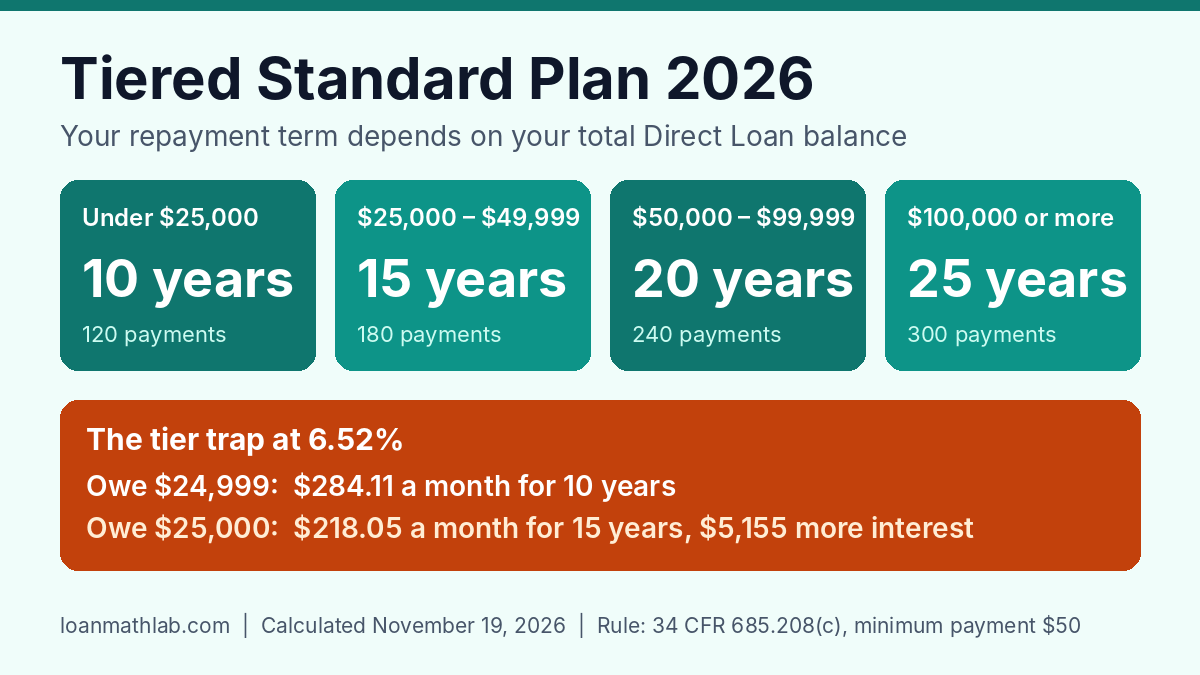
    How long the Tiered Standard plan lasts depends only on the total of your Direct Loans when you enter repayment. These are the four tiers in 34 CFR 685.208(c):

    Total Direct Loan balanceMaximum termNumber of payments
    Less than $25,00010 years120
    $25,000 to $49,99915 years180
    $50,000 to $99,99920 years240
    $100,000 or more25 years300
    Source: 34 CFR 685.208(c) and StudentAid.gov, Tiered Standard Plan definition, read November 19, 2026.

    Three rules sit behind the table. The tier uses the total of all your Direct Loans, not each loan on its own. Months in deferment or forbearance do not count toward the term, so a pause pushes the end date back. And if you add loans to the plan later, or leave it and come back, StudentAid.gov says your maximum term is recalculated on your total outstanding principal at that moment.

    Here is how that last rule plays out. Say you still owe $18,000 on a 10-year Tiered Standard plan, go back to school and borrow $10,000 more. When you re-enter repayment with $28,000, you move to the 15-year tier from that date: at 6.52% the new payment is $244.22 a month for 15 more years.

    Tiered standard plan minimum payment

    The Tiered Standard plan minimum payment is $50 a month. The only exception is a balance under $50, where you pay what is left. On a small loan the minimum can beat the formula: $4,000 at 6.52% over 10 years works out to $45.46, so you pay $50 instead and finish after 106 payments, about 8 years and 10 months, for $5,263 in total.

    Tiered standard plan calculator: payments by balance

    If you came looking for a tiered standard plan calculator, the table below gives the answer for common balances at the three fixed rates for loans first disbursed between July 1, 2026 and June 30, 2027: 6.52% for undergraduates, 8.07% for graduate Direct Unsubsidized Loans and 9.07% for PLUS loans.

    BalanceTerm6.52% undergraduate8.07% graduate9.07% PLUS
    $10,00010 years$113.65
    $3,638 interest
    $121.70
    $4,604 interest
    $127.05
    $5,247 interest
    $20,00010 years$227.30
    $7,276 interest
    $243.40
    $9,207 interest
    $254.11
    $10,493 interest
    $24,99910 years$284.11
    $9,095 interest
    $304.23
    $11,509 interest
    $317.62
    $13,116 interest
    $25,00015 years$218.05
    $14,250 interest
    $239.92
    $18,187 interest
    $254.61
    $20,829 interest
    $40,00015 years$348.88
    $22,799 interest
    $383.88
    $29,098 interest
    $407.37
    $33,328 interest
    $49,99915 years$436.09
    $28,499 interest
    $479.84
    $36,372 interest
    $509.21
    $41,658 interest
    $50,00020 years$373.38
    $39,609 interest
    $420.40
    $50,896 interest
    $452.12
    $58,507 interest
    $80,00020 years$597.40
    $63,376 interest
    $672.64
    $81,435 interest
    $723.39
    $93,611 interest
    $99,99920 years$746.74
    $79,220 interest
    $840.79
    $101,793 interest
    $904.22
    $117,016 interest
    $100,00025 years$676.46
    $102,936 interest
    $776.46
    $132,937 interest
    $844.00
    $153,195 interest
    $150,00025 years$1,014.69
    $154,404 interest
    $1,164.69
    $199,406 interest
    $1,265.99
    $229,800 interest
    Our calculation in Python, November 19, 2026: fixed payment, interest at one twelfth of the yearly rate, payment rounded to the cent, last payment adjusted. Rates from the Federal Student Aid announcement of June 4, 2026; see our federal student loan interest rates table.
    Tiered standard plan 2026: monthly payment by balance at 6.52%, with the term rising from 10 to 15, 20 and 25 years at $25,000, $50,000 and $100,000

    The chart shows the shape of the plan: the payment climbs with the balance, then drops each time a new tier starts, because the same debt is spread over five more years. If you have loans at different rates or want to see the effect of paying extra, our student loan payment calculator lets you pick the Tiered Standard term, and the student loan calculator on our home page compares it with RAP and IBR side by side. This tiered standard repayment plan calculator table is a fixed snapshot; those tools use your own numbers.

    The tier line: a few dollars can add five years

    The most surprising feature of the Tiered Standard plan is what happens right at each threshold. One dollar more in debt can lower your monthly payment and add thousands in interest:

    BalanceTermMonthly paymentTotal interestExtra interest
    $24,999 / $25,00010 / 15 years$284.11 / $218.05$9,095 / $14,250$5,155
    $49,999 / $50,00015 / 20 years$436.09 / $373.38$28,499 / $39,609$11,110
    $99,999 / $100,00020 / 25 years$746.74 / $676.46$79,220 / $102,936$23,716
    Our calculation in Python at 6.52%, November 19, 2026.

    At the first line, owing $25,000 instead of $24,999 cuts the payment by $66.06 a month but adds 60 payments and about $5,155 of interest. The longer term is a maximum, not an obligation. Under 34 CFR 685.211(a)(2), you can prepay all or part of a federal loan at any time without penalty.

    So a borrower who lands just over a line has two ways to keep the shorter payoff. Before entering repayment, paying the balance below the threshold, for example during the grace period, puts you in the lower tier with a fixed shorter term. Or you can stay in the longer tier and pay more each month by choice: $25,000 at 6.52% paid at $284.11 a month instead of $218.05 is gone in 10 years and 1 month, with about $9,096 of interest, almost the same as the 10-year tier. The second way keeps the lower required payment as a safety net if money gets tight.

    One practical point: if an extra payment equals or exceeds your monthly amount, the same rule says the servicer moves your next due date forward unless you ask otherwise. If you want the extra money to cut principal and still pay next month, tell your servicer.

    Tiered standard vs standard repayment plan

    The comparison of Tiered Standard vs Standard repayment plan matters only to borrowers who still have a choice: people whose Direct Loans were all made before July 1, 2026 and who take no new loan. For them, the 10-year Standard plan stays open under 34 CFR 685.208(b), and the Tiered Standard plan is optional. Here is the same balance on both, at 6.52%:

    BalanceStandardTiered StandardInterest, StandardInterest, TieredExtra cost
    $30,000$340.95, 10 years$261.66, 15 years$10,914$17,100$6,186
    $40,000$454.60, 10 years$348.88, 15 years$14,552$22,799$8,248
    $60,000$681.90, 10 years$448.05, 20 years$21,828$47,532$25,704
    Our calculation in Python, November 19, 2026. Same method as the table above.

    Under $25,000 the two plans give the same result. Above it, the Tiered Standard plan lowers the payment, by about $79 a month on $30,000, and costs more in total, about $6,186 on the same loan. If the higher Standard payment fits your budget, it is the cheaper of the two. If it does not, compare the Tiered Standard plan with an income-driven plan before choosing.

    Tiered standard vs RAP: which costs less each month?

    Tiered standard vs RAP is the real choice for most borrowers with new loans. RAP charges 1% to 10% of your adjusted gross income, depending on your income bracket, minus $50 a month for each dependent, with a $10 minimum. Our guide to the Repayment Assistance Plan explains the full rules. Here is the first-year payment for a single borrower with no dependents who owes $30,000 at 6.52%:

    AGIRAP rateRAP paymentTiered Standard, 15 yearsLower payment
    $30,0002%$50.00$261.66RAP
    $40,0003%$100.00$261.66RAP
    $50,0004%$166.67$261.66RAP
    $60,0005%$250.00$261.66RAP
    $75,0007%$437.50$261.66Tiered Standard
    Our calculation in Python, November 19, 2026, with the RAP rules used in our RAP calculator (34 CFR 685.209). Payments are for the first year only; RAP payments change with income every year.

    In this example RAP gives the lower payment up to $60,000 of income, and Tiered Standard wins above that. But the monthly payment is only part of the picture:

    • RAP follows your income. The payment is recalculated every year, so a raise raises it. A Tiered Standard payment never changes.
    • RAP can last 30 years. Any balance left after 360 qualifying payments is forgiven, and that forgiveness may be taxable. Tiered Standard ends on a fixed date with the loan paid in full.
    • RAP counts for PSLF. Tiered Standard does not (see below).
    • Parents have no choice. Parent PLUS loans can use only the Tiered Standard plan.

    To run your own numbers, use our RAP student loan calculator for RAP over the full term, and compare it with the Tiered Standard figure above. If you also have older loans that still qualify for IBR, our IBR vs RAP student loans guide shows where each plan wins.

    Tiered Standard plan and PSLF

    This is the rule public-service workers need to know. StudentAid.gov states that payments made while enrolled in the Tiered Standard plan are not qualifying payments for Public Service Loan Forgiveness or for Temporary Expanded PSLF. Ten years of payments on this plan would bring you no closer to PSLF.

    If you work for a government or nonprofit employer and plan to use PSLF, choose RAP, or IBR if your loans still qualify, from your first payment. Our PSLF calculator estimates how much PSLF could cancel on each plan, and our guide to federal student loan forgiveness covers the other programs.

    How to choose or leave the Tiered Standard plan

    1. Check your loans. Log in to StudentAid.gov and note the type, balance, rate and first disbursement date of each loan. Any loan first disbursed on or after July 1, 2026 limits all your Direct Loans to RAP and Tiered Standard.
    2. Add up your Direct Loans. The total decides your tier. If you are just over $25,000, $50,000 or $100,000, decide whether to pay it down before you enter repayment.
    3. Compare the plans. Use the official Repayment Calculator or our calculators to see your Tiered Standard payment next to RAP.
    4. Tell your servicer. Fixed-payment plans are chosen through your loan servicer. If you say nothing, you will be placed on the Tiered Standard plan.
    5. Set up autopay. Autopay cuts your rate by 1 percentage point through June 30, 2028 if you enroll with your servicer by December 31, 2026, as our interest rates page explains. A lower rate means less of each payment goes to interest.

    Thinking of consolidating to change plans? A Direct Consolidation Loan made now counts as a new loan, which leaves you only RAP and Tiered Standard for all your Direct Loans. Our student loan consolidation guide explains when that still makes sense.

    Tiered Standard plan FAQ

    Is the Tiered Standard plan always 10 years?

    No. It is 10 years only when your total Direct Loans are under $25,000. From $25,000 it is 15 years, from $50,000 it is 20 years and from $100,000 it is 25 years, under 34 CFR 685.208(c).

    What is the new standard repayment plan for 2026?

    The new standard repayment plan for loans made from July 1, 2026 is the Tiered Standard plan. The old 10-year Standard plan still exists, but only for borrowers who have not received a Direct Loan on or after that date.

    Can I switch from the Tiered Standard plan to RAP?

    Loans that are eligible for RAP can be repaid under RAP instead; ask your servicer to change your plan. Parent PLUS loans and consolidation loans that repaid them cannot move to RAP: Tiered Standard is their only option.

    Does the Tiered Standard plan forgive anything?

    No. The plan is built to pay the loan in full by the end of the term, so nothing is left to forgive, and its payments do not count toward PSLF or income-driven forgiveness.

    Are Tiered Standard payments ever lower than $50?

    Only when the balance itself is under $50, in which case you pay what is left. Otherwise the required payment is at least $50 a month.

    Sources for this Tiered Standard plan guide

    This Tiered Standard plan guide is general information, not financial or legal advice. Your loan servicer and the U.S. Department of Education decide your plan, term and payment, and rules can change. Loan Math Lab is not affiliated with the U.S. Department of Education. See our How We Verify page and Disclaimer. Information checked on November 19, 2026.
  • IBR vs RAP Student Loans: 4 Worked Examples for 2026

    IBR vs RAP Student Loans: 4 Worked Examples for 2026

    Comparing IBR vs RAP student loans comes down to one question: which plan gives you the lower payment and the better finish line with your income, family and loans? Both are federal income-driven plans, and both stay open in 2026. They just measure your income in very different ways, so the same borrower can pay $100 a month on one and $134 on the other, or the reverse.

    This IBR vs RAP student loans guide runs the numbers instead of listing pros and cons. You will see the two formulas side by side, four worked examples checked in Python, what happens to your balance in the first year, and a short checklist to decide. If you want your own figures, our student loan calculator puts both plans next to each other in one screen.

    IBR vs RAP student loans at a glance

    IBR (Income-Based Repayment)RAP (Repayment Assistance Plan)
    Who can use itOnly Direct Loans made before July 1, 2026Any Direct Loan borrower with eligible loans
    How income countsAGI minus 150% of the poverty line for your family sizeA percentage of your whole AGI, from 1% to 10%
    Share charged10% (new borrowers) or 15% (earlier borrowers) of discretionary income1% to 10% of AGI, by $10,000 bracket
    FamilyFamily size raises the protected amount$50 a month off for each dependent on your tax return
    Payment capNever more than the 10-year Standard paymentNo cap
    Minimum$0 below $5; $10 between $5 and $10$10 a month
    Unpaid interestCharged, except 3 years on subsidized loansNot charged if you pay on time
    PrincipalNo helpUp to $50 a month added to principal if your payment does not cut it
    Forgiveness20 years (new borrowers) or 25 years30 years (360 payments)
    IBR vs RAP student loans rules. Source: 34 CFR 685.209, read on October 26, 2026.

    The rest of this page explains each row with numbers, because the table alone hides the most important point: which plan is cheaper changes as your income changes.

    Can you choose IBR? Check this first

    Before comparing anything, check whether IBR is still open to you. Under the federal rules in 34 CFR 685.209, only Direct Loans made before July 1, 2026 can be repaid under IBR. RAP has no such limit: any borrower with eligible Direct Loans can choose it.

    • All your loans were paid out before July 1, 2026. You can choose either plan, so the comparison below applies to you.
    • You borrowed a new Direct Loan on or after July 1, 2026. That loan cannot go on IBR. Student loan lawyer Stanley Tate writes that a new loan or consolidation after that date closes IBR for your whole Direct Loan portfolio, so check with your servicer before you borrow or consolidate.
    • You have Parent PLUS loans. They are not eligible for RAP, and they are a separate case not covered by this page. Our guide to the Parent PLUS loan changes explains their new limits and repayment plans.

    Borrowers still on SAVE, PAYE or ICR have a different starting point and a deadline; our SAVE plan update explains the steps.

    How IBR vs RAP student loans set your payment

    The IBR formula

    IBR starts from your adjusted gross income (AGI) and first protects 150% of the federal poverty line for your family size. Only the rest, called discretionary income, is charged. Then it takes 10% of that amount if you are a new borrower, or 15% if you are not, and divides by 12.

    A “new borrower” for IBR is someone who had no federal student loan balance on July 1, 2014 or who had none left when they borrowed again after that date (before July 1, 2026). For a single person in the 48 contiguous states, 150% of the 2026 HHS poverty guideline is $23,940; for a family of three it is $40,980. Alaska and Hawaii have higher figures.

    One more rule matters a lot: the IBR payment never goes above what you would pay on the 10-year Standard plan for the balance you had when you entered IBR. Higher earners hit that cap and stop paying more.

    The RAP formula

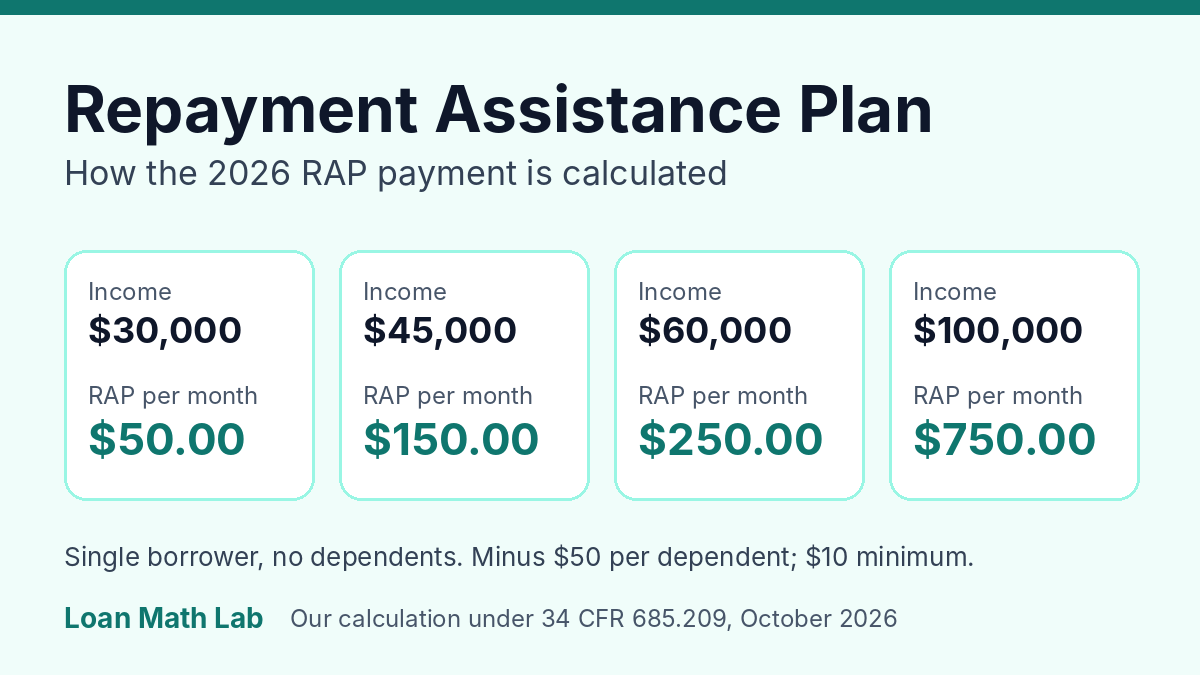
    RAP ignores the poverty line. It takes a percentage of your whole AGI, from 1% at $10,001 to 10% above $100,000, divides by 12 and subtracts $50 for each dependent you claim on your tax return. The minimum is $10 a month, and there is no cap.

    In exchange, RAP protects your balance: if your on-time payment does not cover the month’s interest, the rest is not charged, and if your payment reduces principal by less than $50, the government adds the difference up to $50. Our guide to the Repayment Assistance Plan explains these rules step by step.

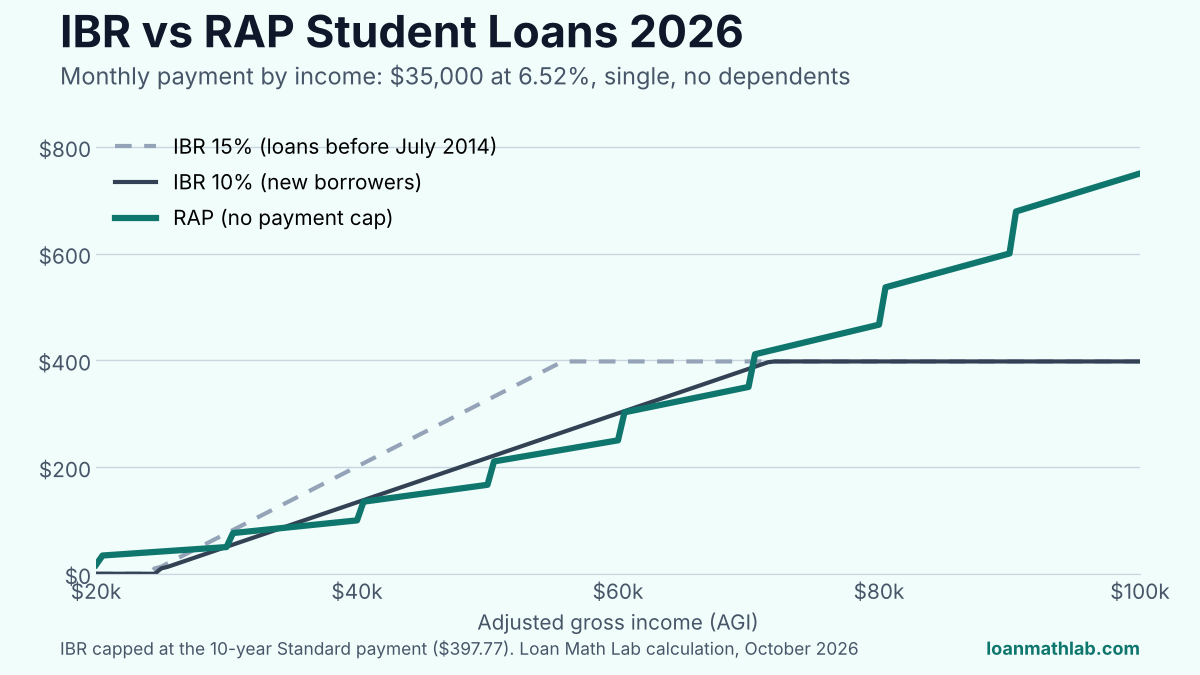
    IBR vs RAP student loans chart: monthly payment by income for RAP, IBR 10% and IBR 15% on $35,000 at 6.52%

    The chart shows the pattern for a single borrower with $35,000 at 6.52%. Between about $35,000 and $70,000 of income, RAP is the lowest line; below that, the poverty-line protection makes IBR cheaper. Above roughly $75,000, both IBR lines flatten at the $397.77 cap while RAP keeps rising.

    Repayment assistance plan vs IBR: four worked examples

    All four IBR vs RAP student loans examples use the same loan, $35,000 in Direct Loans at 6.52%, so only the borrower changes. The 10-year Standard payment for that balance is $397.77, which is the IBR cap. Each example shows what both plans charge in the first month.

    BorrowerAGIRAPIBR 10% (new)IBR 15% (older loans)
    A. Single, no children$40,000$100.00$133.83$200.75
    B. Single, no children$75,000$437.50$397.77 (cap)$397.77 (cap)
    C. Single parent, 2 children$55,000$129.17$116.83$175.25
    D. Single, part-time job$25,000$41.67$10.00$13.25
    IBR vs RAP student loans, first-month payment. Our calculation, checked in Python on October 26, 2026. Balance, rate and incomes are assumptions chosen for illustration; 2026 poverty guidelines for the 48 contiguous states.

    Example A: $40,000 income

    RAP charges 3% of $40,000, which is $1,200 a year or $100.00 a month. IBR first protects $23,940 and charges 10% of the remaining $16,060, so $133.83 a month for a new borrower and $200.75 for an older one. RAP is cheaper here, by $33.83 to $100.75 a month.

    Example B: $75,000 income

    RAP charges 7% of all $75,000: $437.50 a month. Both IBR versions would charge more than $397.77, so the cap applies and the payment stays at $397.77. At this income, IBR saves $39.73 a month, and the gap grows as income rises: at $90,000, RAP asks $600.00.

    Example C: single parent with two children

    With two dependents, RAP takes 5% of $55,000 ($229.17) and subtracts $100, for $129.17. IBR protects $40,980 for a family of three, leaving $14,020: $116.83 at 10% and $175.25 at 15%. A new borrower pays less on IBR; an older borrower pays less on RAP. Your loan dates decide the winner.

    Example D: low income

    At $25,000, RAP charges 2% ($41.67). IBR protects almost all of that income: the 10% version works out to $8.83, which the rules round up to the $10 minimum, and the 15% version to $13.25. For very low incomes, IBR usually asks less each month.

    Your balance after year one

    The monthly payment is only half of the IBR vs RAP student loans comparison. Take borrower A, whose payment is lower than the monthly interest of $190.17 on either plan:

    After 12 monthsIBR 10%RAP
    Paid in the year$1,605.96$1,200.00
    Unpaid interest added$676.08$0
    Principal$35,000.00$34,400.00
    Total owed$35,676.08$34,400.00
    Our calculation, checked in Python on October 26, 2026. Unsubsidized loans; on-time payments; monthly interest at 6.52% / 12.

    Borrower A pays $405.96 less on RAP and ends the year owing $1,276.08 less, because RAP waives the uncovered interest and adds a $50 principal match every month. On IBR, unpaid interest keeps building and can be added to the principal later, for example if you leave the plan. To follow the RAP side over the full 30 years, use our RAP student loan calculator; for the IBR side over 20 or 25 years, use our IBR student loan calculator.

    Which student loan repayment plan is best for you?

    There is no single winner in IBR vs RAP student loans. Use these rules of thumb, then confirm with your own numbers:

    • RAP tends to win for middle incomes (roughly $35,000 to $70,000 for a single borrower with $35,000 of debt), when your payment does not cover the interest, and when you claim dependents, since each one takes $50 off.
    • IBR tends to win at very low incomes, at high incomes where the 10-year cap applies, and for new borrowers with large families, because the poverty line protects more income.
    • Forgiveness changes the long view. IBR forgives what is left after 20 or 25 years; RAP after 30. A borrower with a high balance and low income may finish years earlier on IBR, even if the payments look similar.
    • Your balance size matters. The IBR cap is set by your balance, so a larger debt raises the cap and moves the point where IBR becomes cheaper.

    The break-even incomes above are for this one example. A different balance, rate or family size moves them, which is why a side-by-side calculation is safer than a rule of thumb.

    Forgiveness and PSLF: IBR vs RAP student loans

    For Public Service Loan Forgiveness, the RAP plan is named as a qualifying repayment plan in 34 CFR 685.219, and income-driven plans under 685.209, which include IBR, also qualify. If you expect PSLF after 120 payments, the 20, 25 or 30-year forgiveness date matters less, and the lowest monthly payment usually decides.

    Outside PSLF, the timelines differ by a decade: 20 years for new IBR borrowers, 25 for older ones and 30 years (360 payments) on RAP. Months already made on an income-driven plan can count toward later forgiveness, but the exact credit depends on your history, so check your count in your StudentAid.gov account before switching.

    Married borrowers: IBR vs RAP student loans

    Both plans use your joint income if you file taxes jointly, and only your own income if you file separately, according to 34 CFR 685.209. When both spouses have federal loans and file jointly, RAP splits the payment by each spouse’s share of the combined loan balance.

    Filing separately can lower your loan payment on either plan, but it can raise your tax bill, for example by losing credits available only to joint filers. Compare both before deciding, ideally with a tax professional.

    Switching plans after comparing IBR vs RAP student loans

    • When. A borrower on an income-driven plan may change to another eligible plan at any time, under 34 CFR 685.209. You ask your loan servicer or use the application on StudentAid.gov.
    • One-way doors. If you take a new Direct Loan on or after July 1, 2026, IBR is no longer available for that loan, so moving from RAP back to IBR may not be possible later.
    • Deadline for older plans. Borrowers on PAYE or ICR must choose RAP, IBR or another listed plan before July 1, 2028; if they do not, they are placed on RAP for RAP-eligible loans, or on IBR for others.
    • Interest on leaving IBR. Unpaid interest on IBR can be added to your principal when you leave the plan, which raises the balance RAP starts from.

    If a fixed payment fits your budget better than either income-driven plan, compare the 10-year Standard or Tiered Standard term with our student loan payment calculator.

    IBR vs RAP student loans FAQ

    Is RAP better than IBR?

    For many single borrowers with middle incomes, RAP has the lower payment and better interest protection. At very low or high incomes, IBR often asks less each month, and it forgives the balance sooner.

    Can I switch from IBR to RAP?

    Yes. A borrower on an income-driven plan may change plans at any time. Ask your servicer how any unpaid interest will be treated before you switch.

    Can I still enroll in IBR in 2026?

    Yes, if your loans were made before July 1, 2026. Direct Loans made on or after that date cannot be repaid under IBR.

    Does RAP have a payment cap like IBR?

    No. RAP has no cap, so a high income can push the RAP payment above the 10-year Standard payment. IBR never charges more than that amount.

    Which plan counts for PSLF?

    Both. RAP is listed as a qualifying plan for Public Service Loan Forgiveness, and so are the income-driven plans that include IBR.

    Sources for this IBR vs RAP student loans guide

    This comparison of IBR vs RAP student loans is general information, not financial, legal or tax advice. Your servicer calculates your real payment; check it with the official Repayment Calculator on StudentAid.gov or a qualified professional before you change plans. Loan Math Lab is not affiliated with the U.S. Department of Education. See our How We Verify page and Disclaimer. Information checked on October 26, 2026.

  • SAVE Plan Update 2026: Your Deadline and What to Do Now

    SAVE Plan Update 2026: Your Deadline and What to Do Now

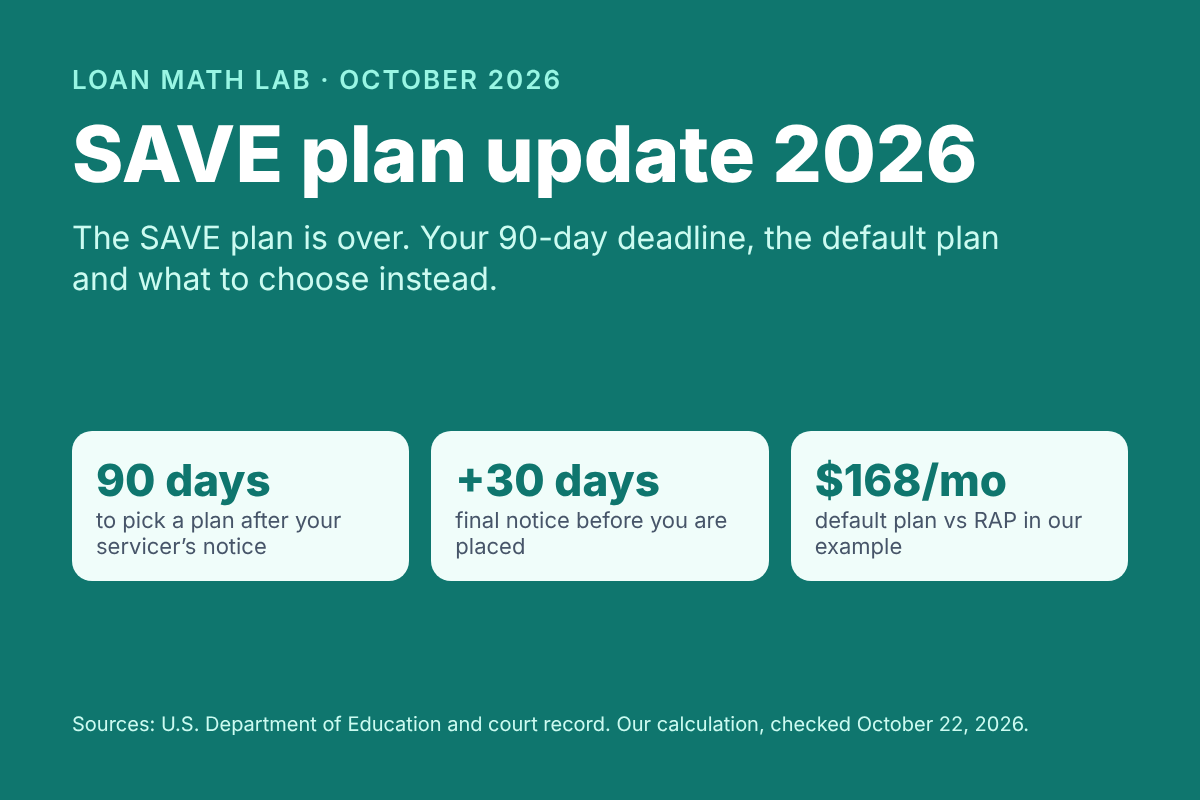
    Here is the SAVE plan update for October 2026: the SAVE plan is over. A federal court ended it in March 2026, no new borrowers can join, and the roughly 7.5 million people still enrolled are being moved to other repayment plans. Each borrower gets a notice with a 90-day deadline to pick a plan. If you do nothing, your servicer chooses for you, and the plan it picks is usually the most expensive one each month.

    This SAVE plan update guide explains what happened, how the deadline works, what happens if you miss it, and how to choose between the plans you can still use, with a worked example. Every date below comes from the U.S. Department of Education or from the court record as reported, and we checked each source on October 22, 2026. Rule changes are also listed in our student loan changes log.

    SAVE plan update at a glance

    QuestionShort answer
    Is the SAVE plan still running?No. A court order ended it in March 2026
    Can I still enroll in SAVE?No. Pending SAVE applications are being denied
    Is my interest paused?No. Interest has been charged on SAVE loans since August 1, 2025
    How long do I have to choose?At least 90 days from your servicer’s notice, then a final 30-day notice
    What if I do nothing?10-year Standard plan, or Tiered Standard if you have a loan paid out on or after July 1, 2026
    Which plans can I choose?Usually RAP, IBR or a fixed plan, depending on when your loans were paid out
    Do SAVE forbearance months count toward forgiveness?No, not toward PSLF or IDR forgiveness
    Sources: Department of Education, next steps for SAVE borrowers and The College Investor. Checked October 22, 2026.

    What happened to the SAVE plan: the full timeline

    SAVE (Saving on a Valuable Education) was an income-driven plan created in 2023. Republican-led states sued, and courts froze it in the summer of 2024. Since then, SAVE borrowers have been in a special forbearance: no payments due, but also no progress toward forgiveness. The table lists every SAVE plan update since then, in order.

    DateWhat happened
    August 2024SAVE borrowers placed in a general forbearance while the courts decided
    July 4, 2025The One Big Beautiful Bill Act becomes law and sets July 1, 2028 as the last date for SAVE, PAYE and ICR
    August 1, 2025Interest starts being charged again on loans in the SAVE forbearance
    December 9, 2025The Department and Missouri sign a settlement to end SAVE
    March 9-10, 2026The Eighth Circuit orders the settlement entered, and the district court signs the final judgment
    July 1, 2026RAP and Tiered Standard open, and servicers start sending 90-day notices to SAVE borrowers
    November 13, 2026The Department says more than 2 million SAVE borrowers have picked a new plan and that anyone who does not switch will be placed on the standard plan. The servicers’ trade group told Money that no one had been moved off SAVE manually yet, even where both notices had run out. Do not count on that lasting: choose a plan yourself
    By December 31, 2026Every SAVE borrower should have received a notice, according to Department guidance reported by The College Investor in October 2026. Each servicer sets its own schedule within that window
    Sources: Department of Education, July 2025, Department of Education, December 9, 2025, The College Investor, March 10, 2026 and Department of Education, March 27, 2026; the December 31 date: The College Investor, October 2026. Checked again October 25, 2026, when we corrected the source given for the December 31 date (see our Corrections Policy).

    Under the settlement, the Department stops enrolling anyone in SAVE, denies pending SAVE applications, moves every SAVE borrower into another plan and will repeal the SAVE rule. Individual borrowers cannot enforce the settlement themselves; it is an agreement between the Department and the states.

    The SAVE plan lawsuit: is there any chance SAVE comes back?

    Searches for the SAVE plan lawsuit have risen this year, so this SAVE plan update separates the two cases. The states’ lawsuit is what ended SAVE. In March 2026, a group of borrowers filed a separate suit asking the courts to force the Department to restart the plan, as reported by the American Counseling Association. As of October 22, 2026, we found no ruling that brings SAVE back, and the Department keeps moving borrowers out.

    Even if a court restored SAVE, the 2025 budget law ends it on July 1, 2028. Waiting for a court is a gamble on a plan with less than two years left. Choosing a plan now, as the SAVE plan update asks, protects you either way.

    SAVE plan update on deadlines: the 90-day and 30-day notices

    Servicers send the notices in batches, so deadlines differ from borrower to borrower. According to the Department and The College Investor:

    • First notice: the subject line reads “You Have 90 Days to Select a New Repayment Plan.” Your 90 days start on the date of your servicer’s notice. An email from Federal Student Aid does not start or reset the clock.
    • Final notice: if the 90 days pass without a choice, you get “Final Notice – You will be Placed into a New Repayment Plan in 30 Days.” Borrowers from the first July wave began receiving it around October 1, 2026, as reported by Student Loan Professor.
    • New payment: your servicer must tell you the new amount at least 21 days before the first payment is due.
    • You do not have to wait: you can contact your servicer and change plans before your notice arrives.

    The Department has not announced a general extension of the 90-day window. The most important SAVE plan update for you is the date on your own notice: treat it as the real deadline.

    What happens if you ignore the SAVE plan update

    If you ignore both notices, the servicer places you in a fixed plan, and that is the SAVE plan update most borrowers notice first, because the bill goes up:

    • All your federal loans were paid out before July 1, 2026: the 10-year Standard plan.
    • You have a loan paid out on or after July 1, 2026: the Tiered Standard plan, with a term of 10 to 25 years set by your balance.

    Fixed plans pay the loan off with no forgiveness, so the monthly payment is often much higher than an income-driven payment. You can still switch to another plan afterwards, but the months spent in the default plan may not help you toward forgiveness. Our student loan calculator shows the 10-year Standard and Tiered Standard amounts for your balance, and our student loan payment calculator shows how much interest a fixed plan costs and what extra payments save.

    Which plans you can choose after the SAVE plan update

    The plans open to you depend on one date: whether any of your federal loans were paid out on or after July 1, 2026.

    Your loansPlans you can chooseDefault if you do nothing
    All paid out before July 1, 2026RAP, IBR, or a legacy fixed plan such as the 10-year Standard10-year Standard
    At least one paid out on or after July 1, 2026RAP or Tiered StandardTiered Standard
    Parent PLUS, or a consolidation loan that repaid oneNot covered by RAP or IBR; ask your servicerSet by your servicer
    Based on 34 CFR 685.209 and the Department’s guidance for SAVE borrowers. PAYE and ICR close by July 1, 2028.

    Most borrowers affected by the SAVE plan update took out their loans before July 2026, so the usual choice is between the Repayment Assistance Plan and Income-Based Repayment. Be careful with new borrowing: a new federal loan or a new consolidation loan after July 1, 2026 closes IBR and the legacy plans to you. Our guide to the Repayment Assistance Plan explains RAP in detail.

    SAVE plan update example: same borrower, four plans

    A single borrower owes $35,000 at 6.52%, has an adjusted gross income (AGI) of $55,000, no dependents, and all loans from before July 1, 2026. Here is the first-year monthly payment on each plan:

    SAVE plan update chart: monthly payment on the 10-year Standard, IBR and RAP for a $35,000 balance and $55,000 income
    PlanMonthly paymentHow it is worked out
    10-year Standard (default)$397.77$35,000 at 6.52% over 120 months; $47,733 paid in total
    IBR at 15%$388.2515% of ($55,000 minus $23,940, which is 150% of the 2026 poverty guideline for 1 person), divided by 12
    IBR at 10%$258.83Same, at 10%. Only for borrowers with no federal loan balance on July 1, 2014
    RAP$229.175% of $55,000 = $2,750 a year, divided by 12
    Our calculation, checked in Python on October 22, 2026. Income, balance and rate are assumptions chosen for illustration.

    In this case, ignoring the SAVE plan update costs about $168 a month compared with RAP, or roughly $2,000 in the first year. With two dependents, RAP drops to $129.17 and IBR at 10% to $116.83, so the cheapest plan changes with your family. Run your own numbers in our plan comparison calculator, and use the RAP student loan calculator to see how a RAP loan ends over 30 years.

    Interest, forbearance and forgiveness in the SAVE plan update

    • Interest: loans in the SAVE forbearance have been charged interest since August 1, 2025, with nothing charged back for earlier months, according to the Department of Education. Your balance has probably grown since then.
    • Forgiveness clock: months in the SAVE forbearance do not count toward Public Service Loan Forgiveness (PSLF) or toward IDR forgiveness after 20 to 30 years.
    • PSLF buyback: if you already have 120 months of qualifying public service employment, you can ask to buy back months spent in forbearance by paying what you would have owed. Our PSLF buyback guide shows who qualifies and how the cost is set.
    • On RAP: unpaid interest is waived in every month you pay on time, so your balance stops growing once you are on the plan and paying.

    If you work toward PSLF, act on the SAVE plan update now and choose an income-driven plan yourself rather than waiting to be placed in a fixed plan. Every month you stay in forbearance is a month that does not count.

    How to act on the SAVE plan update, step by step

    1. Log in at StudentAid.gov with your FSA ID and check which servicer holds your loans and when they were paid out.
    2. Open the latest message from your servicer and write down the deadline on your 90-day notice.
    3. Compare plans with our student loan calculator or the official Repayment Calculator on StudentAid.gov (formerly called the Loan Simulator).
    4. Apply for the income-driven plan you chose on StudentAid.gov, or ask your servicer to move you to a fixed plan.
    5. Allow the IRS to share your tax information. The Department says this speeds up processing and makes yearly recertification automatic.
    6. Keep the confirmation, and check that your servicer account shows the new plan before your deadline.
    7. Set up autopay. Since July 1, 2026, autopay cuts your interest rate by 1 percentage point, as a temporary benefit through June 30, 2028, if you enroll with your servicer by December 31, 2026 (our federal student loan interest rates table has the details).

    If your account still shows SAVE after you applied, call your servicer and keep a note of the date and the agent’s name. The Department posts each official SAVE plan update on its court actions page on StudentAid.gov.

    SAVE plan update FAQ

    Is the SAVE plan ending or already over?

    It is already over. That is the core SAVE plan update: the court entered the settlement in March 2026, and the Department is moving every SAVE borrower to another plan during 2026.

    When does the SAVE forbearance end for me?

    When you enter a new plan, either because you chose one or because your servicer placed you after the final notice. Your first new payment is due at least 21 days after the servicer tells you the amount.

    Will I lose my SAVE forgiveness progress?

    Months you paid under SAVE before the forbearance generally keep counting toward forgiveness under the plan you move to. Forbearance months do not count.

    Can I go back to SAVE if the lawsuit changes?

    Not today. No court has restored SAVE as of October 22, 2026, and the 2025 budget law ends SAVE on July 1, 2028 in any case.

    Is RAP always the best choice after SAVE?

    No. RAP has no payment cap, so at high incomes IBR or a fixed plan can cost less. Compare your own numbers before you choose.

    Sources for this SAVE plan update

    Information checked on October 22, 2026; timeline and autopay deadline updated on November 19, 2026. We will revise this page with each new SAVE plan update from the Department. Our How We Verify page explains how we check every figure.

    This guide explains federal rules in general terms and is not financial, legal or tax advice; your servicer and a qualified professional can confirm what applies to you. Read our Disclaimer.

  • Repayment Assistance Plan (RAP) 2026: How It Works and Who It Suits

    Repayment Assistance Plan (RAP) 2026: How It Works and Who It Suits

    The Repayment Assistance Plan (RAP) is the federal income-driven repayment plan that opened on July 1, 2026. It sets your monthly student loan payment as a percentage of your adjusted gross income (AGI), takes off $50 for each dependent, and never charges you interest your on-time payment does not cover. In exchange, the road to forgiveness is 30 years long.

    This guide explains what the Repayment Assistance Plan is, how the payment is worked out, who can use it and who it tends to suit, with worked examples we calculated from the rule text in 34 CFR 685.209. If you want your own numbers first, our student loan calculator puts RAP next to the other plans you can choose.

    Repayment Assistance Plan monthly payment compared with IBR at incomes from 0 to 120,000 dollars

    Repayment Assistance Plan at a glance

    FeatureWhat the rule says
    Payment1% to 10% of AGI a year, divided by 12, minus $50 per dependent
    Lowest payment$10 a month (lower only for the final payment)
    Income under $10,000Base payment of $120 a year
    Unpaid interestNot charged in any month you pay on time
    PrincipalFalls by at least the smaller of $50 or your payment each on-time month
    ForgivenessAfter 360 qualifying monthly payments (30 years)
    Payment capNone tied to the 10-year Standard payment, unlike IBR
    Loans allowedDirect Subsidized and Unsubsidized, Grad PLUS, consolidation loans without Parent PLUS
    Open sinceJuly 1, 2026
    Source: 34 CFR 685.209 and Edfinancial, an FSA loan servicer. Checked October 19, 2026.

    What is the Repayment Assistance Plan?

    RAP was created by the 2025 budget law known as the One Big Beautiful Bill Act and written into the Direct Loan regulations on May 1, 2026. It is the newest of the income-driven plans and, for many borrowers, the only one left. Anyone who receives a federal loan on or after July 1, 2026, including a new consolidation loan, can repay their Direct Loans only under RAP or the fixed Tiered Standard plan.

    Borrowers whose loans were all paid out before that date keep more choices: Income-Based Repayment (IBR), the older fixed plans and, until July 1, 2028, PAYE and ICR for those already on them. They can also move into RAP whenever they like. If you were on SAVE, our SAVE plan update explains your deadline to choose a new plan. Our log of student loan changes lists each of these dates with its official source.

    People often search for this as the new student loan repayment plan or simply as RAP student loans. Whatever the name, the rules below come from the regulation itself, not from summaries.

    How the Repayment Assistance Plan payment is calculated

    The Repayment Assistance Plan calculation has three steps. First, find your base payment from the tier your AGI falls into. Second, divide it by 12. Third, subtract $50 for every dependent claimed on your federal tax return. If the result is under $10, you pay $10.

    Adjusted gross incomeBase payment for the year
    Up to $10,000$120
    $10,001 to $20,0001% of AGI
    $20,001 to $30,0002% of AGI
    $30,001 to $40,0003% of AGI
    $40,001 to $50,0004% of AGI
    $50,001 to $60,0005% of AGI
    $60,001 to $70,0006% of AGI
    $70,001 to $80,0007% of AGI
    $80,001 to $90,0008% of AGI
    $90,001 to $100,0009% of AGI
    Over $100,00010% of AGI
    Base payment tiers from 34 CFR 685.209(b)(2). The percentage applies to the whole AGI, not just the part inside the tier.

    That last point matters. Older plans such as IBR first protect part of your income, 150% of the poverty guideline, and charge a percentage only on what is left. The Repayment Assistance Plan does not set aside any income. Instead, the percentage itself is low at low incomes and rises one point for every $10,000.

    Worked example: single, $45,000 income

    A single borrower with an AGI of $45,000 and no dependents is in the 4% tier. The base payment is 4% of $45,000, or $1,800 a year. Divided by 12, the monthly payment is $150.00. The size of the loan does not change this figure.

    Worked example: the same income with two children

    Add two dependents to the same return and the payment drops by $100, to $50.00 a month. A borrower with an AGI of $18,000 and one dependent would have a base payment of $180, or $15 a month; minus $50 that goes below zero, so the payment is the $10 minimum.

    Worked example: the $50,000 cliff

    Because each tier applies to the whole income, crossing a boundary by one dollar can raise the payment sharply. At exactly $50,000 the payment is $166.67 a month (4%). At $50,001 it is $208.34 (5%). One extra dollar of income adds $41.67 a month, or about $500 a year. The chart above shows these steps along the green line.

    Legal ways to lower AGI, such as contributions to a traditional 401(k) or a health savings account, can move you back under a boundary. A tax professional can tell you what applies to your situation.

    Worked example: married, filing jointly

    A couple filing jointly with a combined AGI of $110,000 and one child has a base payment of $11,000 (10%), or $916.67 a month, minus $50: $866.67. If both spouses have eligible federal loans, the payment is split by balance. Say the borrower owes $40,000 and the spouse $60,000: the borrower pays 40% of $866.67, which is $346.67. Filing separately means only your own income and the dependents on your own return count.

    Our calculations; incomes, dependents and balances are assumptions chosen for illustration.

    Interest and principal: the two RAP protections

    The Repayment Assistance Plan adds two protections that work only in months when you pay the full amount on time. The first is an interest subsidy: any interest your payment does not cover that month is not charged to you. The second is a matching principal payment: if your payment cuts the principal by less than $50, the Department of Education pays the difference, up to the smaller of $50 or the amount you paid, as set out in 34 CFR 685.209(o)(2).

    Take a $40,000 balance at 6.52%, the 2026-27 undergraduate rate from the FSA interest rate announcement. Interest for one month is about $217.33. Here is what happens with three different payments.

    Your paymentGoes to interestInterest waivedGoes to principalMatching paymentPrincipal falls by
    $150.00$150.00$67.33$0.00$50.00$50.00
    $250.00$217.33$0.00$32.67$17.33$50.00
    $300.00$217.33$0.00$82.67$0.00$82.67
    Our calculation for one month; balance and rate are assumptions.

    So with a $150 payment, the balance still falls by $50 that month and does not grow. That is the main difference from plans where unpaid interest piles up. Both protections stop during deferment or forbearance, and they do not apply to a month in which you paid ahead (more on that below).

    Who can use RAP student loans

    • Direct Subsidized and Direct Unsubsidized Loans.
    • Direct PLUS Loans made to graduate or professional students (Grad PLUS).
    • Direct Consolidation Loans that did not repay a Parent PLUS loan, directly or through an earlier consolidation.
    • Loans in default can also be repaid under RAP, according to 34 CFR 685.209(d)(4).

    Parent PLUS loans cannot go on the Repayment Assistance Plan, and neither can a consolidation loan that includes one. Parents have their own options, covered in our guide to the Parent PLUS loan changes. Older FFEL loans are not Direct Loans; they would need to be consolidated into a Direct Consolidation Loan first, and that new loan would itself count as a loan received after July 1, 2026.

    Who the Repayment Assistance Plan tends to suit

    The fairest test is to compare RAP with the plan you would otherwise use. For borrowers with loans from before July 1, 2026, that is usually IBR. The table puts both side by side for a $40,000 balance at 6.52%, using the 2026 HHS poverty guidelines from the Federal Register for IBR.

    BorrowerRAPIBR at 10%IBR at 15%
    Single, $30,000$50.00$50.50$75.75
    Single, $45,000$150.00$175.50$263.25
    Single, $60,000$250.00$300.50$450.75
    Single, $100,000$750.00$454.60$454.60
    Single parent, 2 children, $45,000$50.00$33.50$50.25
    Our calculation. IBR is 10% of discretionary income for borrowers with no federal loan balance before July 1, 2014, and 15% for others, capped at the 10-year Standard payment ($454.60 here).

    Three patterns stand out. At low and middle incomes without children, the Repayment Assistance Plan is close to IBR at 10% and well below IBR at 15%. With children, the $50 per dependent reduction may still leave RAP above IBR at 10%, because IBR also adjusts for family size through the poverty guideline. At high incomes, RAP has no cap, so it can cost more than the 10-year Standard payment that limits IBR.

    The interest subsidy and principal match tilt the picture further for people whose payment is lower than the monthly interest. These are often borrowers with large graduate balances and modest pay. If that sounds like you, run your own figures in our plan comparison calculator or the official Repayment Calculator on StudentAid.gov before you switch.

    30 years on the Repayment Assistance Plan: two projections

    Repayment Assistance Plan balance over 30 years with flat and growing income
    ScenarioMonths to finishTotal you payLeft to forgiveInterest waivedPrincipal matched
    $45,000, income flat360$54,000$22,000$8,378$16,307
    $45,000, income +3% a year246$72,345$0$2,595$3,732
    $60,000, income +3% a year154$62,248$0$0$190
    Our calculation: $40,000 at 6.52%, single, no dependents, every payment on time, no changes to the rules. Real incomes and family sizes change, so treat these as illustrations.

    With a flat income, the borrower pays $150 a month for 30 years, the balance falls by exactly $50 a month thanks to the match, and about $22,000 is forgiven at the end. With 3% raises, Repayment Assistance Plan payments climb through the tiers and the loan is paid off after about 20 years. In our projections, steady raises were enough to clear the loan about ten years before forgiveness would arrive. To follow your own loan year by year, use our RAP student loan calculator.

    Forgiveness, PSLF and taxes

    The Repayment Assistance Plan forgives what is left after 360 qualifying monthly payments. Months that count include on-time RAP payments, payments under other plans that were at least the 10-year Standard amount, IBR payments, and months of unemployment or economic hardship deferment. Some earlier deferments and forbearances that ended before July 1, 2026 also count.

    If you work for a qualifying public service employer, the Repayment Assistance Plan can lead to Public Service Loan Forgiveness after 10 years, according to Edfinancial. Any amount forgiven at the end of 30 years may be treated as taxable income, so it is worth planning for. Our guide to federal student loan forgiveness compares RAP with the other programs open in 2026 and how each is taxed.

    How to apply and recertify

    1. Sign in to StudentAid.gov with your FSA ID.
    2. Open the income-driven repayment application and choose the Repayment Assistance Plan.
    3. Allow the IRS to share your tax information, or upload proof of income and the number of dependents.
    4. Check the repayment disclosure your servicer sends: it shows your payment and how it was calculated.
    5. Each year, when three payments are left in your 12-month period, the Department recalculates the payment from new tax data.

    On the Repayment Assistance Plan, if the Department asks you for documents at recertification and you miss the deadline, your payment becomes the 10-year Standard amount based on your balance when the loans entered repayment. You can also ask for an early recalculation at any time if your income drops or your family changes.

    Mistakes to avoid on the Repayment Assistance Plan

    • Paying ahead without opting out. Extra money normally moves your next due date forward, and months without a due date get no interest subsidy or principal match. Ask your servicer not to advance the due date.
    • Missing recertification. The payment can jump to the 10-year Standard amount.
    • Ignoring the tier boundaries. A small raise can push you into the next percentage for your whole income.
    • Assuming Parent PLUS qualifies. It does not, even inside a consolidation loan.
    • Missing autopay. The autopay interest cut rose from 0.25% to 1% on July 1, 2026, as a temporary benefit through June 30, 2028, but only if you enroll with your servicer by December 31, 2026. Our federal student loan interest rates table explains the deadline.

    Frequently asked questions

    What is the Repayment Assistance Plan in one sentence?

    It is a federal income-driven plan that charges 1% to 10% of your AGI a year, minus $50 a month per dependent, with a $10 minimum and forgiveness after 30 years.

    Is RAP better than IBR?

    It depends on income, family and balance. RAP tends to be close to IBR at 10% for single middle earners, cheaper than IBR at 15%, and dearer at high incomes because it has no cap. Our guide to IBR vs RAP student loans works through four examples side by side.

    Can I leave the Repayment Assistance Plan later?

    Yes. Under 34 CFR 685.209(i) you can change to any other plan you are eligible for at any time, although borrowers with loans from July 1, 2026 onward can only choose Tiered Standard.

    Does my spouse’s income count?

    Only if you file a joint federal tax return. If your spouse also has eligible federal loans, your payment is reduced in proportion to your share of the couple’s combined balance.

    Will my balance grow on RAP?

    Not in any month you pay on time: unpaid interest is not charged and the principal falls by at least the smaller of $50 or your payment.

    Sources

    See also our How We Verify page for how we check every figure.

    This guide explains federal rules in general terms and is not financial, legal or tax advice; your servicer and a qualified professional can confirm what applies to you. Read our Disclaimer. Information checked in October 2026.