The Repayment Assistance Plan (RAP) is the federal income-driven repayment plan that opened on July 1, 2026. It sets your monthly student loan payment as a percentage of your adjusted gross income (AGI), takes off $50 for each dependent, and never charges you interest your on-time payment does not cover. In exchange, the road to forgiveness is 30 years long.
This guide explains what the Repayment Assistance Plan is, how the payment is worked out, who can use it and who it tends to suit, with worked examples we calculated from the rule text in 34 CFR 685.209. If you want your own numbers first, our student loan calculator puts RAP next to the other plans you can choose.
Table of Contents
%3C/text%3E%3Ctext x='630.0' y='630' font-family='Inter,Arial,sans-serif' font-size='20' fill='%23475569' text-anchor='middle'%3EAdjusted gross income (dollars). Vertical axis: dollars per month. Loan Math Lab, October 2026%3C/text%3E%3C/svg%3E)
Repayment Assistance Plan at a glance
| Feature | What the rule says |
|---|---|
| Payment | 1% to 10% of AGI a year, divided by 12, minus $50 per dependent |
| Lowest payment | $10 a month (lower only for the final payment) |
| Income under $10,000 | Base payment of $120 a year |
| Unpaid interest | Not charged in any month you pay on time |
| Principal | Falls by at least the smaller of $50 or your payment each on-time month |
| Forgiveness | After 360 qualifying monthly payments (30 years) |
| Payment cap | None tied to the 10-year Standard payment, unlike IBR |
| Loans allowed | Direct Subsidized and Unsubsidized, Grad PLUS, consolidation loans without Parent PLUS |
| Open since | July 1, 2026 |
What is the Repayment Assistance Plan?
RAP was created by the 2025 budget law known as the One Big Beautiful Bill Act and written into the Direct Loan regulations on May 1, 2026. It is the newest of the income-driven plans and, for many borrowers, the only one left. Anyone who receives a federal loan on or after July 1, 2026, including a new consolidation loan, can repay their Direct Loans only under RAP or the fixed Tiered Standard plan.
Borrowers whose loans were all paid out before that date keep more choices: Income-Based Repayment (IBR), the older fixed plans and, until July 1, 2028, PAYE and ICR for those already on them. They can also move into RAP whenever they like. If you were on SAVE, our SAVE plan update explains your deadline to choose a new plan. Our log of student loan changes lists each of these dates with its official source.
People often search for this as the new student loan repayment plan or simply as RAP student loans. Whatever the name, the rules below come from the regulation itself, not from summaries.
How the Repayment Assistance Plan payment is calculated
The Repayment Assistance Plan calculation has three steps. First, find your base payment from the tier your AGI falls into. Second, divide it by 12. Third, subtract $50 for every dependent claimed on your federal tax return. If the result is under $10, you pay $10.
| Adjusted gross income | Base payment for the year |
|---|---|
| Up to $10,000 | $120 |
| $10,001 to $20,000 | 1% of AGI |
| $20,001 to $30,000 | 2% of AGI |
| $30,001 to $40,000 | 3% of AGI |
| $40,001 to $50,000 | 4% of AGI |
| $50,001 to $60,000 | 5% of AGI |
| $60,001 to $70,000 | 6% of AGI |
| $70,001 to $80,000 | 7% of AGI |
| $80,001 to $90,000 | 8% of AGI |
| $90,001 to $100,000 | 9% of AGI |
| Over $100,000 | 10% of AGI |
That last point matters. Older plans such as IBR first protect part of your income, 150% of the poverty guideline, and charge a percentage only on what is left. The Repayment Assistance Plan does not set aside any income. Instead, the percentage itself is low at low incomes and rises one point for every $10,000.
Worked example: single, $45,000 income
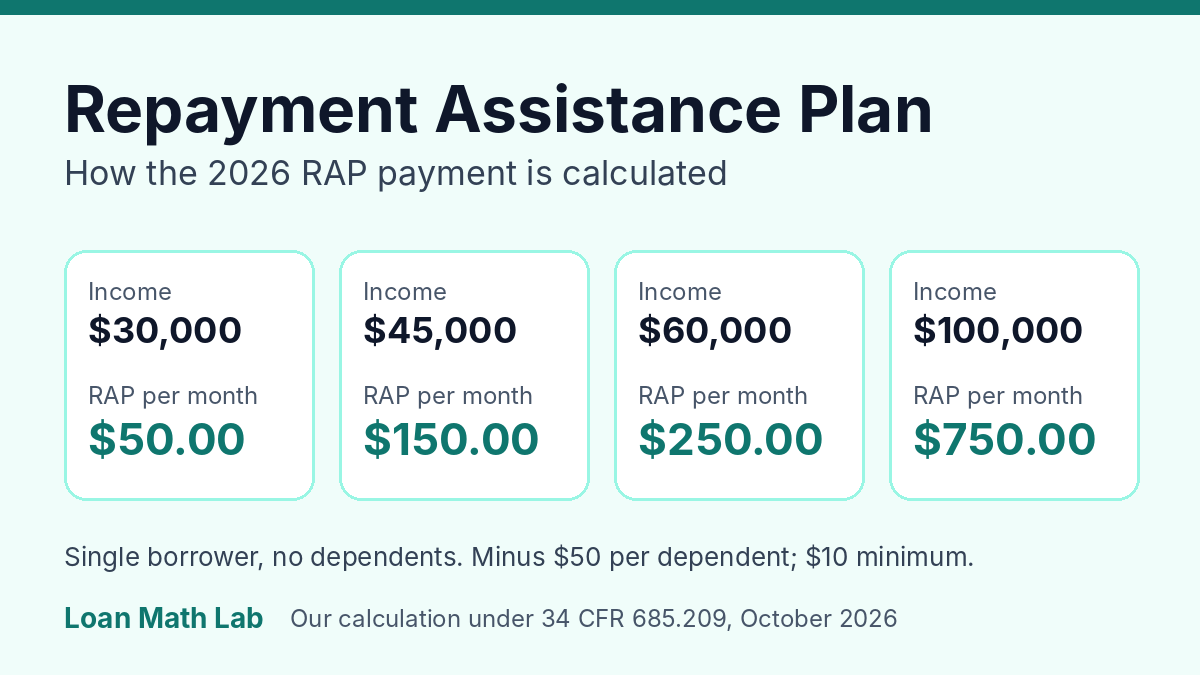
A single borrower with an AGI of $45,000 and no dependents is in the 4% tier. The base payment is 4% of $45,000, or $1,800 a year. Divided by 12, the monthly payment is $150.00. The size of the loan does not change this figure.
Worked example: the same income with two children
Add two dependents to the same return and the payment drops by $100, to $50.00 a month. A borrower with an AGI of $18,000 and one dependent would have a base payment of $180, or $15 a month; minus $50 that goes below zero, so the payment is the $10 minimum.
Worked example: the $50,000 cliff
Because each tier applies to the whole income, crossing a boundary by one dollar can raise the payment sharply. At exactly $50,000 the payment is $166.67 a month (4%). At $50,001 it is $208.34 (5%). One extra dollar of income adds $41.67 a month, or about $500 a year. The chart above shows these steps along the green line.
Legal ways to lower AGI, such as contributions to a traditional 401(k) or a health savings account, can move you back under a boundary. A tax professional can tell you what applies to your situation.
Worked example: married, filing jointly
A couple filing jointly with a combined AGI of $110,000 and one child has a base payment of $11,000 (10%), or $916.67 a month, minus $50: $866.67. If both spouses have eligible federal loans, the payment is split by balance. Say the borrower owes $40,000 and the spouse $60,000: the borrower pays 40% of $866.67, which is $346.67. Filing separately means only your own income and the dependents on your own return count.
Our calculations; incomes, dependents and balances are assumptions chosen for illustration.
Interest and principal: the two RAP protections
The Repayment Assistance Plan adds two protections that work only in months when you pay the full amount on time. The first is an interest subsidy: any interest your payment does not cover that month is not charged to you. The second is a matching principal payment: if your payment cuts the principal by less than $50, the Department of Education pays the difference, up to the smaller of $50 or the amount you paid, as set out in 34 CFR 685.209(o)(2).
Take a $40,000 balance at 6.52%, the 2026-27 undergraduate rate from the FSA interest rate announcement. Interest for one month is about $217.33. Here is what happens with three different payments.
| Your payment | Goes to interest | Interest waived | Goes to principal | Matching payment | Principal falls by |
|---|---|---|---|---|---|
| $150.00 | $150.00 | $67.33 | $0.00 | $50.00 | $50.00 |
| $250.00 | $217.33 | $0.00 | $32.67 | $17.33 | $50.00 |
| $300.00 | $217.33 | $0.00 | $82.67 | $0.00 | $82.67 |
So with a $150 payment, the balance still falls by $50 that month and does not grow. That is the main difference from plans where unpaid interest piles up. Both protections stop during deferment or forbearance, and they do not apply to a month in which you paid ahead (more on that below).
Who can use RAP student loans
- Direct Subsidized and Direct Unsubsidized Loans.
- Direct PLUS Loans made to graduate or professional students (Grad PLUS).
- Direct Consolidation Loans that did not repay a Parent PLUS loan, directly or through an earlier consolidation.
- Loans in default can also be repaid under RAP, according to 34 CFR 685.209(d)(4).
Parent PLUS loans cannot go on the Repayment Assistance Plan, and neither can a consolidation loan that includes one. Parents have their own options, covered in our guide to the Parent PLUS loan changes. Older FFEL loans are not Direct Loans; they would need to be consolidated into a Direct Consolidation Loan first, and that new loan would itself count as a loan received after July 1, 2026.
Who the Repayment Assistance Plan tends to suit
The fairest test is to compare RAP with the plan you would otherwise use. For borrowers with loans from before July 1, 2026, that is usually IBR. The table puts both side by side for a $40,000 balance at 6.52%, using the 2026 HHS poverty guidelines from the Federal Register for IBR.
| Borrower | RAP | IBR at 10% | IBR at 15% |
|---|---|---|---|
| Single, $30,000 | $50.00 | $50.50 | $75.75 |
| Single, $45,000 | $150.00 | $175.50 | $263.25 |
| Single, $60,000 | $250.00 | $300.50 | $450.75 |
| Single, $100,000 | $750.00 | $454.60 | $454.60 |
| Single parent, 2 children, $45,000 | $50.00 | $33.50 | $50.25 |
Three patterns stand out. At low and middle incomes without children, the Repayment Assistance Plan is close to IBR at 10% and well below IBR at 15%. With children, the $50 per dependent reduction may still leave RAP above IBR at 10%, because IBR also adjusts for family size through the poverty guideline. At high incomes, RAP has no cap, so it can cost more than the 10-year Standard payment that limits IBR.
The interest subsidy and principal match tilt the picture further for people whose payment is lower than the monthly interest. These are often borrowers with large graduate balances and modest pay. If that sounds like you, run your own figures in our plan comparison calculator or the official Repayment Calculator on StudentAid.gov before you switch.
30 years on the Repayment Assistance Plan: two projections

| Scenario | Months to finish | Total you pay | Left to forgive | Interest waived | Principal matched |
|---|---|---|---|---|---|
| $45,000, income flat | 360 | $54,000 | $22,000 | $8,378 | $16,307 |
| $45,000, income +3% a year | 246 | $72,345 | $0 | $2,595 | $3,732 |
| $60,000, income +3% a year | 154 | $62,248 | $0 | $0 | $190 |
With a flat income, the borrower pays $150 a month for 30 years, the balance falls by exactly $50 a month thanks to the match, and about $22,000 is forgiven at the end. With 3% raises, Repayment Assistance Plan payments climb through the tiers and the loan is paid off after about 20 years. In our projections, steady raises were enough to clear the loan about ten years before forgiveness would arrive. To follow your own loan year by year, use our RAP student loan calculator.
Forgiveness, PSLF and taxes
The Repayment Assistance Plan forgives what is left after 360 qualifying monthly payments. Months that count include on-time RAP payments, payments under other plans that were at least the 10-year Standard amount, IBR payments, and months of unemployment or economic hardship deferment. Some earlier deferments and forbearances that ended before July 1, 2026 also count.
If you work for a qualifying public service employer, the Repayment Assistance Plan can lead to Public Service Loan Forgiveness after 10 years, according to Edfinancial. Any amount forgiven at the end of 30 years may be treated as taxable income, so it is worth planning for. Our guide to federal student loan forgiveness compares RAP with the other programs open in 2026 and how each is taxed.
How to apply and recertify
- Sign in to StudentAid.gov with your FSA ID.
- Open the income-driven repayment application and choose the Repayment Assistance Plan.
- Allow the IRS to share your tax information, or upload proof of income and the number of dependents.
- Check the repayment disclosure your servicer sends: it shows your payment and how it was calculated.
- Each year, when three payments are left in your 12-month period, the Department recalculates the payment from new tax data.
On the Repayment Assistance Plan, if the Department asks you for documents at recertification and you miss the deadline, your payment becomes the 10-year Standard amount based on your balance when the loans entered repayment. You can also ask for an early recalculation at any time if your income drops or your family changes.
Mistakes to avoid on the Repayment Assistance Plan
- Paying ahead without opting out. Extra money normally moves your next due date forward, and months without a due date get no interest subsidy or principal match. Ask your servicer not to advance the due date.
- Missing recertification. The payment can jump to the 10-year Standard amount.
- Ignoring the tier boundaries. A small raise can push you into the next percentage for your whole income.
- Assuming Parent PLUS qualifies. It does not, even inside a consolidation loan.
- Missing autopay. The autopay interest cut rose from 0.25% to 1% on July 1, 2026, as a temporary benefit through June 30, 2028, but only if you enroll with your servicer by December 31, 2026. Our federal student loan interest rates table explains the deadline.
Frequently asked questions
What is the Repayment Assistance Plan in one sentence?
It is a federal income-driven plan that charges 1% to 10% of your AGI a year, minus $50 a month per dependent, with a $10 minimum and forgiveness after 30 years.
Is RAP better than IBR?
It depends on income, family and balance. RAP tends to be close to IBR at 10% for single middle earners, cheaper than IBR at 15%, and dearer at high incomes because it has no cap. Our guide to IBR vs RAP student loans works through four examples side by side.
Can I leave the Repayment Assistance Plan later?
Yes. Under 34 CFR 685.209(i) you can change to any other plan you are eligible for at any time, although borrowers with loans from July 1, 2026 onward can only choose Tiered Standard.
Does my spouse’s income count?
Only if you file a joint federal tax return. If your spouse also has eligible federal loans, your payment is reduced in proportion to your share of the couple’s combined balance.
Will my balance grow on RAP?
Not in any month you pay on time: unpaid interest is not charged and the principal falls by at least the smaller of $50 or your payment.
Sources
- 34 CFR 685.209, Income-driven repayment plans (eCFR, up to date as of October 15, 2026)
- Repayment Assistance Plan (RAP), Edfinancial Services, official FSA servicer
- FSA Electronic Announcement GENERAL-26-33: 2026-27 Direct Loan interest rates
- Annual Update of the HHS Poverty Guidelines, Federal Register, January 15, 2026
- Repayment Calculator, StudentAid.gov
See also our How We Verify page for how we check every figure.
This guide explains federal rules in general terms and is not financial, legal or tax advice; your servicer and a qualified professional can confirm what applies to you. Read our Disclaimer. Information checked in October 2026.