Category: Consolidation & Refinancing

  • Refinance Federal Student Loans? What You Lose in 2026 and When It Can Still Pay Off

    Refinance Federal Student Loans? What You Lose in 2026 and When It Can Still Pay Off

    Should you refinance federal student loans? A private lender can pay off your federal loans with a new private loan, sometimes at a lower rate, but the switch is permanent and the new loan leaves the federal system for good. This guide lists what you give up when you refinance federal student loans in 2026, puts a dollar figure on it in three worked examples, and shows when a lower rate can still be worth it. We opened every official page cited here on November 23, 2026. We do not list or recommend lenders, and we do not publish lender rates.

    Refinance federal student loans: what changes at a glance

    FeatureFederal Direct LoansAfter you refinance (private loan)
    Who sets the termsFederal law and regulationsThe lender’s contract
    Interest rateFixed, set by formula for each school yearFixed or variable, based on your credit and the lender
    Payment tied to your incomeRAP for Direct Loans except parent PLUS loans and the consolidations that repaid them; IBR if all your loans were made before July 1, 2026Not required by law; ask the lender
    Public Service Loan ForgivenessYes, on qualifying plansNo
    Deferment and forbearanceSet types, such as unemployment and economic hardship defermentOnly what the lender offers
    DeathDischarged; a parent PLUS loan is also discharged if the student diesMany, but not all, lenders offer a discharge
    Prepayment penaltyNoneCheck the contract
    Can you go back?Not applicableNo: private loans cannot go into a Direct Consolidation Loan
    Sources: StudentAid.gov, Federal Versus Private Loans and Discharge Due to Death; CFPB, Should I consolidate or refinance my student loans? Checked November 23, 2026.

    The short version: when you refinance federal student loans, you trade a set of legal protections for a rate. The rest of this guide puts a price on that trade.

    What happens when you refinance federal student loans

    To refinance federal student loans, you take out a brand-new private loan. The lender checks your credit, often asks for a cosigner if your credit history is short, and offers a rate and a term. If you accept, it uses the new loan to pay off the loans you picked. Your federal loans then show as paid in full, and from that day you owe the lender instead of the Department of Education.

    StudentAid.gov sums up the difference in its comparison of federal and private loans: federal loans have terms set by law and benefits such as fixed rates and income-driven plans, while a private loan’s terms are set by the lender, and private loans are generally more expensive. You choose which loans to include, so you can refinance private loans and keep your federal loans as they are.

    The step only goes one way. The Consumer Financial Protection Bureau warns that it cannot be reversed, and StudentAid.gov states that private student loans cannot be consolidated into a Direct Consolidation Loan. Once you refinance federal student loans, no federal program will take them back.

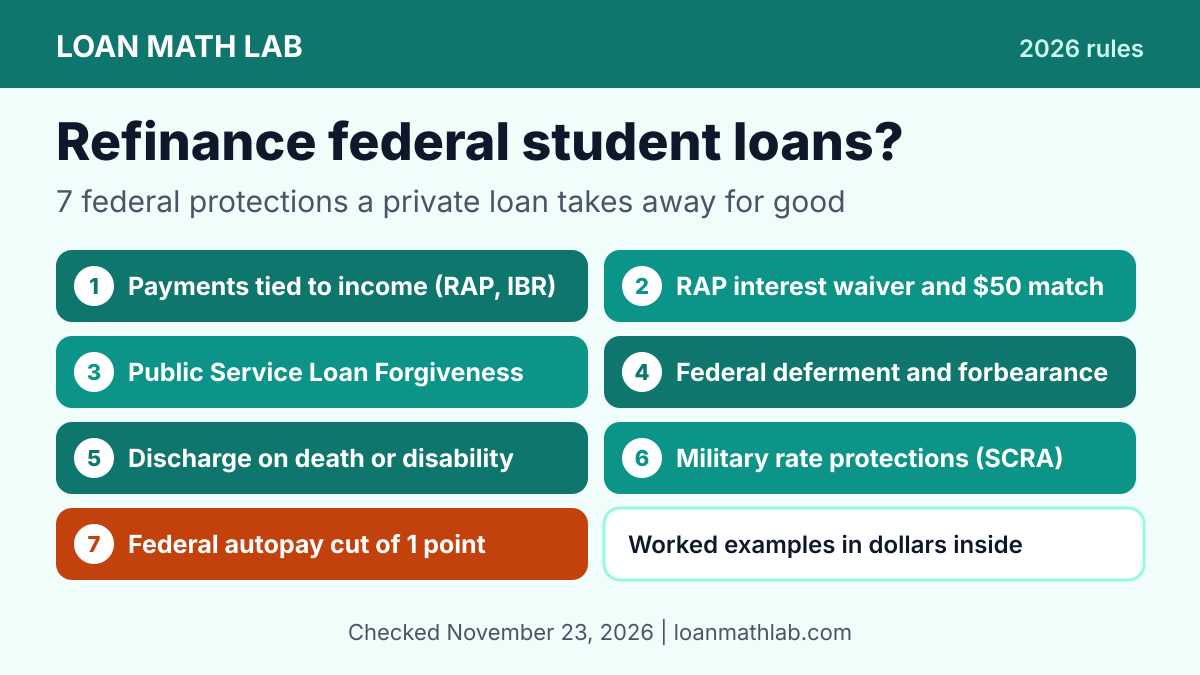
    Seven things you give up when you refinance federal student loans

    1. A payment tied to your income. The Repayment Assistance Plan (RAP) charges 1% to 10% of your adjusted gross income (AGI), divided by 12 and reduced by $50 for each dependent, with a $10 minimum, under 34 CFR 685.209. If your AGI falls to $30,000, RAP asks 2% of it, or $50 a month. A private loan keeps its fixed payment. If all your loans were made before July 1, 2026, Income-Based Repayment (IBR) is open to you as well.
    2. Interest that RAP never charges. On RAP, interest your on-time payment does not cover is not charged at all, and the Department lowers your principal by up to $50 in any month your payment barely touches it. A private lender charges every dollar of interest.
    3. Public Service Loan Forgiveness and other forgiveness. PSLF cancels what is left on Direct Loans after 120 qualifying payments, and a refinanced loan is no longer a Direct Loan. The CFPB notes that you also lose teacher forgiveness and the forgiveness at the end of income-driven plans.
    4. Federal deferment and forbearance. StudentAid.gov lists deferments for unemployment, economic hardship, cancer treatment, military service and other cases, each with fixed rules. A private lender decides its own relief; the CFPB says you may still qualify for options like forbearance, on the lender’s terms.
    5. Discharge if you die or become disabled. Federal loans are discharged on the borrower’s death, and a parent PLUS loan is also discharged if the student dies. Total and permanent disability discharge applies too. According to the CFPB, many but not all private lenders offer something similar.
    6. Military protections. The CFPB warns that active-duty servicemembers can lose the Servicemembers Civil Relief Act interest-rate reduction, including its 6% cap, on loans taken out before service.
    7. The temporary federal autopay cut. Since July 1, 2026, automatic payments lower the rate on Direct Loans made after July 1, 2012 by 1 percentage point instead of 0.25, through June 30, 2028, according to the Department of Education. The federal servicer Edfinancial gives the enrollment deadline as 11:59 p.m. ET on December 31, 2026. On $45,000, one point is worth about $450 of interest a year while it lasts.

    None of these seven items appear in a rate comparison. That is why a lower rate on its own is not a reason to refinance federal student loans: the rate is the only part of the deal you can see on the offer.

    Refinance student loans pros and cons for federal borrowers

    ProsCons
    A lower fixed rate can cut the interest you pay if your credit or income has improved since you borrowedAll seven federal protections above are gone for good
    One lender and one bill if you also have private loansThe rate depends on your credit, and a variable rate can rise above your old fixed federal rate
    A shorter term can clear the debt soonerA longer term lowers the payment but can raise the total interest, as the CFPB points out
    You choose which loans to includeFees, where the offer has them, take months to win back
    Based on StudentAid.gov and the CFPB, checked November 23, 2026.

    The main reason people refinance federal student loans is a lower rate; the main reason not to is everything in the right-hand column. Most disadvantages of refinancing student loans are about risk, not price. The saving is fixed in the contract on day one; the cost only shows up in a bad year, such as a job loss, an illness or a move into public service. So the question is not only how much you save, but what that saving buys if your plans change.

    Worked example: what a lower rate saves, and what it risks

    Jordan owes $45,000 in federal Direct Loans at an average 7.5%, with 10 years left on a fixed payment. A lender offers a fixed 6.0% for 10 years with no fees. The offer is an assumption for illustration, not a lender rate. Here is what it means to refinance federal student loans at that rate.

    Keep federal loansRefinance at 6.0%, 10 years
    Monthly payment$534.16$499.59
    Interest from now$19,099$14,951
    Difference–$4,148 less interest, $34.57 less a month
    If AGI drops to $30,000$50 a month on RAPStill $499.59, unless the lender agrees to relief
    If Jordan diesDischargedDepends on the lender’s contract
    Our calculation in Python, November 23, 2026: fixed payment, interest at one twelfth of the yearly rate, last payment adjusted. Balance, rates and income are assumptions.

    On paper, Jordan saves $4,148 over 10 years by refinancing. The federal autopay cut, about $450 a year on this balance until June 30, 2028, takes a large part of that gap if Jordan has not enrolled yet. And the saving buys nothing in a hard year: with an AGI of $30,000, RAP would ask $50 a month, while the private loan still asks $499.59. Our student loan refinance calculator works out the break-even point and the break-even rate for your own offer, fees included.

    Refinance federal student loans and lose PSLF: the costliest mistake

    Take the teacher from our PSLF calculator: single, $60,000 at 6.5%, an AGI of $50,000 with 3% raises, and 36 qualifying payments already made. On RAP she pays $18,656 over her remaining 84 payments, and PSLF forgives $55,800, tax-free under federal law. Now suppose she refinances at an assumed 5.5% for 10 years.

    Refinance federal student loans example: a teacher pays $18,656 on RAP with $55,800 forgiven by PSLF, or $78,139 after refinancing at 5.5%

    The private loan costs $651.16 a month and $78,139 in total, with nothing forgiven: about $59,500 more than staying on RAP. A lower rate cannot close a gap that size. If you work for a government or a qualifying not-for-profit employer, check your PSLF count before you refinance federal student loans or even look at an offer. PSLF buyback cannot fix it later either, because it needs a Direct Loan with a balance, and a refinanced loan has been paid off.

    Refinance Parent PLUS loans: a closer call in 2026

    Parents who refinance federal student loans taken out for a child have less to lose than students, because the federal side has shrunk. StudentAid.gov’s Parent PLUS page says that a parent who takes out or consolidates a parent PLUS loan after July 1, 2026 can use only the Tiered Standard plan, with no income-driven plan and no PSLF. Here is a $40,000 Parent PLUS loan at the 2026-27 rate of 9.07%, which falls in the 15-year tier:

    Monthly paymentTotal interestInterest saved
    Federal, Tiered Standard, 15 years at 9.07%$407.37$33,328–
    Refinanced at 7.5%, 10 years$474.81$16,977$16,351
    Refinanced at 7.5%, 15 years$370.80$26,746$6,582
    Our calculation in Python, November 23, 2026. The 7.5% offer is an assumption for illustration, not a lender rate.

    A parent who refinances still gives up real protections: the loan is discharged if the parent or the student dies, disability discharge applies, and the Parent PLUS borrower deferment lets payments wait while the student is in school. Parents who consolidated before July 1, 2026 may also have a route through Income-Contingent Repayment to IBR that a private loan ends. Our guide to the Parent PLUS loan changes explains who keeps it. If none of that applies and the rate gap is wide, refinancing a Parent PLUS loan can be a reasonable choice; it is still one you cannot undo.

    Grad PLUS loans are a different case. Graduate borrowers keep RAP and PSLF, and those whose loans were all made before July 1, 2026 can still use IBR, so the full list of seven applies before you refinance grad PLUS loans. Our tiered standard plan guide shows the federal payment for each balance tier.

    Student loan refinance vs consolidation

    Federal Direct Consolidation LoanPrivate refinancing
    Who makes the loanThe Department of Education, through StudentAid.govA private lender
    Interest rateWeighted average of your loans, rounded up to the next one-eighth of a pointA new rate based on your credit
    Loans stay federalYesNo
    Private loans can be includedNoYes
    The 2026 catchA consolidation loan made on or after July 1, 2026 limits your Direct Loans to RAP or Tiered StandardEvery federal protection is lost
    Sources: 34 CFR 685.202 and StudentAid.gov, as explained in our consolidation guide; checked November 23, 2026.

    If what you want is one bill, consolidation keeps your loans federal but does not lower the rate. If what you want is a lower rate, you have to refinance federal student loans with a private lender, at the price above. Our student loan consolidation guide explains when a federal consolidation still pays off in 2026.

    Student loan refinance rates: what to compare them with

    We do not publish student loan refinance rates from lenders, because offers depend on your credit and change often. What you can do before you refinance federal student loans is hold each written offer against the right numbers:

    • Your own federal rate. Use the average of your loans weighted by balance. For loans first paid out in 2026-27, federal rates are 6.52% for undergraduates, 8.07% for graduate unsubsidized loans and 9.07% for PLUS loans; earlier years are in our federal student loan interest rates table.
    • Your federal rate after the autopay cut. If you are enrolled in autopay, compare against your rate minus one point until June 30, 2028.
    • A fixed rate, not a range. Advertised ranges are not offers, and a variable rate can rise above your fixed federal rate, as the CFPB warns.
    • The same term. Compare at the years you have left first. A longer term can show a lower payment and still cost more.

    Should I refinance federal student loans? Five questions first

    1. Do I work in public service, or might I in the next ten years? If yes, stop here: PSLF is worth more than any rate cut.
    2. Is my income steady enough that I will not need RAP, a deferment or a forbearance?
    3. Do I have savings that cover several months of the new payment if I lose my job?
    4. Does the offer beat my federal rate after the autopay cut, at the same term, after fees?
    5. Have I read the lender’s contract on death and disability discharge, forbearance and prepayment penalties?

    If every answer points the same way, it can make sense to refinance federal student loans, usually for borrowers with steady private-sector income and a wide rate gap. If any answer gives you pause, keep the federal loans and refinance only private loans, if you have them. To compare federal plans first, start with our student loan calculator.

    Refinance federal student loans FAQ

    Can you refinance private student loans into federal loans?

    No. StudentAid.gov says private student loans cannot be consolidated into a Direct Consolidation Loan, and there is no federal refinancing program. Private loans can only be refinanced with another private lender.

    Can I undo it if I refinance federal student loans to private?

    No. The CFPB says the change cannot be reversed. Paying the private loan off is the only way out of it.

    Can I refinance only some of my loans?

    Yes. When you refinance federal student loans, you choose which loans to include. Many borrowers refinance private loans and keep the federal ones, especially loans counting toward PSLF.

    Do I keep the student loan interest deduction?

    StudentAid.gov lists interest as possibly tax deductible for federal and private student loans alike. Whether you can take the deduction depends on your income and the IRS rules for your tax year.

    What happens to forgiveness progress I already have?

    If you refinance federal student loans, progress on those loans ends. They are paid in full, so their PSLF and income-driven repayment counts no longer lead anywhere, and buyback cannot restore them.

    Sources for this guide

    Information checked on November 23, 2026. The examples use assumed balances, rates and incomes; our How We Verify page explains how we check each figure. Rule changes are listed in our student loan changes log.

    Loan Math Lab is an independent website. It is not affiliated with the U.S. Department of Education, Federal Student Aid, any loan servicer, lender or school, and it does not list or recommend lenders. Nothing on it is financial, legal or tax advice. Read our Disclaimer.
  • Federal Student Loan Consolidation 2026: Should You Consolidate After July 1?

    Federal Student Loan Consolidation 2026: Should You Consolidate After July 1?

    Student loan consolidation combines one or more federal student loans into a single new Direct Consolidation Loan with one fixed rate and one monthly bill. It is free and done through StudentAid.gov, but in 2026 it carries a cost that did not exist before: a consolidation loan you receive on or after July 1, 2026 counts as a new loan, so all of your Direct Loans can then be repaid only on the Repayment Assistance Plan (RAP) or the Tiered Standard Plan.

    This guide explains how federal student loan consolidation works under the 2026 rules, how the interest rate is set, what it does to your forgiveness clock, and when it is worth it. We opened every official page cited here on November 13, 2026. It covers federal loans only; private loans cannot go into a Direct Consolidation Loan. For the full list of rule changes, see our student loan changes log.

    Student loan consolidation at a glance

    QuestionShort answer in 2026
    What it isA new Direct Consolidation Loan pays off the federal loans you choose
    Cost to applyNo application fee
    Interest rateWeighted average of your rates, rounded up to the next 1/8 of a point, fixed for life
    Repayment plans after July 1, 2026Only RAP or Tiered Standard, for all your Direct Loans
    Parent PLUS inside the new loanOnly Tiered Standard, which does not count for PSLF
    Unpaid interestAdded to the principal of the new loan
    Can you undo it?No. The old loans are paid off and no longer exist
    Sources: StudentAid.gov, Consolidating Student Loans and 34 CFR 685.202, read November 13, 2026.

    In one line: student loan consolidation rarely saves money by itself. It is a tool to reach a plan or a program, to leave default, or to merge loans held by different servicers, and in 2026 it closes the door to IBR, PAYE and ICR on the way.

    What a Direct Consolidation Loan is

    A Direct Consolidation Loan is the only form of federal student loan consolidation available today. The Department of Education makes the new loan, sends the money to the holders of the loans you picked, and those loans are discharged. Under 34 CFR 685.220, you can include Direct Subsidized and Unsubsidized Loans, Direct PLUS Loans, older FFEL Stafford and PLUS loans, Federal Perkins Loans, health-profession loans and certain existing consolidation loans.

    Three conditions matter in practice. You can generally consolidate once you graduate, leave school or drop below half-time. The loans must be in repayment or in a grace period. And you cannot reconsolidate a single consolidation loan on its own: StudentAid.gov requires at least one more eligible loan, with narrow exceptions for single FFEL Consolidation Loans, for example to qualify for Public Service Loan Forgiveness (PSLF).

    You do not have to include every loan. Leaving a loan out is how you protect a benefit tied to it, such as a Perkins cancellation or a lower FFEL rate for on-time payments, which consolidation would remove.

    The July 1, 2026 rule: consolidation now makes a new loan

    This is the part that changed most in student loan consolidation. StudentAid.gov now says that if you consolidate Direct Loans, FFEL loans or Perkins loans into a Direct Consolidation Loan received on or after July 1, 2026, you can enroll only in the Tiered Standard Plan and RAP for all of your Direct Loans, including loans you received before that date.

    • IBR, PAYE and ICR close. The repayment plans page says that to use these plans you must not have received any new loan, “including a new consolidation loan,” on or after July 1, 2026. 34 CFR 685.209(d)(5) limits them to Direct Loans made before that date.
    • The old consolidation Standard plan is gone for new loans. Direct Loans disbursed on or after July 1, 2026 are not eligible for the Standard Repayment Plan, according to StudentAid.gov.
    • Tiered Standard sets the term by balance. Under 34 CFR 685.208(c), the term is 10 years below $25,000, 15 years from $25,000, 20 years from $50,000 and 25 years from $100,000 of total Direct Loans, with a minimum payment of $50. Our tiered standard plan guide shows the payment for each tier.
    • RAP stays open for loans that are not parent loans. Our RAP student loan calculator shows what that payment would be.

    Before July 1, 2026, a Direct Consolidation Loan on the Standard plan could run 10 to 30 years depending on your total debt. Loans consolidated before that date keep those terms. If you already consolidated in 2025 or the first half of 2026 and take no new loan, nothing changes for you.

    If IBR gives you a lower payment than RAP, that difference is the real price of consolidating now. Our IBR vs RAP student loans guide shows where each plan wins, and the IBR student loan calculator gives your IBR figure.

    Student loan consolidation interest rate

    The student loan consolidation interest rate is not negotiated and does not depend on your credit. Under 34 CFR 685.202(a)(10), for applications received on or after July 1, 2013, it is the weighted average of the rates on the loans you consolidate, “rounded to the nearest higher one-eighth of one percent,” with no cap. StudentAid.gov adds that the calculation uses each loan’s official rate and ignores any rate reduction you receive now.

    Here is how the weighted average works, step by step, on three loans:

    LoanBalanceRateBalance × rate
    Undergraduate, 2023-24$10,0005.50%550
    Undergraduate, 2024-25$12,0006.53%783.6
    Graduate, 2024-25$8,0008.08%646.4
    Total$30,0001,980
    Rates by year: our federal student loan interest rates table. Balances are an assumption chosen for illustration.

    Divide 1,980 by 30,000 and you get 6.60%. Rounded up to the next eighth, the Direct Consolidation Loan rate would be 6.625%. Rounding up costs about $7.50 of extra interest a year on $30,000, so the rate is not the problem. The problem is the length of the new loan. To run your own loans, the average-rate tool on our interest rates page does this exact step; if you were looking for a student loan consolidation calculator, that is the rate part of it.

    What student loan consolidation costs: a worked example

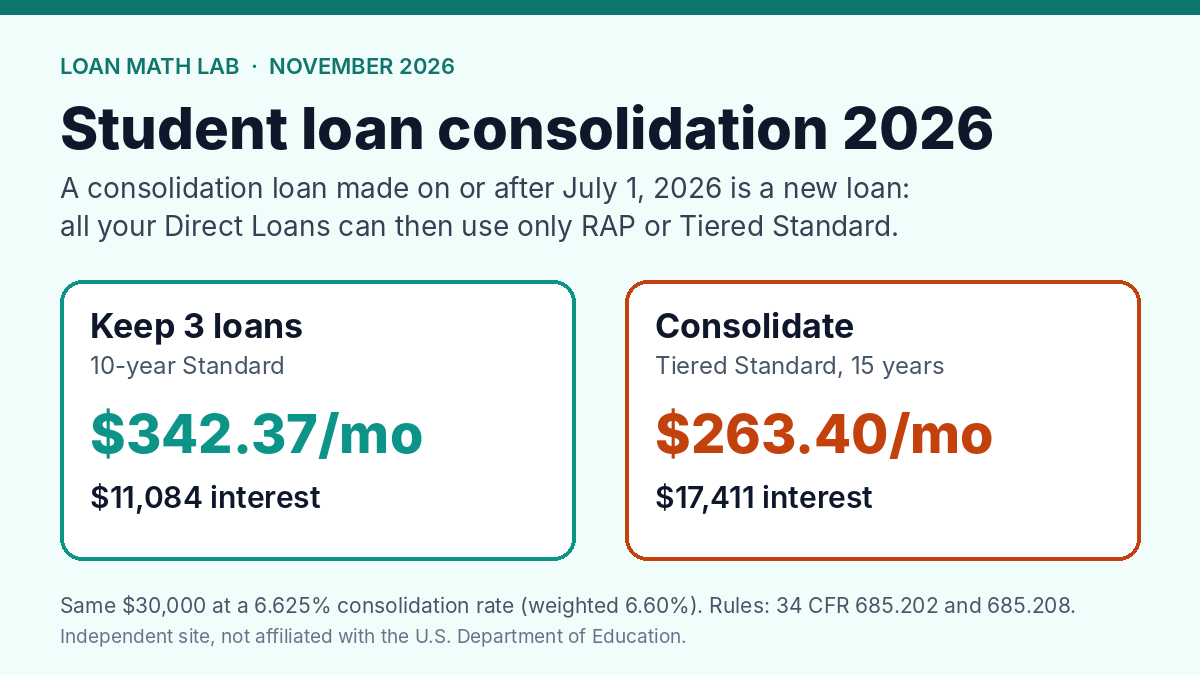
    Take the same three loans, $30,000 in total. Before consolidating, each one is on the 10-year Standard plan. After a student loan consolidation in November 2026, the new $30,000 loan at 6.625% goes on Tiered Standard, which gives 15 years for a balance between $25,000 and $50,000.

    ScenarioMonthly paymentTotal interestTotal paid
    Keep the three loans, 10-year Standard$342.37$11,084$41,084
    Consolidate, Tiered Standard 15 years$263.40$17,411$47,411
    Consolidate with $2,000 of unpaid interest added$280.96$18,572$50,572
    Our calculation in Python, November 13, 2026: fixed payments, interest at one twelfth of the yearly rate, last payment adjusted. The $2,000 of unpaid interest is an assumption; StudentAid.gov confirms that outstanding interest becomes part of the principal.
    Student loan consolidation 2026 example: $30,000 kept on 10-year Standard costs $11,084 of interest; consolidated on Tiered Standard over 15 years it costs $17,411, or $18,572 with $2,000 of unpaid interest added

    The lower payment is real: about $79 less a month. But the longer term adds about $6,300 of interest, and if $2,000 of unpaid interest is folded into the new principal, you pay about $9,500 more in total than if you had kept the loans. StudentAid.gov’s own consolidation checklist makes the same point and suggests paying unpaid interest before you consolidate where you can. You can also prepay a consolidation loan at any time; our student loan payment calculator shows what an extra amount each month saves.

    Student loan consolidation pros and cons

    ProsCons
    One loan and one bill instead of several servicersAfter July 1, 2026, only RAP or Tiered Standard for all your Direct Loans
    FFEL and Perkins loans become Direct Loans, eligible for RAP and PSLFUnpaid interest is added to the principal
    Variable-rate loans become fixed-rateA longer term usually means more total interest
    A route out of defaultLoss of benefits tied to some loans: Perkins cancellation, FFEL rate cuts, rebates
    Lower monthly payment if the term gets longerParent PLUS inside the loan limits you to Tiered Standard
    No application feeIt cannot be reversed
    Based on StudentAid.gov and StudentAid.gov, One Big Beautiful Bill Act updates, read November 13, 2026.

    Should I consolidate my student loans?

    Should I consolidate my student loans? In 2026 the honest answer for most borrowers with only Direct Loans is no, unless one of the reasons below applies to you. Student loan consolidation tends to make sense when:

    • You have FFEL or Perkins loans and want PSLF or an income-driven plan. Those loans only reach RAP and PSLF once they become a Direct Consolidation Loan.
    • You are in default and consolidation is the faster way back to good standing (see below).
    • You have old variable-rate loans and want a fixed rate.
    • You already planned to use RAP or Tiered Standard, so losing IBR costs you nothing, and one bill is worth it to you.

    Student loan consolidation is usually a poor fit when:

    • You are on IBR and it gives you a lower payment than RAP, or you want to keep the option.
    • You have Parent PLUS loans and would mix them with loans for your own education.
    • You have Perkins loans that you are earning cancellation on through your job.
    • You have a lot of unpaid interest that would be added to the principal.
    • Your only goal is a lower rate. The consolidation rate is never below your current average.

    If you want a lower payment without consolidating, StudentAid.gov suggests an income-driven plan instead. Borrowers with only pre-July 2026 loans can already opt into RAP without a new loan, and our student loan calculator compares the plans you can choose side by side.

    Consolidating student loans for PSLF and income-driven forgiveness

    Consolidation no longer wipes out your progress toward forgiveness the way it once did, but it can lower your count. Under 34 CFR 685.219(c)(3), when you consolidate Direct Loans, the weighted average of the qualifying PSLF payments you made on them counts on the new loan. The rule for income-driven forgiveness, 34 CFR 685.209(k)(4)(vi), gives you the weighted average of qualifying months, rounded up to the next whole month, and also counts qualifying payments made on FFEL loans.

    An example: $20,000 with 48 qualifying payments and $10,000 with 12. The weighted average is (20,000 × 48 + 10,000 × 12) ÷ 30,000 = 36 payments, not 48. If a large, newer loan has few payments, consolidating it with an older loan pulls the count down. When the newer loan is small, the effect is smaller. Certify your employment before you apply, so the payments you already have are on record.

    The 2026 plan limits matter here too. Payments under Tiered Standard do not count toward PSLF, according to StudentAid.gov, so a borrower who consolidates after July 1, 2026 to pursue PSLF needs RAP, where only on-time payments in full count. Our PSLF calculator estimates how much PSLF could cancel on RAP or IBR, and our guide to federal student loan forgiveness covers the other programs.

    Consolidate FFEL loans and Perkins loans

    To consolidate FFEL loans is still the way to bring them into PSLF and RAP, because those programs cover Direct Loans. A single FFEL Consolidation Loan can even be reconsolidated alone for PSLF. If you consolidate Perkins loans, the Perkins cancellation for teachers, nurses and other jobs no longer applies to that money. StudentAid.gov’s advice is direct: if you are working toward those benefits, leave those loans out.

    Consolidate Parent PLUS loans: keep them apart

    Parents need the most care. StudentAid.gov says that if you consolidate on or after July 1, 2026 and the new loan includes parent PLUS loans, you will only have access to Tiered Standard, which does not qualify for PSLF. RAP is closed to parent PLUS loans and to any consolidation loan that repaid one, including a double consolidation.

    Two practical rules follow. Do not put parent PLUS loans and loans for your own education in the same Direct Consolidation Loan: StudentAid.gov recommends consolidating them separately so your own loans keep RAP. And if you consolidated parent PLUS loans before July 1, 2026, ICR remains your bridge to IBR: StudentAid.gov lists IBR as open to those loans if at least one payment was made under ICR between July 4, 2025 and July 1, 2028, and if you take no new loan, a new consolidation loan included. Our guide to the Parent PLUS loan changes explains these steps and the double consolidation history in detail.

    Defaulted loans and consolidation

    Student loan consolidation is one of the two ways out of default. According to StudentAid.gov, you must either make three consecutive monthly payments on the defaulted loan before you consolidate, or agree to repay the new loan on an income-driven plan. After July 1, 2026, that plan is RAP. You cannot consolidate a defaulted loan while your wages are being garnished for it or while a court judgment is in force, unless the garnishment order is lifted or the judgment vacated. Our student loan default guide compares consolidation with rehabilitation, the other way out, which also removes the default from your credit history.

    How to consolidate student loans, step by step

    1. List your loans. Log in to StudentAid.gov and note each loan’s type, balance, rate, servicer and any unpaid interest. Mark parent PLUS, Perkins and FFEL loans.
    2. Check your forgiveness counts first. Look at your IDR and PSLF counts and certify employment if you are pursuing PSLF.
    3. Compare plans before you commit. Run the official Repayment Calculator or our calculators. Steps 1 and 2 of the application also show your weighted rate and payment, and you can stop at any point before submitting.
    4. Apply online. The Direct Consolidation Loan Application is free and most people finish it in under 30 minutes. Choose which loans to include and a repayment plan.
    5. Keep paying. Unless your loans are in deferment, forbearance or a grace period, keep making payments until the consolidation servicer tells you the old loans are paid off.
    6. Watch for the first bill. Repayment starts within 60 days after the new loan is disbursed. You can ask to add eligible loans within 180 days after it is made, under 34 CFR 685.220(e).

    If a loan is still in its grace period, the application lets you ask the servicer to wait until close to the end of the grace period before consolidating, so your payments do not start early. Never pay a company to consolidate federal loans: the application is free, and questions before you apply go to the Federal Student Aid Information Center at 1-800-433-3243.

    Student loan consolidation vs refinancing

    The two words are often mixed up. Federal student loan consolidation keeps your loans federal: the government makes the new loan at the weighted average rate. Refinancing means a private lender pays off your loans with a new private loan at a rate based on your credit. A refinanced federal loan is no longer federal, so it leaves RAP, PSLF, federal deferment and discharge programs behind for good. Our guide on whether to refinance federal student loans puts a price on each of those losses with worked examples. We do not list lenders or their rates. To see whether an offer pays off after fees and when you break even, use our student loan refinance calculator, which also lists the federal protections a refinance gives up.

    Student loan consolidation FAQ

    Is student loan consolidation a good idea?

    It is a good idea when it unlocks something you need: PSLF or RAP for FFEL and Perkins loans, a way out of default, or a fixed rate. It is rarely a good idea just to tidy up Direct Loans in 2026, because it ends IBR access for all of them.

    How long does student loan consolidation take?

    The online application usually takes less than 30 minutes. Processing time after that is not fixed, so keep paying your old loans until the servicer confirms they are paid off. Your first payment on the new loan is due within 60 days after it is disbursed.

    Is there a student loan consolidation deadline?

    The key date has passed: a consolidation loan had to be disbursed before July 1, 2026 to keep access to IBR, PAYE and ICR. You can still consolidate today with no deadline, under the newer plan limits. Parents with consolidated parent PLUS loans should watch for the ICR enrollment deadlines that StudentAid.gov says it will publish before ICR ends, no later than July 1, 2028.

    Can I undo a Direct Consolidation Loan?

    No. Once the new loan is made, the loans it paid off no longer exist. You can add eligible loans within 180 days, but you cannot split it back into the original loans. Joint consolidation loans for spouses are the one exception, under a 2022 law that lets each borrower separate.

    Can I consolidate private student loans with federal loans?

    No. Private education loans are not eligible for a Direct Consolidation Loan. They can, however, be listed on the application as other debt that helps set the term on the old Standard plan for loans consolidated before July 1, 2026.

    Sources for this student loan consolidation guide

    This student loan consolidation guide is general information, not financial or legal advice. Your loan servicer and the U.S. Department of Education decide your plan, rate and counts, and rules can change. Loan Math Lab is not affiliated with the U.S. Department of Education. See our How We Verify page and Disclaimer. Information checked on November 13, 2026.