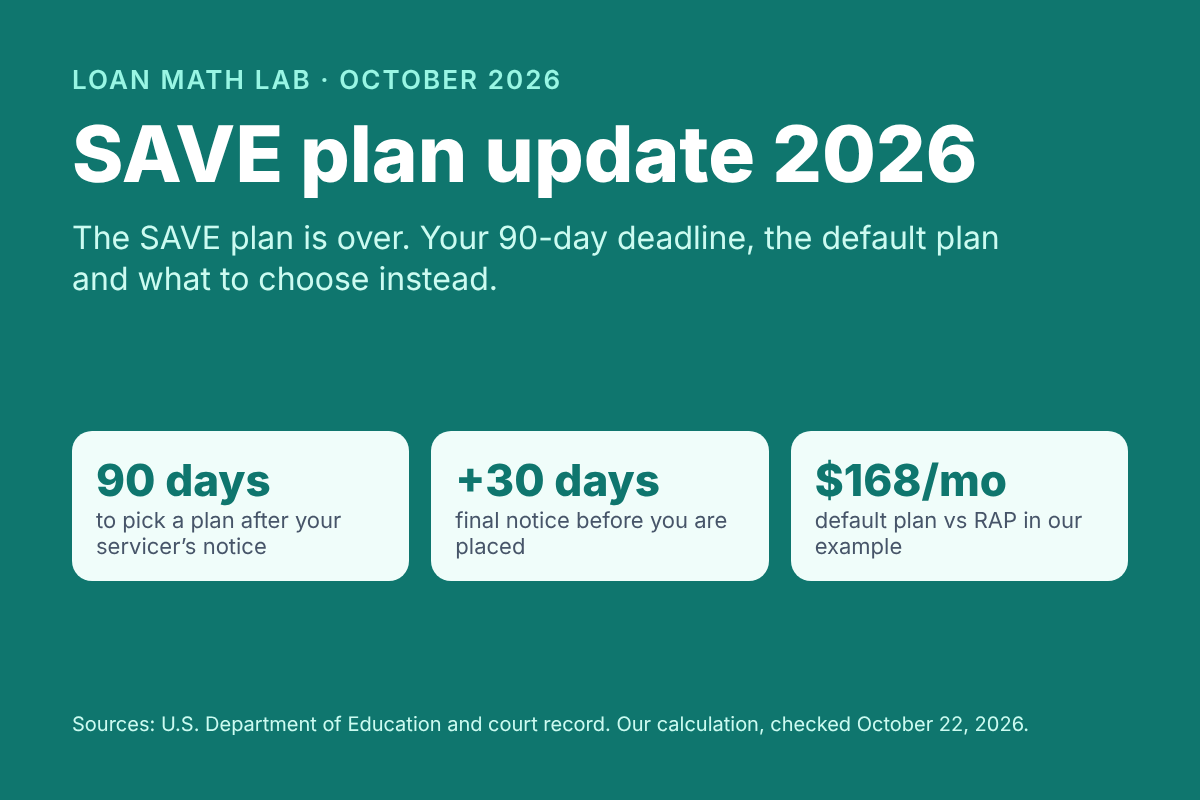
Here is the SAVE plan update for October 2026: the SAVE plan is over. A federal court ended it in March 2026, no new borrowers can join, and the roughly 7.5 million people still enrolled are being moved to other repayment plans. Each borrower gets a notice with a 90-day deadline to pick a plan. If you do nothing, your servicer chooses for you, and the plan it picks is usually the most expensive one each month.
This SAVE plan update guide explains what happened, how the deadline works, what happens if you miss it, and how to choose between the plans you can still use, with a worked example. Every date below comes from the U.S. Department of Education or from the court record as reported, and we checked each source on October 22, 2026. Rule changes are also listed in our student loan changes log.
Table of Contents
SAVE plan update at a glance
| Question | Short answer |
|---|---|
| Is the SAVE plan still running? | No. A court order ended it in March 2026 |
| Can I still enroll in SAVE? | No. Pending SAVE applications are being denied |
| Is my interest paused? | No. Interest has been charged on SAVE loans since August 1, 2025 |
| How long do I have to choose? | At least 90 days from your servicer’s notice, then a final 30-day notice |
| What if I do nothing? | 10-year Standard plan, or Tiered Standard if you have a loan paid out on or after July 1, 2026 |
| Which plans can I choose? | Usually RAP, IBR or a fixed plan, depending on when your loans were paid out |
| Do SAVE forbearance months count toward forgiveness? | No, not toward PSLF or IDR forgiveness |
What happened to the SAVE plan: the full timeline
SAVE (Saving on a Valuable Education) was an income-driven plan created in 2023. Republican-led states sued, and courts froze it in the summer of 2024. Since then, SAVE borrowers have been in a special forbearance: no payments due, but also no progress toward forgiveness. The table lists every SAVE plan update since then, in order.
| Date | What happened |
|---|---|
| August 2024 | SAVE borrowers placed in a general forbearance while the courts decided |
| July 4, 2025 | The One Big Beautiful Bill Act becomes law and sets July 1, 2028 as the last date for SAVE, PAYE and ICR |
| August 1, 2025 | Interest starts being charged again on loans in the SAVE forbearance |
| December 9, 2025 | The Department and Missouri sign a settlement to end SAVE |
| March 9-10, 2026 | The Eighth Circuit orders the settlement entered, and the district court signs the final judgment |
| July 1, 2026 | RAP and Tiered Standard open, and servicers start sending 90-day notices to SAVE borrowers |
| November 13, 2026 | The Department says more than 2 million SAVE borrowers have picked a new plan and that anyone who does not switch will be placed on the standard plan. The servicers’ trade group told Money that no one had been moved off SAVE manually yet, even where both notices had run out. Do not count on that lasting: choose a plan yourself |
| By December 31, 2026 | Every SAVE borrower should have received a notice, according to Department guidance reported by The College Investor in October 2026. Each servicer sets its own schedule within that window |
Under the settlement, the Department stops enrolling anyone in SAVE, denies pending SAVE applications, moves every SAVE borrower into another plan and will repeal the SAVE rule. Individual borrowers cannot enforce the settlement themselves; it is an agreement between the Department and the states.
The SAVE plan lawsuit: is there any chance SAVE comes back?
Searches for the SAVE plan lawsuit have risen this year, so this SAVE plan update separates the two cases. The states’ lawsuit is what ended SAVE. In March 2026, a group of borrowers filed a separate suit asking the courts to force the Department to restart the plan, as reported by the American Counseling Association. As of October 22, 2026, we found no ruling that brings SAVE back, and the Department keeps moving borrowers out.
Even if a court restored SAVE, the 2025 budget law ends it on July 1, 2028. Waiting for a court is a gamble on a plan with less than two years left. Choosing a plan now, as the SAVE plan update asks, protects you either way.
SAVE plan update on deadlines: the 90-day and 30-day notices
Servicers send the notices in batches, so deadlines differ from borrower to borrower. According to the Department and The College Investor:
- First notice: the subject line reads “You Have 90 Days to Select a New Repayment Plan.” Your 90 days start on the date of your servicer’s notice. An email from Federal Student Aid does not start or reset the clock.
- Final notice: if the 90 days pass without a choice, you get “Final Notice – You will be Placed into a New Repayment Plan in 30 Days.” Borrowers from the first July wave began receiving it around October 1, 2026, as reported by Student Loan Professor.
- New payment: your servicer must tell you the new amount at least 21 days before the first payment is due.
- You do not have to wait: you can contact your servicer and change plans before your notice arrives.
The Department has not announced a general extension of the 90-day window. The most important SAVE plan update for you is the date on your own notice: treat it as the real deadline.
What happens if you ignore the SAVE plan update
If you ignore both notices, the servicer places you in a fixed plan, and that is the SAVE plan update most borrowers notice first, because the bill goes up:
- All your federal loans were paid out before July 1, 2026: the 10-year Standard plan.
- You have a loan paid out on or after July 1, 2026: the Tiered Standard plan, with a term of 10 to 25 years set by your balance.
Fixed plans pay the loan off with no forgiveness, so the monthly payment is often much higher than an income-driven payment. You can still switch to another plan afterwards, but the months spent in the default plan may not help you toward forgiveness. Our student loan calculator shows the 10-year Standard and Tiered Standard amounts for your balance, and our student loan payment calculator shows how much interest a fixed plan costs and what extra payments save.
Which plans you can choose after the SAVE plan update
The plans open to you depend on one date: whether any of your federal loans were paid out on or after July 1, 2026.
| Your loans | Plans you can choose | Default if you do nothing |
|---|---|---|
| All paid out before July 1, 2026 | RAP, IBR, or a legacy fixed plan such as the 10-year Standard | 10-year Standard |
| At least one paid out on or after July 1, 2026 | RAP or Tiered Standard | Tiered Standard |
| Parent PLUS, or a consolidation loan that repaid one | Not covered by RAP or IBR; ask your servicer | Set by your servicer |
Most borrowers affected by the SAVE plan update took out their loans before July 2026, so the usual choice is between the Repayment Assistance Plan and Income-Based Repayment. Be careful with new borrowing: a new federal loan or a new consolidation loan after July 1, 2026 closes IBR and the legacy plans to you. Our guide to the Repayment Assistance Plan explains RAP in detail.
SAVE plan update example: same borrower, four plans
A single borrower owes $35,000 at 6.52%, has an adjusted gross income (AGI) of $55,000, no dependents, and all loans from before July 1, 2026. Here is the first-year monthly payment on each plan:

| Plan | Monthly payment | How it is worked out |
|---|---|---|
| 10-year Standard (default) | $397.77 | $35,000 at 6.52% over 120 months; $47,733 paid in total |
| IBR at 15% | $388.25 | 15% of ($55,000 minus $23,940, which is 150% of the 2026 poverty guideline for 1 person), divided by 12 |
| IBR at 10% | $258.83 | Same, at 10%. Only for borrowers with no federal loan balance on July 1, 2014 |
| RAP | $229.17 | 5% of $55,000 = $2,750 a year, divided by 12 |
In this case, ignoring the SAVE plan update costs about $168 a month compared with RAP, or roughly $2,000 in the first year. With two dependents, RAP drops to $129.17 and IBR at 10% to $116.83, so the cheapest plan changes with your family. Run your own numbers in our plan comparison calculator, and use the RAP student loan calculator to see how a RAP loan ends over 30 years.
Interest, forbearance and forgiveness in the SAVE plan update
- Interest: loans in the SAVE forbearance have been charged interest since August 1, 2025, with nothing charged back for earlier months, according to the Department of Education. Your balance has probably grown since then.
- Forgiveness clock: months in the SAVE forbearance do not count toward Public Service Loan Forgiveness (PSLF) or toward IDR forgiveness after 20 to 30 years.
- PSLF buyback: if you already have 120 months of qualifying public service employment, you can ask to buy back months spent in forbearance by paying what you would have owed. Our PSLF buyback guide shows who qualifies and how the cost is set.
- On RAP: unpaid interest is waived in every month you pay on time, so your balance stops growing once you are on the plan and paying.
If you work toward PSLF, act on the SAVE plan update now and choose an income-driven plan yourself rather than waiting to be placed in a fixed plan. Every month you stay in forbearance is a month that does not count.
How to act on the SAVE plan update, step by step
- Log in at StudentAid.gov with your FSA ID and check which servicer holds your loans and when they were paid out.
- Open the latest message from your servicer and write down the deadline on your 90-day notice.
- Compare plans with our student loan calculator or the official Repayment Calculator on StudentAid.gov (formerly called the Loan Simulator).
- Apply for the income-driven plan you chose on StudentAid.gov, or ask your servicer to move you to a fixed plan.
- Allow the IRS to share your tax information. The Department says this speeds up processing and makes yearly recertification automatic.
- Keep the confirmation, and check that your servicer account shows the new plan before your deadline.
- Set up autopay. Since July 1, 2026, autopay cuts your interest rate by 1 percentage point, as a temporary benefit through June 30, 2028, if you enroll with your servicer by December 31, 2026 (our federal student loan interest rates table has the details).
If your account still shows SAVE after you applied, call your servicer and keep a note of the date and the agent’s name. The Department posts each official SAVE plan update on its court actions page on StudentAid.gov.
SAVE plan update FAQ
Is the SAVE plan ending or already over?
It is already over. That is the core SAVE plan update: the court entered the settlement in March 2026, and the Department is moving every SAVE borrower to another plan during 2026.
When does the SAVE forbearance end for me?
When you enter a new plan, either because you chose one or because your servicer placed you after the final notice. Your first new payment is due at least 21 days after the servicer tells you the amount.
Will I lose my SAVE forgiveness progress?
Months you paid under SAVE before the forbearance generally keep counting toward forgiveness under the plan you move to. Forbearance months do not count.
Can I go back to SAVE if the lawsuit changes?
Not today. No court has restored SAVE as of October 22, 2026, and the 2025 budget law ends SAVE on July 1, 2028 in any case.
Is RAP always the best choice after SAVE?
No. RAP has no payment cap, so at high incomes IBR or a fixed plan can cost less. Compare your own numbers before you choose.
Sources for this SAVE plan update
- U.S. Department of Education: next steps for borrowers enrolled in the SAVE Plan (2026)
- U.S. Department of Education: agreement with Missouri to end SAVE (December 9, 2025)
- U.S. Department of Education: repayment changes and SAVE interest from August 1, 2025 (July 2025)
- The College Investor: SAVE plan officially ended by court order (March 10, 2026)
- The College Investor: SAVE borrowers who miss the 90-day deadline get a final 30-day notice
- Student Loan Professor: student loan updates for October 2026
- 34 CFR 685.209, Income-driven repayment plans (eCFR)
- Will Student Loan Borrowers in SAVE Ever Actually Get Kicked Out of the Plan? (Money, November 13, 2026)
Information checked on October 22, 2026; timeline and autopay deadline updated on November 19, 2026. We will revise this page with each new SAVE plan update from the Department. Our How We Verify page explains how we check every figure.
This guide explains federal rules in general terms and is not financial, legal or tax advice; your servicer and a qualified professional can confirm what applies to you. Read our Disclaimer.