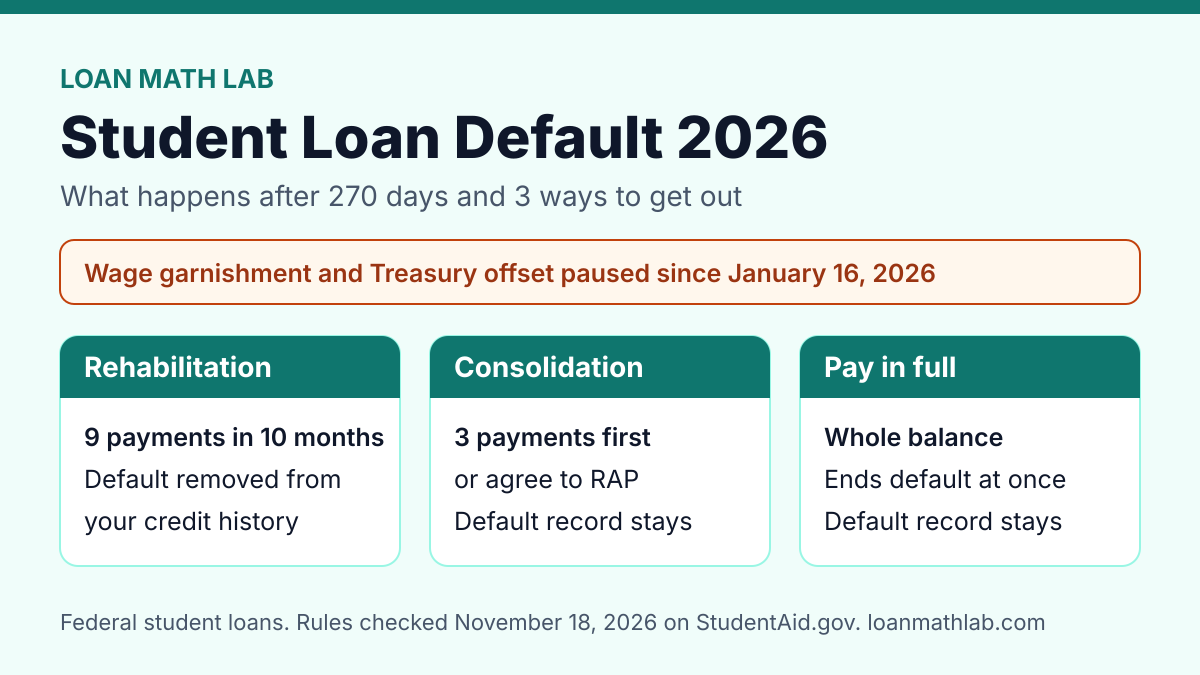
Student loan default is what happens when a federal student loan goes unpaid for at least 270 days: the whole balance becomes due at once and the government can collect without going to court. In 2026 two things are unusual. The Department of Education paused wage garnishment and tax refund seizures on January 16, 2026, and the Treasury Department has taken over the work of collecting defaulted loans.
This student loan default guide explains what happens if you default on student loans, how much can be taken from a paycheck or a Social Security check when collections restart, and the three ways to get your loans out of default. We opened every official page cited here on November 18, 2026. It covers federal student loans only; private loans follow your loan contract and state law. For every rule change this year, see our student loan changes log.
Table of Contents
Student loan default at a glance
| Question | Short answer in November 2026 |
|---|---|
| When a Direct or FFEL loan defaults | After at least 270 days without scheduled payments |
| What becomes due | The entire unpaid balance and interest (“acceleration”) |
| Wage garnishment | Up to 15% of disposable pay, without a court order. Paused since January 16, 2026 |
| Treasury offset | Tax refunds and some federal benefits. Also paused since January 16, 2026 |
| Ways out | Rehabilitation, consolidation or paying in full |
| Rehabilitation payment | Based on income, as low as $5 a month (a $10 minimum from July 1, 2027) |
| Who to call about a student loan default | Default support, 1-800-621-3115 (TTY 1-877-825-9923) |
In one line: a paused collection is not a cancelled one. Student loan default still damages your credit, still blocks new federal aid and still adds collection costs, and the government can switch garnishment and offset back on after sending the required notices.
What happens if you default on student loans
Student loan default does not happen the day you miss a payment. It builds in stages, and each stage has its own consequence. The timeline below is for loans in the Direct Loan and FFEL programs; a Perkins Loan can be declared in default as soon as you miss a payment.
| Days past due | What happens |
|---|---|
| Day 1 | The loan is delinquent. Your servicer can still put you on another plan, a deferment or a forbearance |
| Day 90 | The servicer reports the delinquency to the national credit bureaus |
| Day 270 | The loan is in default: the balance is accelerated and you lose deferment, forbearance and the choice of a plan |
| Day 360 and later | The loan moves to the Default Resolution Group, the servicer for defaulted federal loans |
Once a loan is in student loan default, StudentAid.gov lists these consequences:
- Acceleration. The full balance and interest are due immediately.
- Treasury offset. Federal and state tax refunds and some federal benefit payments can be kept and applied to the loan.
- Wage garnishment. Your employer can be ordered to send part of your pay to the government.
- No more federal aid. You lose eligibility for Pell Grants and new federal student loans until the default is resolved.
- Credit damage. The default is reported to the credit bureaus and can stay visible for years.
- Costs and court. You can be charged collection fees, court costs and attorney fees, and the loan holder can sue you.
- Transcripts. Your school may withhold your official transcript, though it must give you an unofficial one on request.
The best time to act is before day 270, when student loan default begins. If you are behind but not yet in default, an income-driven plan can bring the payment down a lot: our RAP student loan calculator and IBR student loan calculator show what you would pay on each plan.
Student loan collections in 2026: what is paused and what is not
On January 16, 2026, the Department of Education announced a delay of involuntary collections, naming Administrative Wage Garnishment and the Treasury Offset Program, so that it could put the new repayment rules in place first. It gave no restart date.
As of November 18, 2026, the official collections page on StudentAid.gov still says that collections through Treasury offset and Administrative Wage Garnishment are paused, and that tax refunds are not being withheld for defaulted federal student loans. Two other changes matter:
- Treasury now runs default collections. Under an agreement announced on March 19, 2026, Treasury’s Bureau of the Fiscal Service took over operational responsibility for collecting defaulted federal student loans. The loans still belong to the Department of Education.
- There is a new online portal. On September 30, 2026, Treasury and the Department of Education launched the Defaulted Loans Support Center on StudentAid.gov, where you can apply online to rehabilitate or consolidate a defaulted loan and make payments.
A paused collection does not end a student loan default. What the pause does not stop: the default itself, interest, credit reporting and the loss of federal aid. No official restart date has been published. If garnishment or offset restarts, you will first get a written notice with a deadline, as described below. We will add any restart date to our changes log the day it is announced.
Student loan wage garnishment
Student loan wage garnishment is the government’s power, after a student loan default, to make your employer withhold part of your pay without suing you first. For federal student loans this is called administrative wage garnishment. StudentAid.gov says the loan holder can order your employer to withhold up to 15% of your disposable pay, and the withholding continues until the loan is paid in full or out of default. Disposable pay is what is left after taxes and other deductions the law requires.
There is also a floor. Under 34 CFR 34.19, the employer withholds the smaller of the amount in the order or the amount by which your disposable pay exceeds 30 times the federal minimum wage. With the minimum wage at $7.25 an hour, that floor is $217.50 a week, $435 every two weeks, $471.25 twice a month or $942.50 a month.
How much can student loans garnish?
Here is how much can be garnished from a paycheck paid every two weeks, at five levels of disposable pay. The rule takes the smaller of 15% and the amount above $435.
| Disposable pay every two weeks | 15% of pay | Pay above the $435 floor | Garnished per paycheck | Garnished per year (26 paychecks) |
|---|---|---|---|---|
| $500 | $75.00 | $65.00 | $65.00 | $1,690 |
| $800 | $120.00 | $365.00 | $120.00 | $3,120 |
| $1,200 | $180.00 | $765.00 | $180.00 | $4,680 |
| $1,600 | $240.00 | $1,165.00 | $240.00 | $6,240 |
| $2,500 | $375.00 | $2,065.00 | $375.00 | $9,750 |

Below about $512 of disposable pay every two weeks, the floor is the limit, so less than 15% is taken. At $435 or less, nothing can be taken. Above that point the 15% cap decides. If you were searching for a student loan wage garnishment calculator, this table is the whole formula: multiply your disposable pay by 0.15, subtract the floor for your pay period from your disposable pay, and the smaller number is the most an order can take.
How to stop student loan wage garnishment
Garnishment starts with a letter, not with a smaller paycheck. StudentAid.gov says you must be sent a notice 30 days before the order goes to your employer, explaining the debt and your rights. You then have four ways to stop or end it:
- Agree on a repayment plan within 30 days. If the government receives your first payment under an agreed repayment arrangement no later than 30 days after the notice was sent, the garnishment is avoided.
- Ask for a hearing in writing within 30 days. A request postmarked within 30 days of the notice holds the garnishment until a decision is made, usually within about 60 days. You can object that you do not owe the debt or the amount, that 15% would cause extreme financial hardship, or that you went back to work less than 12 months after an involuntary job loss.
- Start rehabilitation. Under 34 CFR 685.211(f), the garnishment order is withdrawn after your fifth rehabilitation payment, unless you ask otherwise. Until July 1, 2027 you can get this benefit once per loan; from then on, twice.
- Leave default another way. Paying in full or consolidating ends the garnishment, but you cannot consolidate a loan while a garnishment order is in force unless the order is lifted first.
Your employer cannot fire you, refuse to hire you or discipline you because of a student loan garnishment, and it may only receive the information it needs to make the deduction.
Treasury Offset Program and student loans
The Treasury Offset Program is the second way the government collects student loan default without a court. It intercepts federal payments due to you and applies them to the loan. Before an offset starts, a notice of intent is sent to your last known address, and you have 65 days to act.
Student loan tax refund offset
In a student loan default, StudentAid.gov says offset can take all or part of a federal or state tax refund and apply it to the defaulted loan. Within the 65 days on the notice you can avoid the offset by starting a payment arrangement, starting rehabilitation, sending a signed consolidation application, paying in full, or filing a written objection with the Default Resolution Group. If you ask for copies of your loan documents within 20 days, you get 15 more days after they are mailed to request a review.
Can student loans garnish Social Security?
Yes, part of it, if you are in student loan default, through Treasury offset rather than garnishment. Under 31 CFR 285.4, the amount taken from a monthly Social Security benefit is the smallest of the debt, 15% of the benefit, or the amount above $750. Supplemental Security Income (SSI) cannot be offset.
| Monthly Social Security benefit | 15% of benefit | Amount above $750 | Monthly offset |
|---|---|---|---|
| $650 | $97.50 | $0 | $0 |
| $850 | $127.50 | $100.00 | $100.00 |
| $1,250 | $187.50 | $500.00 | $187.50 |
| $1,900 | $285.00 | $1,150.00 | $285.00 |
If your Social Security disability benefit is being offset and the Social Security Administration finds you totally disabled with no expected improvement, StudentAid.gov says the offset is suspended. Discharge programs, including Total and Permanent Disability discharge, are covered in our guide to federal student loan forgiveness.
How to get student loans out of default
There are three ways out of student loan default, and they do not give you the same result. Rehabilitation takes longer but cleans up your credit report; consolidation is faster but leaves the default on your record.
| Rehabilitation | Consolidation | Pay in full | |
|---|---|---|---|
| What you do | 9 payments within 10 months | 3 payments first, or agree to an income-driven plan | Pay the whole balance |
| Time to leave default | About 9 to 10 months | Faster: you can apply right away | As soon as the payment posts |
| Default record on your credit report | Removed (late payments before default stay) | Stays | Stays |
| Plans afterwards | Any plan you are eligible for | Only RAP if you choose the income-driven route; RAP or Tiered Standard for new loans | Not needed |
| Repeat use | Once per loan; twice from July 1, 2027 | Special rules for a defaulted consolidation loan | Not applicable |
Whichever route you choose, you never need to pay a company to do it. StudentAid.gov warns that a firm asking for “enrollment” or “maintenance” fees to get you out of student loan default should be avoided: the Default Resolution Group does it for free.
Student loan rehabilitation
Student loan rehabilitation is a deal with the loan holder: you make 9 voluntary, on-time monthly payments within 10 consecutive months, and the student loan default ends. Each payment must arrive within 20 days of its due date. Money taken by garnishment or offset does not count toward the nine.
The payment is set from your income, not your balance. 34 CFR 685.211(f) says it starts from the payment you would owe on an eligible income-driven plan, with a $5 minimum before July 1, 2027 and a $10 minimum from that date. StudentAid.gov describes it as 10% or 15% of your discretionary income divided by 12, depending on when you received your loans. Discretionary income is your adjusted gross income (AGI) minus 150% of the poverty guideline for your family size. You must send proof of income.
| AGI and family | Discretionary income | Payment at 15% | Payment at 10% | Nine payments at 15% |
|---|---|---|---|---|
| $20,000, single | $0 | $5.00 (minimum) | $5.00 (minimum) | $45 |
| $30,000, single | $6,060 | $75.75 | $50.50 | $681.75 |
| $40,000, single | $16,060 | $200.75 | $133.83 | $1,806.75 |
| $55,000, single | $31,060 | $388.25 | $258.83 | $3,494.25 |
| $55,000, family of 3 | $14,020 | $175.25 | $116.83 | $1,577.25 |
The written agreement must tell you that you can object to the amount, orally or in writing, and how. After the ninth payment, the record of the default is removed from your credit history and you regain deferment, forbearance, plan choice, forgiveness programs and federal aid. For loans rehabilitated on or after July 1, 2026, the Secretary may move you straight onto the income-driven plan if you applied for both on one form.
The student loan rehabilitation program has one hard limit today: if a rehabilitated loan defaults again, you cannot rehabilitate it a second time. From July 1, 2027, the One Big Beautiful Bill Act allows two rehabilitations per loan. To start, use the Defaulted Loans Support Center, which lets you apply, upload documents, see an estimated payment and sign the agreement online.
Consolidate defaulted student loans
To consolidate defaulted student loans into a new Direct Consolidation Loan, you must either make three consecutive, voluntary, on-time full monthly payments on the defaulted loan first, or agree to repay the new loan on an income-driven plan. For a consolidation loan disbursed on or after July 1, 2026, the only income-driven plan is the Repayment Assistance Plan (RAP), and a consolidation that includes a Parent PLUS loan cannot use any income-driven plan, so it needs the three payments.
Consolidation is the quicker way out of student loan default, but it has costs. Unpaid interest is added to the new balance, the default stays on your credit report, and the new loan can only be repaid on RAP or Tiered Standard, which closes IBR for all your Direct Loans. Our student loan consolidation guide explains the July 2026 rule and the rate in detail, and our student loan calculator compares RAP and Tiered Standard for your balance.
Default Resolution Group: who they are and how to reach them
The Default Resolution Group is the Department of Education’s own servicer for federal loans in student loan default that are more than 360 days delinquent. It is not a private collection agency. It is where you set up rehabilitation, payment arrangements and disputes, and where written objections and document requests are sent.
- Phone: 1-800-621-3115, TTY 1-877-825-9923.
- Online: the Defaulted Loans Support Center on StudentAid.gov, and the group’s site, myeddebt.ed.gov.
- Mail for objections and document requests: U.S. Department of Education, Default Resolution Group, P.O. Box 5227, Greenville, TX 75403-5227.
Not every defaulted loan is with this group. An FFEL loan may be held by a guaranty agency, and a Perkins Loan by your school. Log in to StudentAid.gov and look at your loan servicers: a name starting with “DEPT OF ED” means the Department holds that loan.
Student loan default and your credit score
Student loan default usually does the most lasting damage through your credit report. The late payments reported from day 90 stay for seven years from when they were first reported, and the default adds a separate, serious mark. Only rehabilitation removes the record of the student loan default itself; consolidation and paying in full do not. That is the main reason to choose rehabilitation if you can afford nine payments and do not need the loan out of default within weeks.
Student loan default FAQ
How long before student loans go into default?
Student loan default starts when a Direct Loan or FFEL loan has gone at least 270 days without the scheduled payments, about nine months. The Defaulted Loans Support Center adds that the serious financial consequences come after about a year of missed payments.
Are student loan collections paused right now?
Wage garnishment and Treasury offset have been paused since January 16, 2026, and StudentAid.gov still said so on November 18, 2026. Voluntary payments, rehabilitation and consolidation all work during the pause, and it is a good time to fix a student loan default.
Can I get federal student aid while my loans are in default?
No. A student loan default blocks new federal aid, including Pell Grants and federal loans. StudentAid.gov says you regain eligibility after rehabilitation or consolidation.
Does student loan default affect forgiveness?
Yes. While a loan is in default you lose access to benefits such as forgiveness programs, and StudentAid.gov says you regain them after rehabilitation or consolidation. Our PSLF calculator shows how many qualifying payments you still need once you are back in good standing.
What changed for student loan default in 2026?
Four things: involuntary collections were paused on January 16, Treasury took over default collections in March, consolidating out of default now leads to RAP or Tiered Standard for loans disbursed from July 1, and a new online portal opened on September 30. Two more changes start on July 1, 2027: a second rehabilitation per loan and a $10 minimum rehabilitation payment.
Sources for this student loan default guide
- Student Loan Delinquency and Default, Collections on Defaulted Loans, Getting Out of Default and Defaulted Loans Support Center (StudentAid.gov)
- U.S. Department of Education Delays Involuntary Collections (ED.gov, January 16, 2026)
- Treasury and Education Launch New Defaulted Loans Support Center (Treasury, September 30, 2026)
- 34 CFR 685.211, rehabilitation of defaulted loans and 34 CFR 34.19, amounts withheld under a garnishment order (Cornell LII)
- 31 CFR 285.4, offset of federal benefit payments (eCFR, up to date as of October 22, 2026)
- HHS Poverty Guidelines for 2026 (ASPE)
This student loan default guide is general information, not financial or legal advice. Your loan holder and the U.S. Department of Education decide your payment amounts and collection actions, and rules can change. Loan Math Lab is not affiliated with the U.S. Department of Education or the Treasury. See our How We Verify page and Disclaimer. Information checked on November 18, 2026.